
Learning outcome
What Is Marketing Ethics?
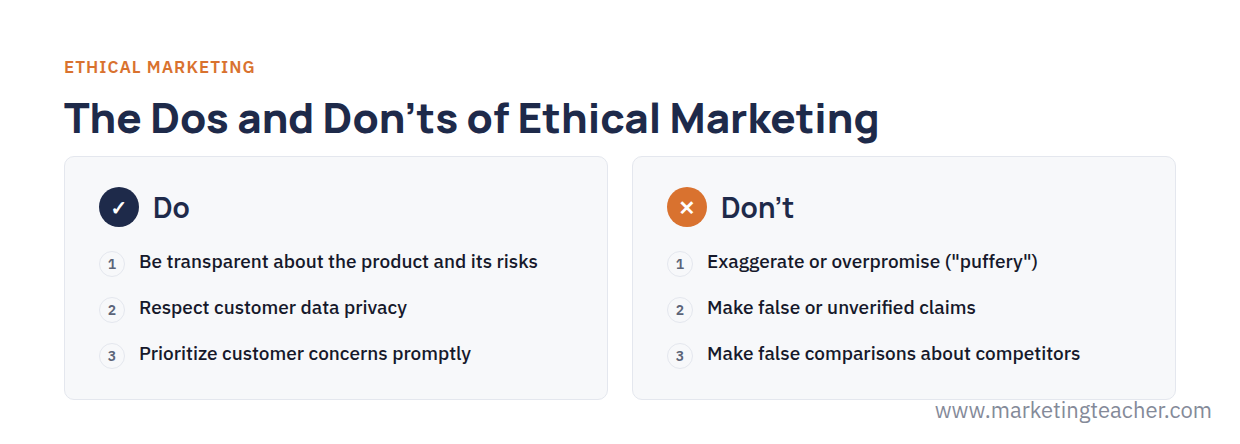
Marketing ethics is not so much a rulebook as a philosophy: it asks a business to consider not only whether a marketing message works, but whether it is fair, honest, and responsible. As OpenStax (2023) defines it, ethical marketing tries to promote fairness, honesty, and a sense of responsibility in everything a company does to sell its products or services. That sounds simple enough in principle, but it becomes a genuinely difficult daily discipline the moment a business is under pressure to hit a sales target, launch a campaign fast, or make a product sound better than a rival’s. Ethical marketing is the set of habits and guardrails that keep those short-term pressures from overriding a business’s longer-term relationship with its customers.
Why Ethical Marketing Matters
It would be easy to treat ethics as a nice-to-have that only matters once the basics of price, product, and promotion are sorted. The research says otherwise. In one widely cited consumer study reported by OpenStax (2023), 56 percent of people said they had stopped buying from a company they believed was acting unethically, and roughly a third said they were inclined to tell others when they felt a brand was being dishonest or unfair — with nearly 3 in 10 of those people sharing that view on social media, where it can spread far beyond the original complaint. A company’s ethics, in other words, are not a private matter between the business and its conscience; they are public, visible, and directly tied to whether customers keep buying.
Part of why this matters so much today is speed. A single misleading claim, once caught out, can travel across social media in hours, long before a company’s PR team has drafted a response. Trust that took years to build can be damaged in a single viral post, and unlike a product recall, a reputation for dishonesty is not something a business can simply reissue or refund its way out of.
The Dos of Ethical Marketing
Ethical marketing has a few recurring habits behind it. The first is transparency — giving customers the real information they need about a product, its use, and any risks, rather than only the information that flatters the sale. The second is respecting data privacy: marketers today collect enormous amounts of information about customers, and the ethical line is using that data to serve customers better, not to track them in ways they never agreed to or would be uncomfortable learning about. The third is prioritizing customer concerns promptly — research suggests a large share of customers expect a response to a complaint within an hour, and how quickly and honestly a business responds shapes whether that customer ever buys again (OpenStax, 2023).
The Don’ts of Ethical Marketing
The don’ts are just as important as the dos, and they tend to be where businesses get into real trouble. The first is exaggeration, sometimes called “puffery” in the industry — describing a product’s benefits so enthusiastically that customers are misled about what it can actually do. A little enthusiasm is normal marketing; promising something a product cannot deliver is not. The second is making false or unverified claims. One well-known case saw a company fined several million dollars after marketing an energy shot as “doctor-recommended” when that claim could not be substantiated — a costly reminder that a marketing claim needs to be true, not just persuasive. The third is making false comparisons about competitors, which in some countries can expose a business to legal action from the rival it named, on top of the reputational damage.
Example: Marketing Ethics
When Marketing Crosses the Line
Ethical lapses in marketing are rarely one dramatic lie; they are usually a series of small shortcuts that add up. A business might round up a statistic, quietly drop an inconvenient caveat from an advertisement, or describe a “sale” price that was never really the regular price to begin with. Individually these might feel minor. Collectively, they are exactly the pattern research shows customers notice and punish — not necessarily by complaining directly to the company, but by quietly switching to a competitor and telling others why. This is also why ethical marketing and effective marketing are not actually in tension with each other in the long run: a business that customers trust needs to spend less convincing them and more time simply keeping its promises.
Summary
Marketing ethics is the practice of promoting fairness, honesty, and responsibility throughout a business’s marketing, not just its products. It matters commercially as well as morally: over half of consumers say they’ve stopped buying from a company they saw as unethical. The dos — transparency, respecting data privacy, and responding promptly to concerns — build trust over time. The don’ts — exaggeration, false claims, and false comparisons — are usually what destroys it, often faster than it was built.
Quiz

The slides, worksheet, lesson plan and poster for this lesson are free to download and free to use in your course — no sign-up, no permission needed.

