
What Is Retail Media?
Retail media is advertising sold by a retailer, on its own digital properties (its website, app, and increasingly its in-store screens), targeted using the retailer’s own first-party data about what real shoppers actually search for and buy. A retail media network is the retailer’s own advertising platform built around this data and inventory – the mechanism through which a retailer sells that advertising space to brands, typically including the retailer’s own products alongside those of other suppliers competing for the same shelf space online. This model exchanges customer data and personalisation for targeted advertising: the retailer profits from monetising traffic it already has, and the advertiser gets access to shoppers at the exact moment they are actively looking to buy, rather than earlier in a general browsing session.
The category has grown quickly enough that over two hundred retail media networks now exist globally, spanning large online marketplaces, supermarket chains, and other retailers with a large enough audience and enough first-party purchase data to make the advertising valuable.
Why Retail Media Has Grown So Quickly
The clearest driver is data. As third-party tracking has become less reliable due to browser and platform privacy changes, retailers’ own first-party data – what a logged-in shopper has actually searched for, clicked, and purchased on that retailer’s own site – has become comparatively more valuable and more privacy-compliant than data bought from an external broker. Research on U.S. retailers found that first-party-data-driven retail media networks improve measurable advertising performance, through better audience segmentation and campaign attribution, while also supporting compliance with tightening data-privacy regulation, which has made retail media attractive to advertisers precisely as other targeting options have become harder to use.
A second driver is measurability at the point of sale. Because retail media sits directly inside the platform where the purchase itself happens, retailers can report a much more direct link between an advert shown and a sale completed than most other advertising channels can offer, which is attractive to brands under pressure to demonstrate return on marketing spend.
The Trade-offs Involved
Retail media is not free of tension for any of the parties involved. Consumers benefit from more relevant, personalised recommendations but have raised concerns about data privacy and increasing ad clutter inside what used to be a straightforward shopping search. Brands gain a channel with strong purchase-intent targeting but must navigate competitive pressure, since a retailer’s own competing private-label products often sit in the same auction, and they face genuine difficulty proving incrementality – whether the advertised sale would have happened anyway, since the shopper was already on the retailer’s site actively looking to buy. Retailers gain a valuable new revenue stream but must balance their role as a neutral platform operator against their own interest as a seller of competing products in the same space. Effective retail media strategy for a brand means treating it as one channel within a full-funnel marketing plan rather than a guaranteed source of incremental sales on its own.
Main Types of Retail Media Placement
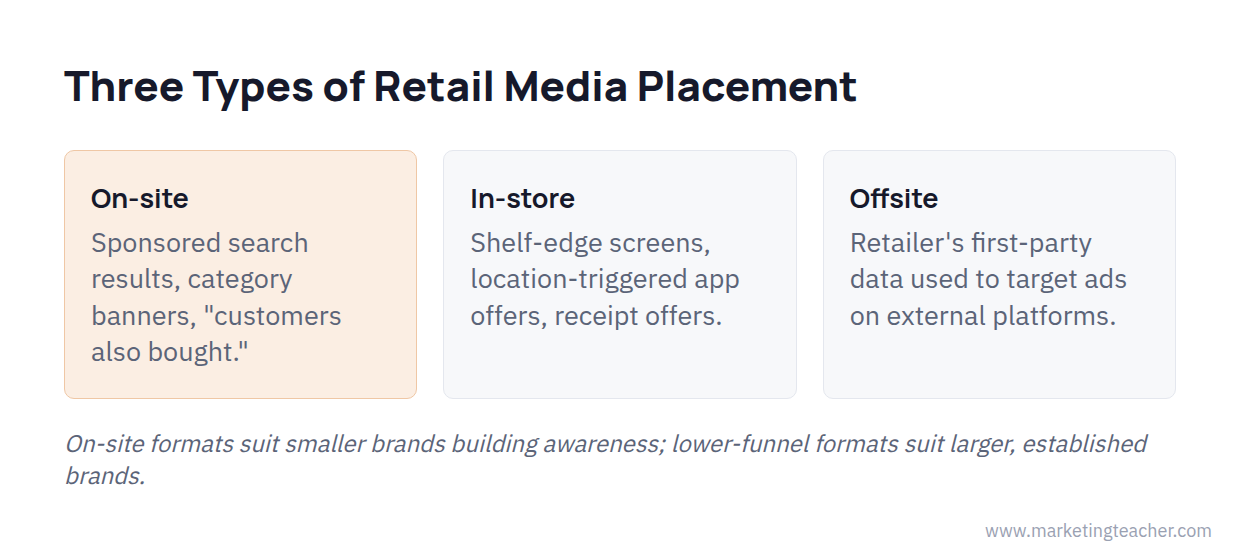
Retail media inventory generally falls into three groups. On-site placements are the most established: sponsored product listings in search results, banner adverts on category and homepage placements, and sponsored recommendations in “customers also bought” style modules. In-store placements extend the same targeting logic into the physical shop, through digital shelf-edge screens, in-app offers triggered by a shopper’s location inside the store, and receipt-printed offers based on that trip’s purchases. Offsite placements are the newest category, where a retailer uses its own first-party shopper data to target adverts on external platforms – social media or open web advertising – on behalf of a brand, extending the retailer’s data advantage beyond its own site. Research comparing these formats has found that upper-funnel, on-site advertising tends to be most effective for smaller or newer brands trying to build awareness, while lower-funnel formats closer to the actual purchase point tend to suit larger, already-established brands better.
Summary
Retail media is advertising sold on a retailer’s own digital and in-store properties, powered by that retailer’s first-party purchase data, and packaged into a retail media network the retailer sells access to. Its rapid growth reflects both the declining reliability of third-party tracking and its unusually direct link to measurable sales. It benefits retailers, brands, and, when done well, consumers – but each party carries a real trade-off, and brands in particular need to test for genuine incremental sales rather than accepting a retailer’s own attributed results at face value.

