
What Are GEO and AEO?
Generative Engine Optimisation (GEO) and Answer Engine Optimisation (AEO) are the practice of shaping content so that it is understood, trusted, and directly cited by AI-driven answer systems – tools such as AI-generated search summaries, conversational AI assistants, and AI-powered research tools – rather than only ranked in a traditional list of blue links. The two terms are used almost interchangeably in current industry usage: AEO is generally used for optimising toward direct question-and-answer style results, while GEO is the broader term covering any generative AI system that synthesises an answer from multiple sources. Industry analysts now describe this as “the new SEO,” on the basis that a growing share of search-style queries are answered by an AI system quoting or summarising a source directly, rather than the person clicking through to a page at all (Kantar, 2026).
How GEO/AEO Differs From Traditional SEO
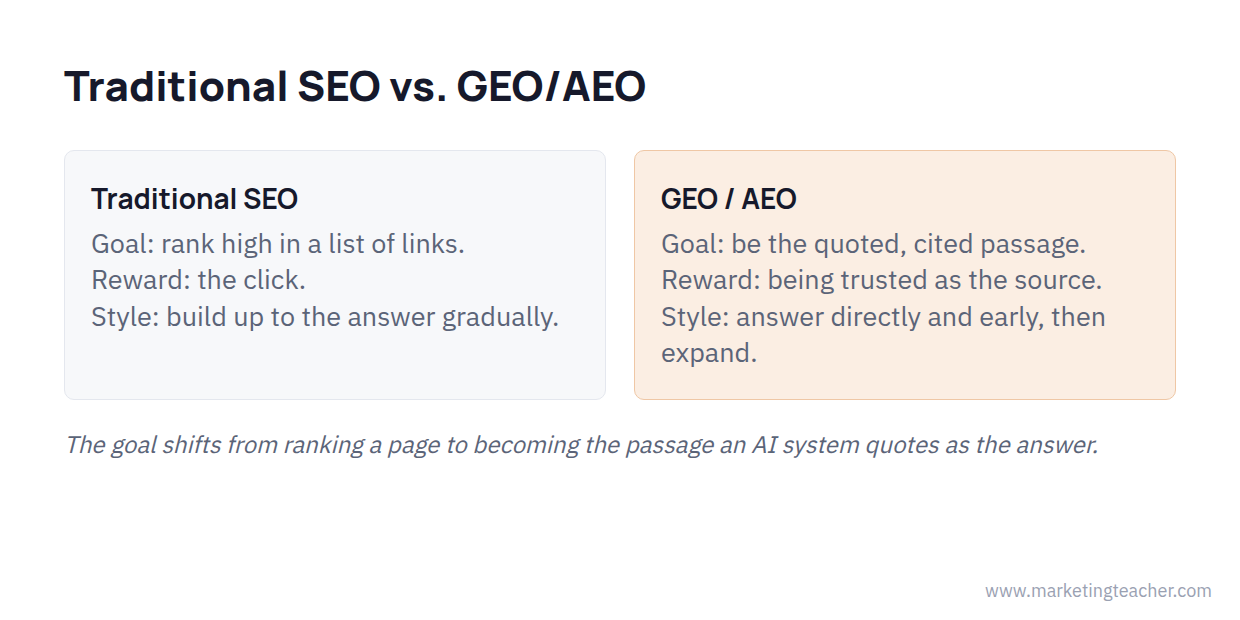
Traditional search engine optimisation is built around ranking a page as high as possible in a list of results the searcher must then click through. GEO and AEO are built around being the specific passage an AI system chooses to quote, cite, or paraphrase when it constructs a single synthesised answer – which means a page can “win” without necessarily being clicked at all, since the value shifts from the visit to being the cited, trusted source behind someone else’s answer. This changes what good content looks like in practice. Structured, clearly attributable factual statements, direct answers stated plainly near the top of a section, and content written from real, lived experience or original data tend to be favoured by these systems, because generative engines are explicitly trying to identify content that reads as authoritative and citable rather than content that is merely well-optimised for a ranking algorithm (Marketer Milk, 2026).
Why Blog-Style Content Is Making a Comeback
One counter-intuitive effect of this shift is a renewed value in first-person, experience-based blog writing. As AI answer engines have become a larger share of how people find information, industry observers have noted that these systems particularly favour content that reads as genuine lived experience by a real, identifiable author, over generic, keyword-stuffed pages with no clear authorship – because that kind of content is harder to fabricate at scale and easier for an AI system to treat as a credible primary source (Marketer Milk, 2026). This has led to a shift back toward long-tail, specific blog content (“10 best project management tools for a five-person agency,” rather than a generic “what is project management”) aimed at being cited for a specific, narrow question rather than ranked broadly for a competitive keyword.
Practical Steps for GEO/AEO
Three changes carry most of the practical value. First, answer the implied question directly and early in the content, in plain language, rather than building up to it – generative systems tend to extract the passage that most directly resembles a complete answer. Second, use clear structure (headings, short lists, defined terms) since this makes content easier for a system to parse into a citable unit. Third, attribute real expertise and, where relevant, original data or a named, credible author, since generic, unattributed content is both less likely to be cited and more vulnerable as AI answer engines get better at identifying genuinely authoritative sources over merely well-optimised ones.
Measuring GEO/AEO Is Still Immature
Measurement is the least developed part of this practice. Traditional SEO has decades of settled metrics – ranking position, organic clicks, click-through rate. GEO/AEO lacks an equivalent standard: there is no universal report showing how often a page was quoted inside an AI-generated answer, and traffic referred directly from an AI assistant is often difficult to distinguish from other traffic in standard analytics. In practice, marketers currently rely on a mix of imperfect signals: manually testing common questions in the relevant AI tools to see whether and how a brand is mentioned, tracking any direct referral traffic that analytics tools do manage to attribute to AI sources, and watching for a decline in traditional organic clicks on informational pages that is not matched by a decline in brand awareness or leads – which can indicate the content is still being used, just via an AI summary rather than a click.
Summary
Generative and Answer Engine Optimisation are the emerging discipline of making content citable and trustworthy to AI-driven answer systems, not just visible to a traditional search ranking algorithm. The practical changes are direct, early answers; clear, parseable structure; and genuine, attributable expertise. As more search-style queries are resolved by an AI-generated answer rather than a clicked link, this is quickly becoming a core, rather than optional, part of digital marketing practice.
The slides, worksheet, lesson plan and poster for this lesson are free to download and free to use in your course — no sign-up, no permission needed. See the teacher resources →
Assign this lesson to your class:
Using Canvas, Blackboard or Moodle? Copy the link and paste it into your course page or assignment. More ways to add lessons to your LMS.

