
What Is the Social Publishing Zone?
Tuten and Solomon (2018) define social publishing as the production and distribution of content through vehicles that let an audience discover, discuss, and share it. Where the social community zone (see Lesson 6) is built around relationships, the social publishing zone treats content itself as the unit of value — the social object around which conversation happens. Publishing has always existed, of course, but social publishing removes the old barriers to entry: anyone, from an amateur hobbyist to a global news organisation, can now publish content and build an audience without owning a printing press or a broadcast licence.
The Four Main Channels
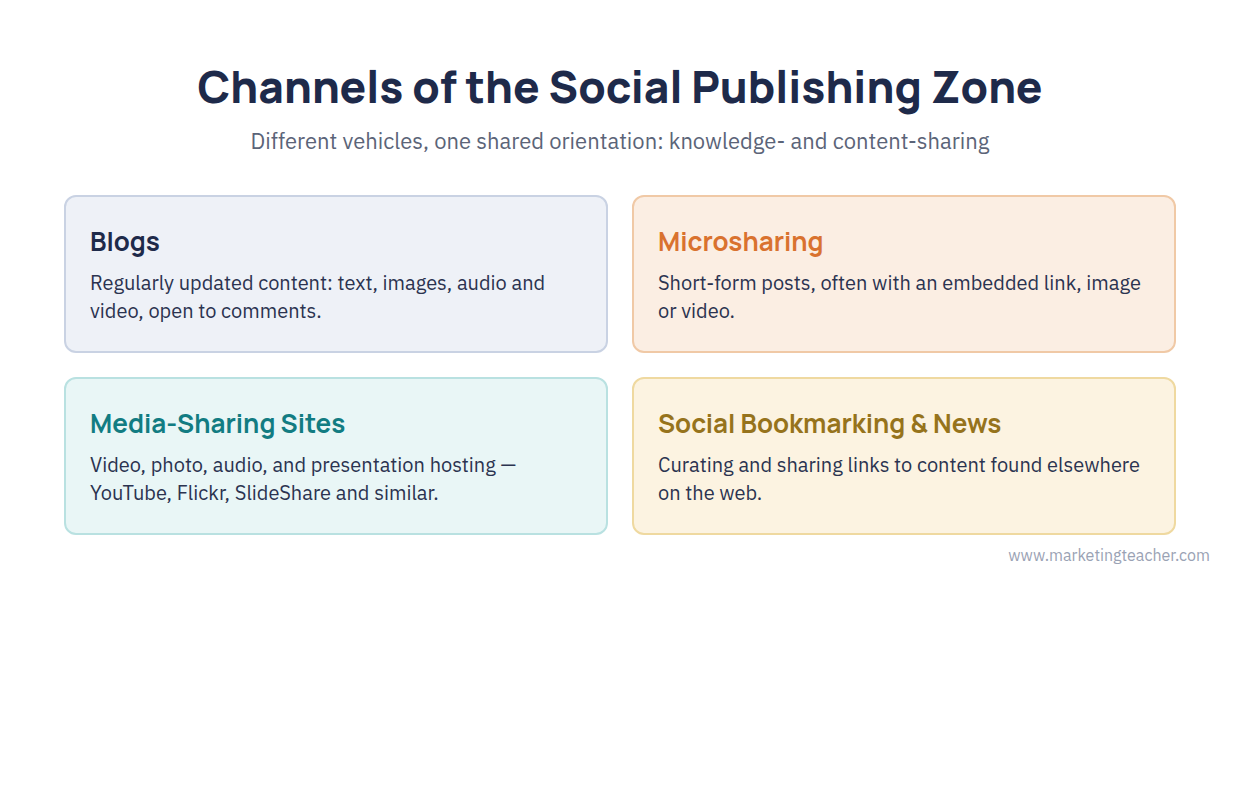
Tuten and Solomon (2018) group social publishing vehicles into four broad channel types. Blogs are regularly updated sites, usually owned media controlled entirely by the publisher, that host everything from short opinion posts to in-depth articles. Microsharing platforms carry short-form posts, often built around a single link, image, or video. Media-sharing sites — YouTube, Flickr, and similar platforms — host video, photo, audio and presentation content, and count as earned rather than owned media because the publisher doesn’t control the platform itself. Social bookmarking and news sites let people curate and share links to content they found elsewhere, extending its reach well past its original audience.
Many Formats, One Underlying Content
A single piece of content can take many forms: blog posts and feature articles, press releases, white papers and ebooks, newsletters, videos, webinars, podcasts, photos, and infographics, among others. Tuten and Solomon (2018) describe content as increasingly multi-layered — a magazine article, for instance, might be republished online with an embedded video, a comment section, and a share button added, none of which existed in the original print piece. The content did not become genuinely social until those layers of interactivity, participation, and shareability were added on top of it. This matters for planning: the same underlying idea can often be adapted into several formats for several channels, rather than treated as a single, disposable post.
Not All Content Is Created Equal: The Content Value Ladder
Tuten and Solomon (2018) describe a content value ladder that ranks content by its originality and lasting usefulness. At the bottom sits filler content: material simply repurposed from other sources, adding little of its own. Above that is original content — genuinely new material, though not yet substantial enough to establish real authority. Authority-building content goes further, positioning its creator as a credible expert on the topic. When a body of authority-building content keeps attracting new viewers over time, gaining momentum through reposts and citations, it becomes pillar content. At the very top is flagship (or evergreen) content: original, authoritative, pillar-level work that becomes a lasting reference point in its field, continuing to draw an audience years after it was first published.
This distinction matters commercially. Tuten and Solomon (2018) cite HubSpot research analysing thousands of company blogs, which found that only around one in ten posts qualified as genuinely “compounding” — steadily gaining traffic over time — yet those posts alone accounted for 38% of all blog traffic across the sample studied. A single strong piece of pillar content can outperform many quickly forgotten posts combined.
Who Actually Made This Content?
Tuten and Solomon (2018) note that social publishing has blurred the once-clear line between journalism, editorial opinion, and paid promotion. User-generated content that people publish for their own reasons is generally perceived as authentic. But brands increasingly shape what gets published too: consumer-solicited content invites submissions under brand guidelines, incentivized content rewards contributions with prizes or cash, and sponsored content pays creators outright to feature a brand. Because audiences assume independent content is unpaid, Tuten and Solomon (2018) note that regulators now require clear disclosure whenever money has changed hands, so that sponsorship is transparent rather than disguised as an organic recommendation.
Getting Content Seen: Distribution and Promotion
High-value content still needs an audience to reach. Tuten and Solomon (2018) report that marketers typically distribute content across an average of six different social channels rather than relying on any single platform, and combine organic sharing with paid promotion to guarantee reach. The goal is always twofold: increase exposure to the brand’s message, and use that content to pull traffic back toward the brand’s own owned media, where the relationship can continue.
Summary
The social publishing zone spans blogs, microsharing, media-sharing sites, and bookmarking and news platforms, but the channel matters less than the value of what gets published. Climbing the content value ladder from filler toward authority-building, pillar, and flagship content — while being transparent about who paid for what — is what turns social publishing into a durable marketing asset rather than a stream of disposable posts (Tuten & Solomon, 2018).

