
What Is the Social Community Zone?
Tuten and Solomon (2018) identify the social community zone as the first, and most foundational, of the four zones of social media marketing. Where the other zones focus on publishing, entertainment, or commerce, the social community zone is about relationships: conversation, connection, and collaboration, usually happening around content rather than being the content itself. Every social network site sits on the same underlying structure — nodes, flows and graphs, as covered in Lesson 3 — but Tuten and Solomon (2018) note that individual networks still differ along three dimensions: how specialised their audience is (a general network like Facebook versus a narrow interest-based “vertical” network), what social object holds members together (a hobby, a profession, a shared identity), and how open the network is to new members and outside developers.
Building a Brand’s Social Presence
To participate in a social community, a brand needs a profile of its own — effectively becoming another node in the network’s social graph. Tuten and Solomon (2018) explain that this presence is usually personified: represented as a corporate voice, a set of individuals speaking for the brand, or a dedicated mascot, and it works best when the brand then “stays in character” consistently across every post and reply. Author Brian Solis, cited in Tuten and Solomon (2018), recommends building that persona on eight underlying questions: the brand’s core values, the pillars or social objects that express those values, its promise to customers, its aspirational attributes, its associated traits, the opportunities available to it, its fit with the wider company culture, and the stories that can bring its personality to life. A consistent answer to these questions is what lets a brand mascot or brand voice feel like a real participant in the community rather than an advertisement wearing a costume.
How Much of the Audience Actually Participates?
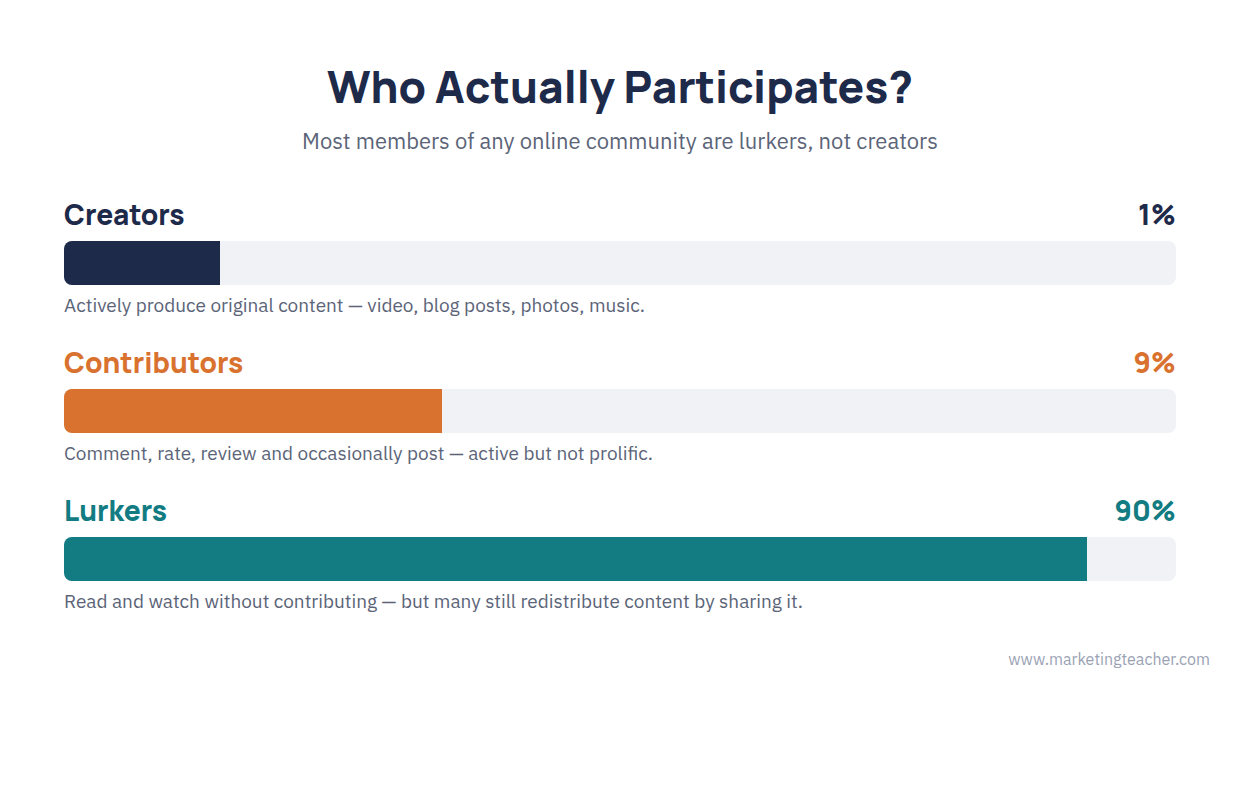
It is tempting to imagine an engaged community as a place where everyone is posting, commenting, and sharing. In practice, Tuten and Solomon (2018) note that the overwhelming majority of any online community are lurkers — people who read posts and watch videos but never contribute content of their own — a pattern widely described in the industry as the 90-9-1 rule of participation inequality, and one that later empirical work has continued to examine and refine across different platforms (van Mierlo, 2014). Under this pattern, roughly 90% of a community’s members only observe, around 9% contribute occasionally, and as little as 1% create the bulk of all original content.
This matters for two reasons. First, it means a healthy-looking community can still have very few active voices, so a brand should not judge a community’s health purely by follower count. Second, and more encouragingly, Tuten and Solomon (2018) point out that even lurkers extend a brand’s reach when they simply share content with a click — so an experience worth sharing can travel through a network far beyond the small minority who create original posts.
What Brands Actually Post: The 3M Model
Given the effort required to build a following, what should a brand actually post once it has one? Tuten and Solomon (2018), drawing on Gallaugher and Ransbotham’s 3M model, describe three broad approaches to firm-generated content. Megaphone posts simply broadcast company messages outward. Magnet posts are designed to invite engagement — asking a question, inviting a response. Monitor posts reflect genuine listening, responding directly to what consumers are already saying. Research cited in Tuten and Solomon (2018) finds that most brands default to megaphone behaviour, broadcasting offers and announcements, even though consumer engagement is consistently higher for posts that are interactive and audience-focused rather than purely promotional.
From Fans to Engaged Communities
Tuten and Solomon (2018) describe brand fans as people who display loyalty toward a brand much as they would toward a sports team or a musician — in a social network, that loyalty often starts with something as small as a follow or a “like.” Engagement itself ranges from that mild starting point up to genuinely evangelistic advocacy, and brands benefit from treating it as a ladder to climb rather than a single yes/no state: the more engaged a follower becomes, the more likely they are to generate positive word-of-mouth and influence other people’s purchase decisions, which is exactly the kind of earned reach a brand cannot simply buy.
Summary
The social community zone is where brands build relationships rather than simply broadcast messages. A consistent brand persona, awareness of the 90-9-1 pattern of participation, and a shift away from megaphone-only posting toward magnet and monitor content are what turn a brand’s social profile into a genuine, engaged community rather than an audience that quietly scrolls past (Tuten & Solomon, 2018).

