
What Is Marketing Automation?
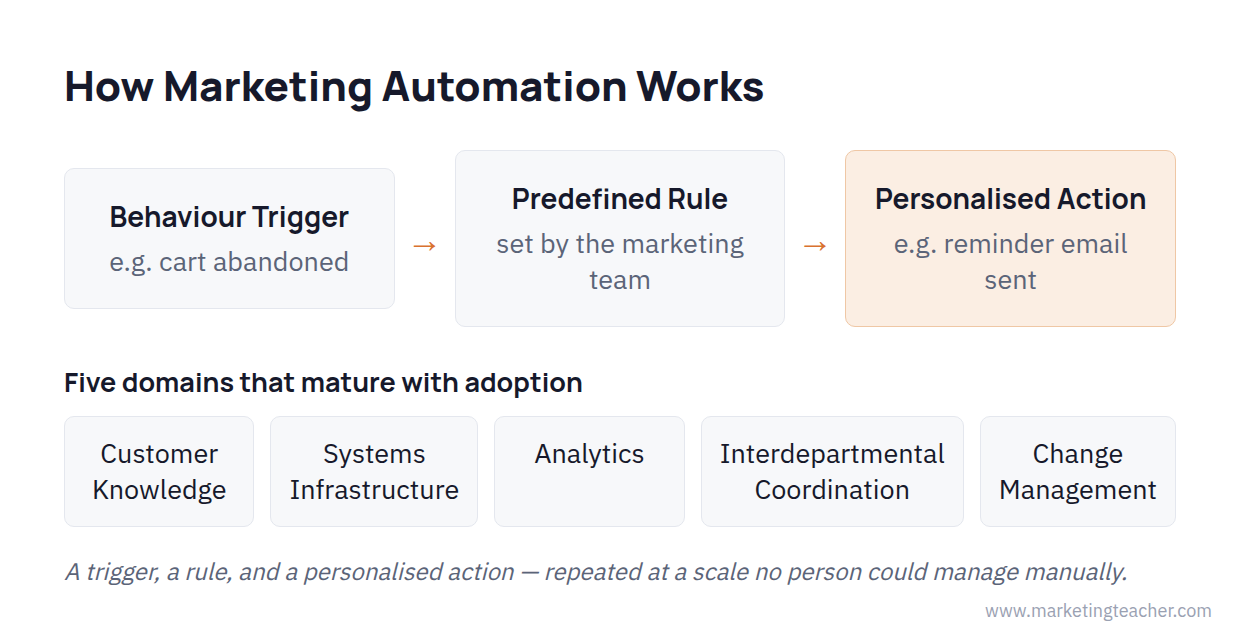
Marketing automation is software that triggers personalised marketing activity automatically, based on rules a business sets in advance and data it holds about a customer’s characteristics or behaviour. Rather than a marketer manually sending an email to every new subscriber, an automation platform watches for the sign-up event and sends a predefined welcome sequence itself, adjusting the content or timing based on what that person does next. The technology is built on a customer database and a set of triggered rules, and its purpose is to deliver the right message to the right person at the right point in their journey without a human manually actioning every step.
Common applications include email sequences triggered by behaviour (an abandoned cart, a downloaded guide, a lapsed subscription), lead scoring that ranks prospects by how sales-ready their behaviour suggests they are, social media post scheduling, and dynamic website content that changes based on a visitor’s known interests. Marketing automation adoption has grown quickly across company sizes, and industry surveys suggest a majority of B2B companies now use some form of it.
Where the Value Actually Comes From
The clearest documented benefit is in B2B content marketing. A widely cited case study found that marketing automation allows a business to generate high-quality sales leads through behavioural targeting and content personalisation – tracking what content a prospect engages with and using that signal to decide what to send them next, rather than sending the same generic follow-up to everyone. This turns content marketing from a one-way broadcast into a data-driven process that adapts to each prospect individually, at a scale no marketing team could manage by hand.
Research studying how organisations actually adopt marketing automation technology, rather than how vendors describe it, found something counter-intuitive: adoption tends to proceed through trial-and-error and iterative experimentation rather than a single rational, planned rollout, even inside large firms. Researchers identified five domains that mature gradually as a business gets better at automation: customer knowledge, information systems infrastructure, analytics capability, interdepartmental coordination between marketing and sales, and change management. Treating automation as a one-off software purchase, rather than a capability that develops across all five domains over time, is one of the most consistent reasons implementations under-deliver.
Why Implementations Fail
The word “automation” itself causes a common misconception: that the technology reduces marketing workload. Research following real B2B adopters through the early phase of implementation found the opposite – automation typically requires more human resource at first, not less, because building the customer segments, content library, and trigger rules that make automation useful is a substantial upfront investment. Studies of adoption challenges across firms also point to more concrete failure points: poor-quality underlying customer data undermines every rule built on top of it, systems that do not integrate cleanly with the tools already in use create manual workarounds that quietly defeat the point of automating in the first place, and over-reliance on automation without any human review can produce impersonal, tone-deaf messages sent at exactly the wrong moment for a given customer.
Marketing Automation vs. CRM and Sales Force Automation
Marketing automation is often confused with related technologies it sits alongside. A Customer Relationship Management (CRM) system is primarily a record-keeping tool for sales teams, tracking individual contacts and deals; Sales Force Automation (SFA) automates sales-team tasks such as call scheduling and pipeline updates. Marketing automation’s distinct role is the automatic personalisation of marketing activity itself – deciding what content or message a contact receives and when, based on their behaviour and characteristics – and it typically only delivers its full value when it is properly integrated with the CRM a sales team already relies on, so that a lead’s automated marketing history and a salesperson’s manual notes sit in the same place rather than two disconnected systems.
Summary
Marketing automation uses software and customer data to trigger personalised marketing activity automatically, most commonly in email sequencing, lead scoring, and content personalisation. Its documented commercial value comes from matching content to individual behaviour at a scale manual marketing cannot reach, but the evidence is equally clear that most of the effort is in the underlying data, rules, and cross-team coordination – not in the automation platform itself – which is why a large share of implementations fail to deliver on their promise in the first year.

