
What Is Diversity in Marketing?
Diversity in marketing refers to the portrayal of people with different characteristics – gender, ethnicity, age, sexual orientation, ability, and body type among them – within a brand’s advertising and content. It is a decision about who appears and whose life is shown as normal, alongside whoever else is featured. This is a different question from inclusivity in marketing, which asks whether the resulting material can actually be used and understood by a wide audience. A brand can represent a diverse cast of people in an advert that is itself inaccessible, and a brand can produce a highly accessible advert that still shows only one narrow type of customer. Diversity is the “who,” inclusivity is the “how.”
Why Representation Shapes Buying Decisions
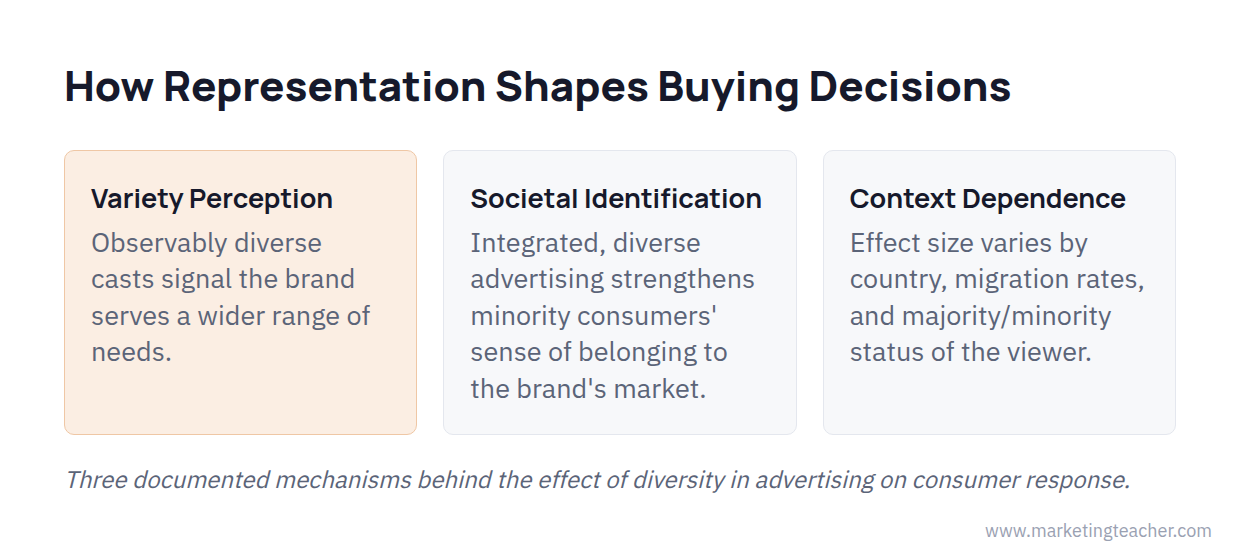
Marketing research has spent decades studying how audiences respond to diversity in advertising, and a large academic review covering gender, ethnicity, sexual orientation, and age concludes that diverse and inclusive advertising tends to produce favourable brand and social effects overall, although the size and direction of the effect depends heavily on context, execution, and the audience viewing it. One consistent mechanism researchers have identified is a variety effect: when adverts depict people who are observably different from one another, consumers infer that the brand serves a wider range of needs and therefore offers greater product variety, even when the advert makes no explicit claim about variety at all. This perception improves brand impression, perceived creativity, willingness to pay, and willingness to use the product – a purely perceptual effect that has nothing to do with the product itself changing.
A separate, large-scale meta-analysis pooling more than a thousand effect sizes across over a hundred studies published between 1969 and 2024 found that the effect of ethnic diversity in advertising is real but small on average, and that it is shaped strongly by country-level factors such as migration rates and the rule of law, as well as by whether the viewer belongs to the ethnic majority or a minority group in that market. This matters practically: a diversity strategy that performs well in one country’s marketing mix cannot be assumed to transfer unchanged to another market with a different demographic and legal context.
The Business Case, and Where It Breaks Down
There is a credible commercial argument for representation beyond social responsibility. Research on advertising with racially mixed, integrated casts has found that when minority consumers see advertising that depicts diverse people together, it strengthens their sense of societal identification, which in turn strengthens purchase intention toward the mainstream brands running that advertising – while a lack of such representation can reinforce a sense of exclusion that measurably weakens brand preference among minority consumers. In other words, representation (or its absence) has a real, documented effect on how included a customer feels in a brand’s target market, not just on how the advert looks.
That business case breaks down quickly when representation is inconsistent with the rest of a brand’s behaviour, or handled without care for the group being depicted. Advertising research on this point is consistent: audiences distinguish between representation that looks like genuine understanding of a group and representation that looks like a demographic box being ticked, and they penalise the latter in brand trust and purchase intention.
Getting Diversity Strategy Right
Three practical steps reduce the risk of representation backfiring. First, base casting and framing decisions on research into the specific market being addressed, rather than reusing one global creative unchanged, since the evidence shows effects vary by country and audience composition. Second, involve people from the group being represented in the creative process itself, since authenticity is what audiences are actually judging, not just visible presence. Third, keep representation consistent across a brand’s touchpoints – staffing, product range, customer service – rather than confined to a single campaign, since inconsistency is what reads as tokenism.
Summary
Diversity in marketing means representing a genuinely varied range of people in a brand’s advertising and content, and the evidence shows this can shape brand perception, perceived variety, and purchase intention in measurable ways – strongest where representation is executed with genuine understanding of the group shown, and weakest or even reversed where it comes across as a token gesture. Because effects vary meaningfully by country and audience, diversity strategy is best treated as a research question for each market rather than a single global creative choice.
The slides, worksheet, lesson plan and poster for this lesson are free to download and free to use in your course — no sign-up, no permission needed. See the teacher resources →
Assign this lesson to your class:
Using Canvas, Blackboard or Moodle? Copy the link and paste it into your course page or assignment. More ways to add lessons to your LMS.

