
What Is Sustainability in Marketing?
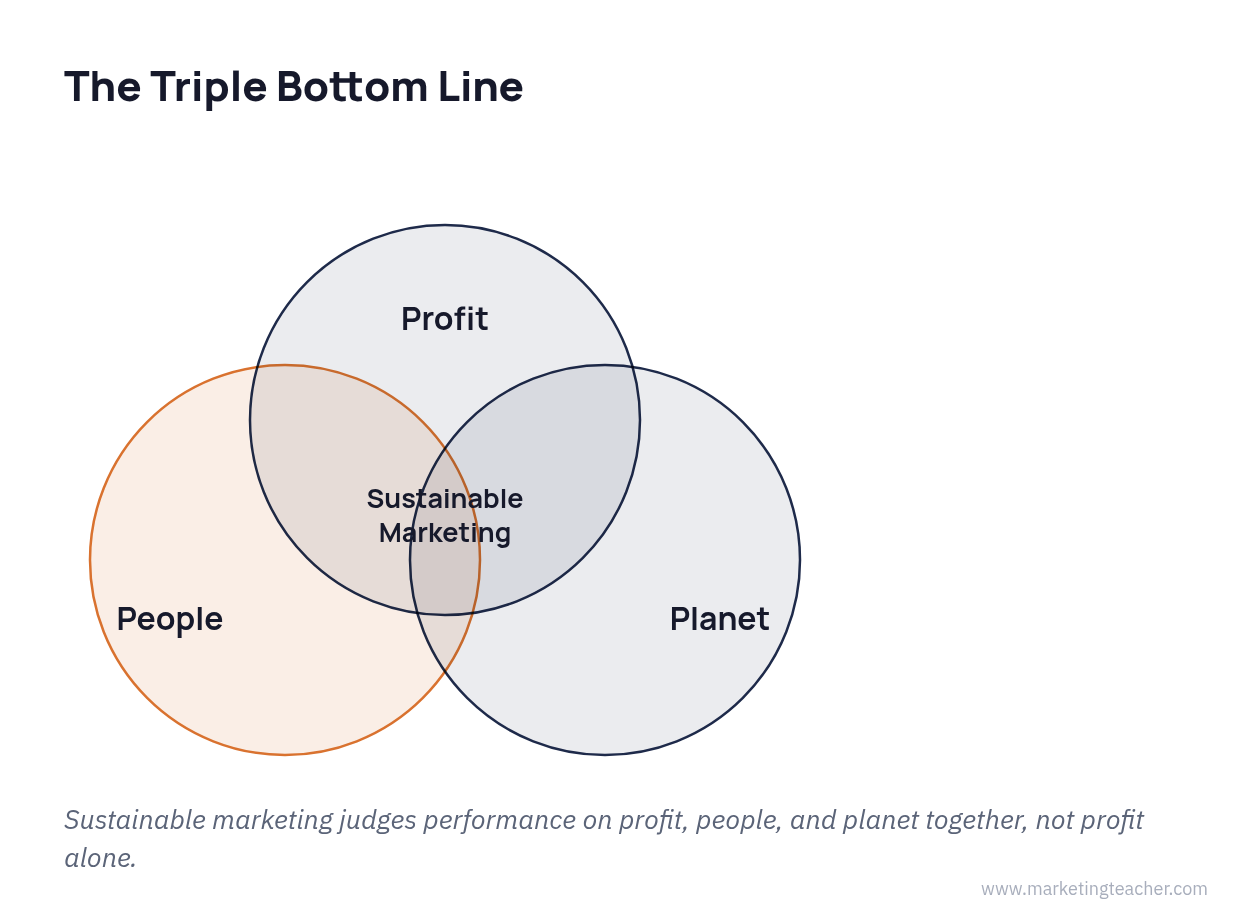
Sustainable marketing is the practice of developing, communicating, and delivering value to customers in a way that maintains or improves the wellbeing of both consumers and the environment over the long term, rather than optimising only for a single sale. It builds on the “triple bottom line” idea, developed by the sustainability consultant John Elkington in the 1990s, that a business’s performance should be judged against three measures together – profit, people, and planet – rather than financial return alone. In marketing terms, this shows up in decisions across the whole marketing mix: sourcing and packaging (product), fair and transparent value (price), lower-impact logistics (place), and honest, evidence-based communication about environmental and social impact (promotion).
Academic interest in this area has grown substantially since 2010, with research tracking a shift from marketing’s early, general engagement with the abstract idea of sustainability toward far more specific, technology- and industry-focused applications – for example, how sustainability claims interact with digital marketing, packaging design, or supply chain transparency in a particular sector, rather than sustainability as a single broad topic.
Sustainable Marketing vs. Greenwashing
The central risk in this area is greenwashing: making environmental or ethical claims that are exaggerated, vague, or unverifiable, in order to benefit from consumer goodwill toward sustainability without the underlying practice to back it up. Common patterns include vague language (“eco-friendly,” “natural”) with no defined standard behind it, irrelevant claims that are technically true but meaningless (advertising a product as free from an ingredient that was never used in that category anyway), and selective disclosure that highlights one sustainable attribute while omitting a much larger negative impact elsewhere in the same product’s lifecycle. Regulators in several markets, including the UK’s Competition and Markets Authority, have become more active in enforcing against exactly these patterns, which raises the practical risk of greenwashing beyond reputational damage into regulatory and legal exposure.
Why Precision Matters Commercially
Consumer trust in sustainability claims is not unconditional, and audiences have become more sceptical of vague or unsubstantiated messaging over time. This means the commercial upside of sustainable marketing depends heavily on execution: specific, verifiable claims tend to build trust and support a price premium, while vague or exaggerated claims that are later challenged – by journalists, regulators, or simply attentive customers on social media – can produce a worse outcome than making no sustainability claim at all, because the resulting backlash extends beyond the specific claim to the brand’s overall credibility.
Building a Sustainable Marketing Claim
A defensible sustainability claim generally needs three things: a specific, measurable basis (a percentage, a certification, a defined scope) rather than a general adjective; evidence that can be produced if challenged, ideally from an independent standard or third-party certification rather than the company’s own assessment; and consistency with the rest of the brand’s visible practice, since a single sustainable product line marketed heavily by a company whose broader operations are not sustainable invites exactly the greenwashing accusation the marketing was meant to avoid.
Sustainability as a Segmentation Variable
Not every customer weighs sustainability equally, which means it can be used as a genuine segmentation variable rather than a blanket message aimed at everyone. Some segments will actively pay a premium for a verified sustainable option and treat it as a primary purchase driver; others are price-led first and will only choose the sustainable option when it costs the same or less; a third group is largely indifferent unless the unsustainable alternative is actively inconvenient or unavailable. Sustainable marketing that tries to persuade every segment with the same environmental argument tends to under-perform marketing that leads with sustainability for the segment that cares most, while leading with price, convenience, or quality for the segments that do not – with the sustainability credentials still present, just not the headline message.
Summary
Sustainable marketing means designing products, pricing, distribution, and communication around long-term wellbeing for people and the environment, not just short-term sales, following the triple-bottom-line idea of judging performance on profit, people, and planet together. Its biggest practical risk is greenwashing: claims that are vague, irrelevant, or selectively disclosed. Defensible sustainability marketing is specific, evidenced, and consistent with a brand’s actual practice – the same discipline that separates genuine claims from ones that damage trust when challenged.
The slides, worksheet, lesson plan and poster for this lesson are free to download and free to use in your course — no sign-up, no permission needed. See the teacher resources →
Assign this lesson to your class:
Using Canvas, Blackboard or Moodle? Copy the link and paste it into your course page or assignment. More ways to add lessons to your LMS.

