
What Is Transformative Marketing?
Every business changes constantly: a new supplier here, an updated pricing sheet there, a reshuffled team every few years. Most of this is routine housekeeping, not something worth a special name. Kumar (2018) argues that a much rarer kind of change deserves to be treated differently: transformative marketing, which he defines as the coming together of a firm’s marketing activities, concepts, metrics, strategies and programmes in direct response to marketplace changes and future trends, with the goal of giving customers a level of value that leapfrogs the competition while also creating benefits for every stakeholder involved, not just the paying customer.
That last part matters. A change that only helps the company’s own bottom line, at the expense of customers, employees or regulators, is not what this concept is describing. The change has to move value in more than one direction at once: customers get something genuinely better, and the firm and its partners benefit too. This is also why transformative marketing is bigger than a single campaign or a single new tool. It reshapes how a company thinks about its offer, not just how it advertises that offer.
The Three Triggers of Genuine Transformation
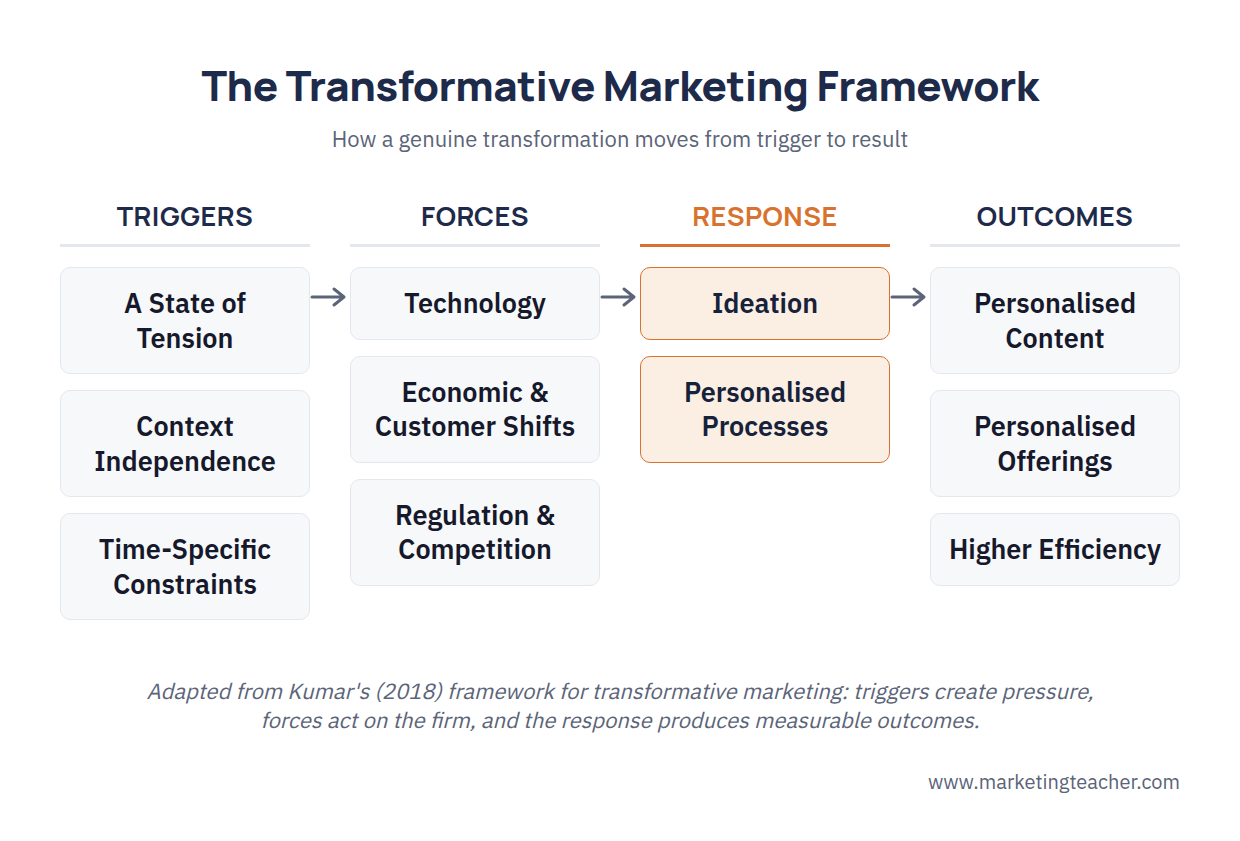
If every business is changing all the time, how do you tell a genuine transformation from routine housekeeping? Kumar (2018) proposes three conditions that all have to be present together before a change earns the label.
The first is a state of tension: a real gap between how things currently work and how they ought to work, serious enough to force a response. Swapping an advertising agency or updating a piece of software rarely clears this bar, because nothing about the business is actually under pressure to change. A tension worth calling transformative is usually tied directly to whether the firm and its customers are creating value for each other at all.
The second is context independence: the pressure behind the change is not specific to one company’s quirks or one department’s local problem. It applies whatever the size or setting of the business, because it comes from a shift in the wider environment – technology, customer expectations, or regulation – that every player in that space eventually has to answer.
The third is that the change is constrained to a specific time period rather than open-ended. Kumar (2018) traces roughly one shift in marketing approach every two decades: mass marketing built around simple selling in the 1960s, targeted marketing once cable television let firms reach narrower audience segments from the 1980s, personalised marketing once digital recording and on-demand technology arrived from the late 1990s, and what he calls engaged customisation today, where the customer increasingly decides what marketing content they receive, and how. Each phase eventually gives way to the next.
Hearth & Home, a fictional regional homeware chain, had relied on a printed seasonal catalogue for over a decade. Response rates had been drifting down for years, but a genuine state of tension arrived when three things converged in the same year: a rival chain launched an app that recommended products based on browsing history, new data-protection rules forced Hearth & Home to rewrite how it stored customer records, and a survey showed six in ten shoppers under 40 said they would not open another paper catalogue at all.
The catalogue had been converting at 0.8% of households mailed. Rather than simply printing a glossier version, the team built a small in-app recommendation feature and personalised email content drawing on the same purchase history, redesigned around the new data rules from the outset. Within two quarters, the app’s personalised recommendations were converting at 2.6%, more than three times the old catalogue rate, while the printing and postage budget fell by 40%, freeing up funds to keep improving the recommendation engine itself. Nothing about the underlying products changed. What changed was how precisely the business could match an offer to a specific customer, and how much of its budget it no longer had to spend guessing.
How Forces Turn Into Outcomes
Kumar (2018) sets out a broader framework for what happens between a trigger and a result. External forces – mainly technology, economic and environmental pressures, shifting customer preferences, government regulation, and competitive moves – push against a firm’s usual way of operating until the pressure becomes too significant to ignore. The firm’s response takes two connected forms: ideation, meaning fresh thinking about what the business could offer, and personalised processes, meaning the operational systems that can actually deliver something tailored to an individual customer rather than a mass segment.
When ideation and personalised processes are both genuinely present, three outcomes tend to follow: marketing content that speaks to a specific customer rather than a broad segment, offerings that can flex to what that customer actually wants, and higher operational efficiency and effectiveness, since a firm that understands its customers more precisely tends to waste less effort on offers nobody wanted in the first place. Hearth & Home’s story above is a small-scale version of exactly this chain: forces (competitor pressure, regulation, changing habits) led to a response (a new recommendation feature, redesigned around the data rules) which produced outcomes (higher conversion, lower cost).
Summary
Not every business change is transformative marketing. A genuine transformation needs a real state of tension, a pressure that is not unique to one company’s circumstances, and a shift bounded to roughly two decades rather than permanent disruption. When those triggers are present, external forces such as technology, regulation, and shifting customer preference push a firm toward fresh ideation and genuinely personalised processes, and the payoff shows up as content and offerings tailored to the individual customer, alongside real gains in efficiency.
The slides, worksheet, lesson plan and poster for this lesson are free to download and free to use in your course — no sign-up, no permission needed.

