
What Is Gap Analysis?
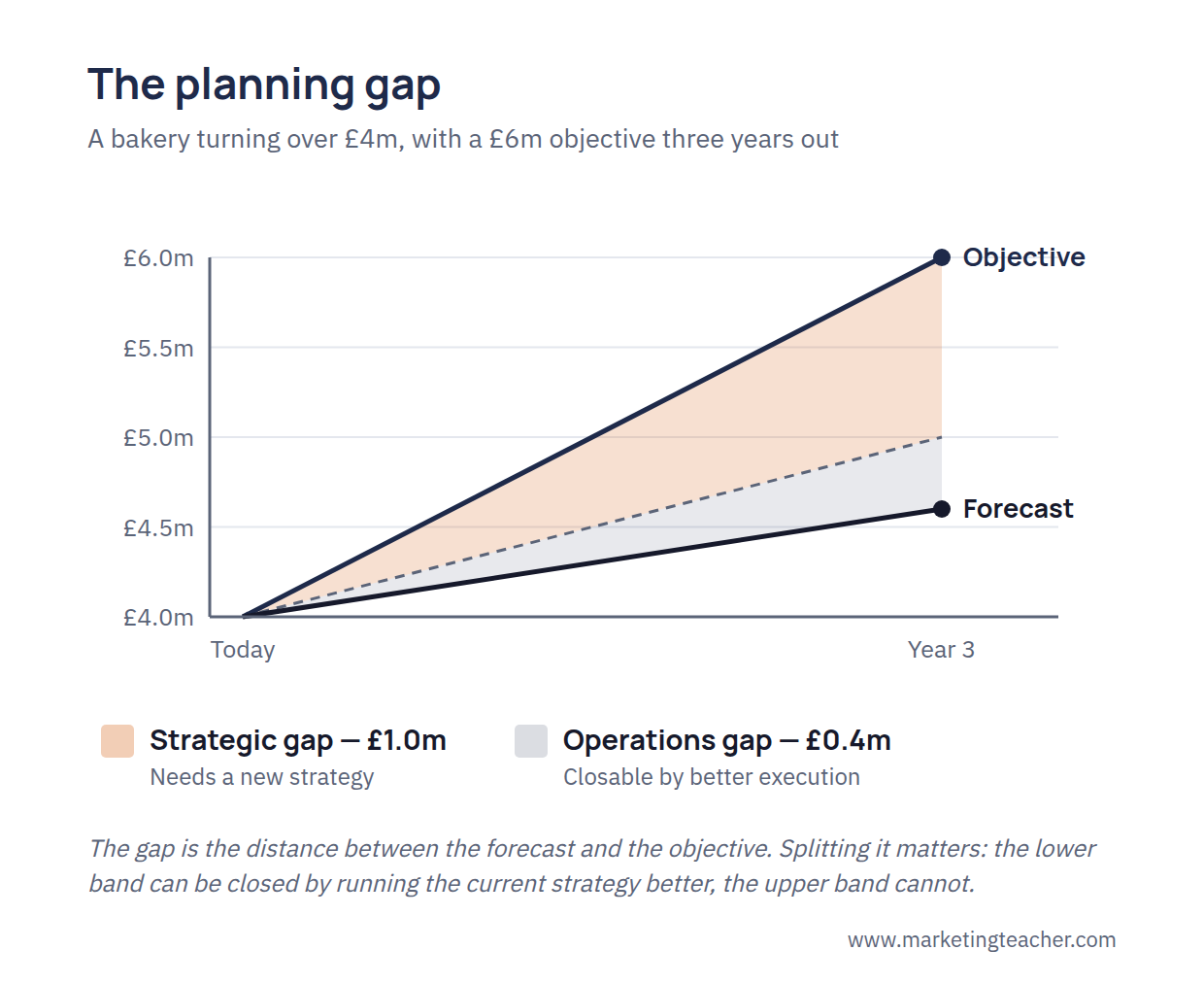
Gap analysis is the comparison between where a business expects to be if it changes nothing, and where its objectives say it needs to be. The difference between those two lines, plotted over the planning period, is the planning gap. Everything a marketing plan then proposes exists to close it.
The technique comes from Igor Ansoff, whose work on corporate strategy set out the problem formally: a firm forecasts its performance on current products in current markets, compares that forecast with its stated objectives, and treats any shortfall as the strategic problem to be solved (Ansoff, 1965). It is a deceptively simple idea, and it is the reason a marketing plan begins with objectives rather than with tactics.
Where Does the Planning Gap Come From?
Two separate pieces of work produce the gap. The first is the objective: what the organisation has committed to achieve, usually expressed as revenue, volume or profit by a stated date. The second is the forecast, sometimes called the momentum line — what the business would achieve if it simply carried on, allowing for known market growth or decline, existing contracts and the natural ageing of its products.
The gap only becomes visible when both are drawn. A business that sets objectives without forecasting has no way of knowing how much work is required; a business that forecasts without setting objectives has nothing to measure the forecast against. Kotler and Armstrong (2018) place this comparison at the heart of strategic planning, because it converts an aspiration into a quantified problem.
How Big Is the Gap?
The gap is rarely one number. It is usually decomposed into an operations gap — what better execution of the current strategy could deliver — and a strategic gap, which is whatever remains and can only be closed by doing something genuinely different. That distinction matters, because the two halves are closed by different means and carry very different levels of risk.
The Four Ways to Close a Gap
Ansoff (1965) identified four broad directions, and they remain the standard framing. Market penetration sells more of the existing product to the existing market — through higher purchase frequency, larger pack sizes, or share taken from competitors. It is the cheapest and least risky option, and usually the first to be exhausted.
Market development takes the existing product to a new market: a new region, a new customer segment, or a new channel. The product is proven, so the risk sits in whether the new market values it in the same way. Product development reverses this, offering something new to customers the business already understands. Here the customer relationship is proven and the risk sits in the product itself.
Diversification means new products for new markets, and carries the highest risk because nothing is known — neither the offer nor the buyer. Ansoff was explicit that diversification should be considered when the other three cannot close the gap, not treated as an equivalent option.
Why the Gap Must Be Quantified
The value of gap analysis lies almost entirely in the arithmetic. A plan that proposes market development without stating how much revenue it must produce cannot be evaluated, resourced or held to account. Once the gap is a number, each proposed strategy can be given a share of it, and each share can be tested against the cost and risk of achieving it.
It also disciplines the objective itself. If the gap is so large that no realistic combination of strategies could close it, the honest conclusion is that the objective was wrong rather than that the marketing was insufficient. Kotler and Armstrong (2018) note that objectives should be achievable as well as specific, and gap analysis is where that is tested.
Limitations
The technique is only as reliable as the forecast beneath it. A momentum line built on optimistic assumptions produces a small gap and a comfortable plan, and the error is discovered only when the results arrive. A forecast should therefore be built from evidence about the market rather than from the growth rate the business would like to achieve.
Gap analysis is also silent on capability. It identifies the size of the shortfall and the direction of travel, but not whether the organisation possesses the skills, capital or distribution to follow that direction. It works best alongside an honest internal analysis, which is why it usually sits next to a SWOT rather than replacing it.
Finally, the four directions are not equally available to everyone. A business with weak cash reserves cannot realistically diversify, whatever the matrix suggests. The framework structures the options; judgement decides which are genuinely open.
Summary
Gap analysis compares where a business is heading with where it intends to be, and treats the difference as the planning gap. That gap divides into an operations gap, closable by better execution, and a strategic gap, which requires a change of direction. Ansoff’s four options — market penetration, market development, product development and diversification — provide the directions, in ascending order of risk. The discipline of the technique is that it forces the gap to be expressed as a number, so that every strategy proposed afterwards can be judged on whether it is big enough to matter.
The slides, worksheet, lesson plan and poster for this lesson are free to download and free to use in your course — no sign-up, no permission needed. See the teacher resources →
Assign this lesson to your class:
Using Canvas, Blackboard or Moodle? Copy the link and paste it into your course page or assignment. More ways to add lessons to your LMS.

