
What Is Ansoff’s Matrix?
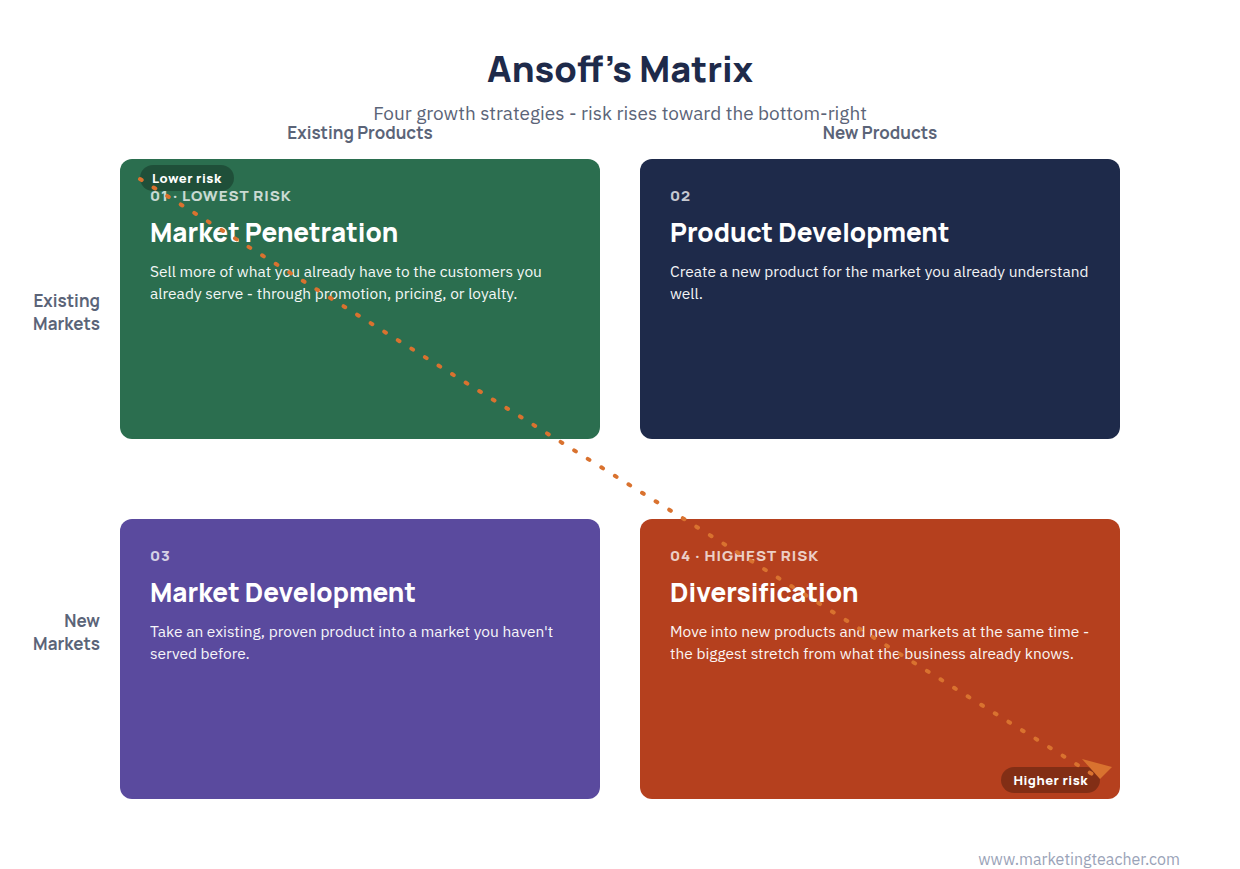
Ansoff’s Matrix is a simple planning tool that maps a business’s growth options against two dimensions: whether it is selling products it already has or new products, and whether it is selling into markets it already serves or new markets (Ansoff, 1957). Crossing these two dimensions produces four named strategies – Market Penetration, Market Development, Product Development, and Diversification – each carrying a different level of risk. The matrix does not tell a manager which option is “best”; it gives a shared vocabulary for comparing options that would otherwise be hard to weigh against each other, and for being explicit about how much risk each one carries. Ansoff first set out this reasoning in 1957 as a way of helping large, diversified companies think systematically about where their next investment should go, and the same four-way classification has stayed in everyday use in strategy teaching ever since, largely unchanged from its original form.
Market Penetration
Market Penetration means selling more of the existing product range to the existing market – through heavier promotion, more competitive pricing, or simply encouraging existing customers to buy more often. It is the lowest-risk quadrant, since the business is not asking customers to trust anything unfamiliar; it already knows the product and the market. The ceiling on this strategy is real, though – a business cannot grow through penetration alone once a market approaches saturation.
Market Development
Market Development means taking the existing, proven product into a market the business has not served before – a new country, a new customer segment, or a new distribution channel. The product risk is low, since nothing about what is being sold has changed, but the market risk is real: a product that succeeds with one audience does not automatically succeed with another, and local competitors, regulations, or buying habits can all work against it.
Product Development
Product Development means creating a new product for the existing, already-understood market – a new model, a new flavour, or a new feature set aimed at customers the business already knows well. The market risk is low, since the business understands who it is selling to, but the product risk is real: development takes time and money, and there is no guarantee the new product will perform as well as the one it is meant to extend or replace.
Diversification
Diversification means moving into new products and new markets at the same time, and it is the highest-risk quadrant of the four – the business has no existing track record to fall back on for either the product or the market it is entering. Diversification is sometimes split further into “related” diversification (staying reasonably close to the business’s existing skills or supply chain) and “unrelated” diversification (moving into a genuinely different industry), with related diversification generally considered the less risky of the two. Johnson, Whittington and Scholes (2011) describe this rising risk along the matrix’s diagonal as the central reason Ansoff’s framework remains useful: it forces a business to be explicit about how far it is stretching beyond what it already knows, rather than treating every growth idea as equally safe.
Using Ansoff Alongside Other Strategy Tools
Ansoff’s Matrix works best alongside other tools rather than in isolation, since it describes the shape of a growth option without judging whether that option genuinely suits the business making it. A TOWS Analysis can help decide which quadrant actually fits a business’s real strengths and the opportunities in front of it, rather than picking a growth direction on instinct alone. Where a Product Development or Diversification strategy involves serving smaller, more specific customer niches rather than one big mass market, the Long Tail concept is worth considering as a specific version of that idea. And once a direction is chosen, tools such as the Boston Matrix help track how a resulting new product or business unit is performing against the rest of the portfolio over time. Where a business runs several units at once, the wider family of portfolio analysis models extends that same comparison across the whole company.
Summary
Ansoff’s Matrix maps a business’s growth options against two dimensions – existing or new products, and existing or new markets – producing four strategies of rising risk: Market Penetration, Market Development, Product Development, and Diversification. It does not choose a strategy for a business, but it makes the trade-off between growth and risk explicit, and works well alongside tools such as TOWS Analysis, the Long Tail concept, and the Boston Matrix when deciding how, and how far, to grow.
The slides, worksheet, lesson plan and poster for this lesson are free to download and free to use in your course — no sign-up, no permission needed. See the teacher resources →
Assign this lesson to your class:
Using Canvas, Blackboard or Moodle? Copy the link and paste it into your course page or assignment. More ways to add lessons to your LMS.

