
What Is Proximity Marketing?
Most mobile marketing broadcasts the same message to everyone who might see it. Proximity marketing does something different: it uses a customer’s real-time physical location, picked up through the device they are carrying, to decide what message to send and when to send it (Dodson, 2016). Because the message only fires when someone is actually close by, it tends to feel timely rather than intrusive, and a business can target an area as broad as an entire city or as narrow as a single shelf.
This kind of location-based targeting is sometimes called hyperlocal marketing, because it can be scoped down to a neighbourhood, a single store, or even one aisle within that store, rather than the broad city-wide or national reach of a standard advertising campaign.
Three Technologies, Three Zones of Reach
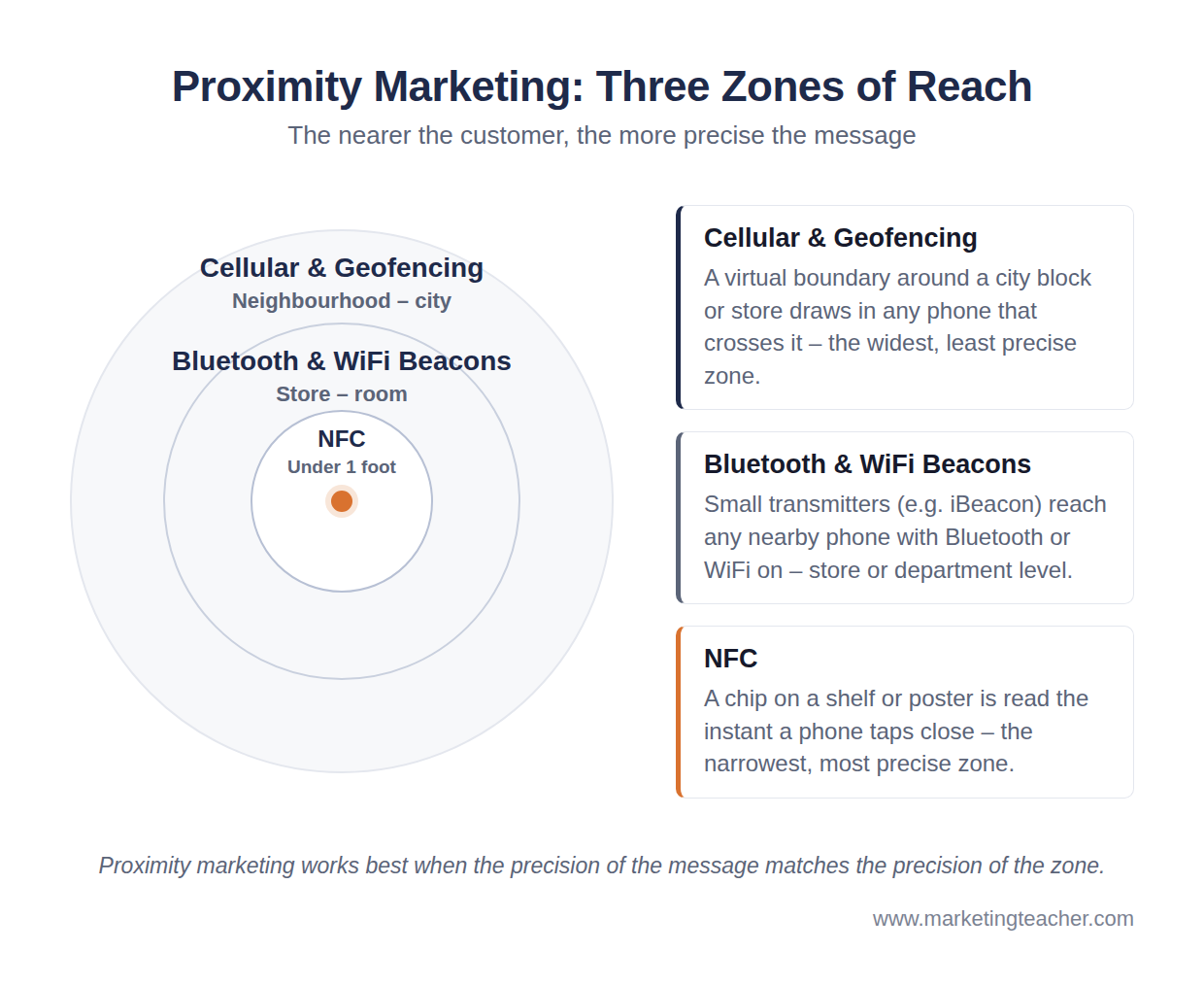
Proximity marketing is not one technology but a family of them, and each works over a different radius (Dodson, 2016). It helps to picture them as three zones around a customer, widening out from an almost-touching distance to an entire neighbourhood.
The widest zone relies on a phone’s connection to a mobile network or GPS. A business can draw a virtual boundary, known as a geofence, around a city block, an airport, or a country border, and trigger a message the moment a customer’s phone crosses into it – the same underlying idea a mobile network uses to warn a traveller about roaming charges the instant they land abroad.
The middle zone uses small transmitters called beacons, which broadcast a signal that any nearby phone with Bluetooth or WiFi switched on can pick up. The idea dates back to before mobile data plans were common, when a shop could use Bluetooth alone to send free content to anyone who walked into range and opted in. It found new life in 2013, when Apple built a low-energy Bluetooth beacon standard called iBeacon into its devices; a single beacon chip costs only a few dollars and can run for around two years, which is part of why beacon networks have since spread through malls, airports, and museums as well as shops (Dodson, 2016).
The narrowest zone belongs to near field communication, or NFC, which only works within about a foot of a small chip. A retailer can embed one of these chips in a poster, a shelf edge, or a product tag, and a shopper’s phone reads it the moment it passes close enough – useful for launching a specific piece of content tied to the exact spot a customer is standing in.
QR Codes: A Lower-Cost Route Into Proximity Marketing
Not every business can justify installing a beacon network, and QR codes offer a simpler, largely free alternative. A code printed on a poster, receipt, or shelf label can be scanned with a phone’s own camera and taken straight to a mobile-optimised page, a coupon, or a short video, so the barrier to entry is far lower than beacons or NFC chips (Dodson, 2016). Codes work best when they lead somewhere a customer would not have found on their own, such as an exclusive discount or bonus content, rather than to a homepage the customer could just as easily have typed in themselves.
Using Proximity Marketing Responsibly
Proximity marketing only works with a customer’s permission, and the same closeness that makes it powerful can just as easily make it feel invasive if it is overused. A shopper who receives a fresh push notification every few steps around a store is more likely to switch off Bluetooth, delete the app, or opt out altogether than to buy anything. The businesses that get the most value from proximity marketing treat location data as a way to be more useful at the right moment, rather than a licence to message constantly, and they stay transparent about what is being collected and why – which matters as much for keeping a customer’s trust as it does for complying with data protection rules such as GDPR.
Summary
Proximity marketing uses a customer’s real-time location, picked up through cellular networks and geofencing, Bluetooth or WiFi beacons, or NFC, to deliver a message scoped to wherever the customer actually is, from an entire city down to a single shelf. QR codes offer a cheaper way into the same idea for businesses that cannot justify a beacon network. The technology only pays off when it is used with permission and restraint: the goal is to be useful at the right moment, not to message someone every time they take a step.
The slides, worksheet, lesson plan and poster for this lesson are free to download and free to use in your course — no sign-up, no permission needed.

