
What Is the Speed Matrix?
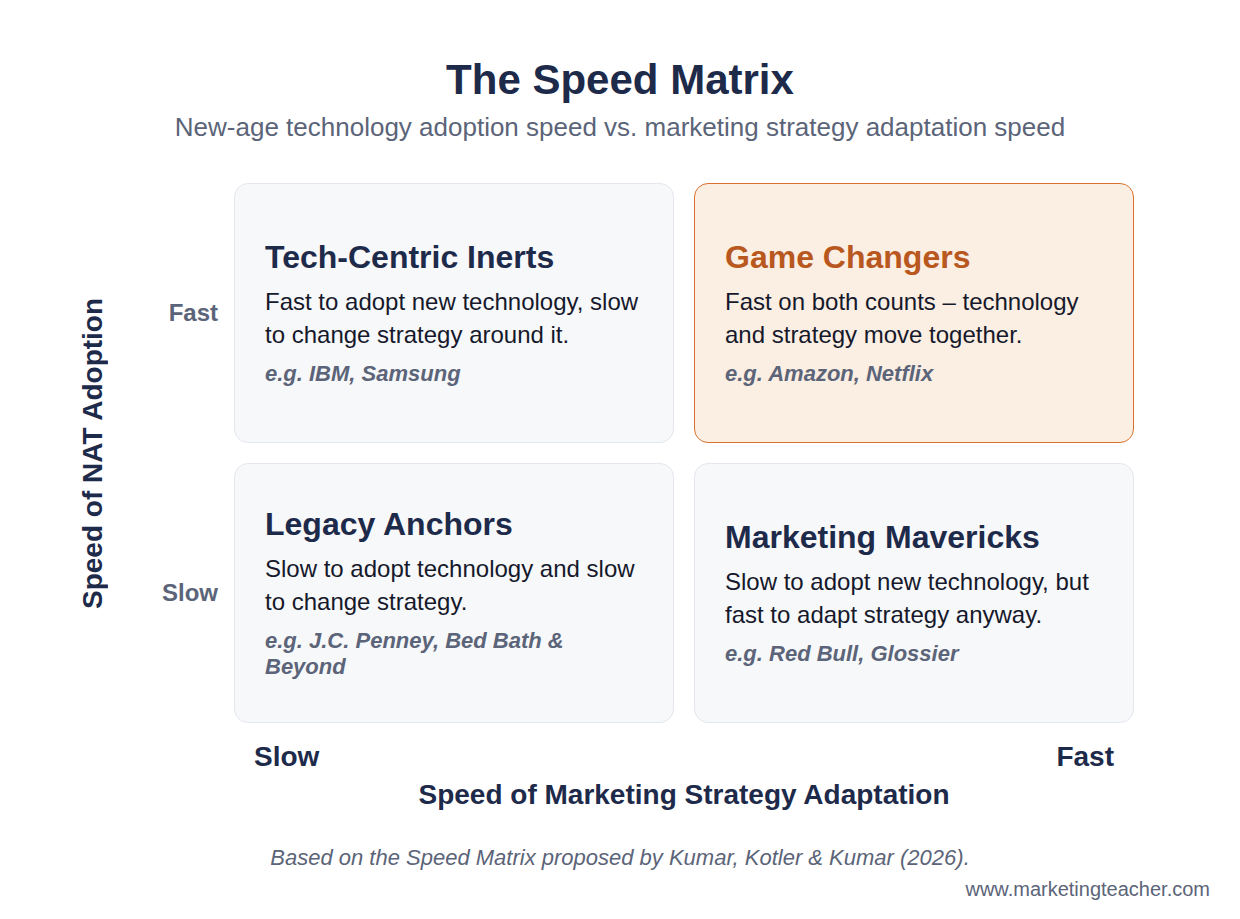
Generative AI, agentic AI, the metaverse and blockchain are often grouped together under one label: new-age technologies, or NATs. Marketing teams are under constant pressure to adopt them, but Kumar, Kotler and Kumar (2026) argue that adoption on its own proves very little. A firm can spend heavily on the latest AI tools and still lose ground if its marketing strategy – its pricing, product, promotion, distribution, selling, global market entry and innovation decisions – does not change at anything like the same pace. Their Speed Matrix is built to expose exactly that gap: it plots how fast a firm takes up NATs against how fast it actually revises its marketing strategy in response.
Two Axes, Four Quadrants
The vertical axis is the relative speed of NAT adoption – not how fast an individual algorithm responds, but the organisational pace at which a firm moves from noticing a new technology to using it at scale. Kumar, Kotler and Kumar (2026) tie this to five factors: how long implementation takes, how much a firm invests in its own digital capability, its existing digital readiness, whether its culture rewards experimentation, and how hard competitors or regulators are pushing it to move.
The horizontal axis is the relative speed of marketing strategy adaptation: how often a firm actually recalibrates its tactics, how quickly it can launch or change a campaign, how well customer feedback gets folded back into decisions, how easily budget and people move to a new priority, and whether decision-making is centralised or spread out. Crossing the two axes produces four named quadrants.
Thornfield Home Stores spends £1.6m on an AI personalisation engine that can re-price products in real time – fast NAT adoption. But its actual pricing policy is only reviewed twice a year by a committee, so the engine’s recommendations mostly sit unused. That combination of fast technology and slow strategy makes Thornfield a Tech-Centric Inert.
Its smaller rival, Bramble & Co, has no AI budget at all, but its four-person marketing team rewrites promotions every week based on what customers say on social media – about 40 changes a year, on a tools budget of under £10,000. Fast strategy, slow technology: a Marketing Maverick. Neither retailer is safe. Thornfield is paying for capability it isn’t using; Bramble is exposed the moment a better-funded competitor combines its own agility with real AI investment.
The Four Quadrants, With Real Companies
Kumar, Kotler and Kumar (2026) illustrate all four quadrants with real, named companies. Game Changers move fast on both axes: Amazon combines AI, cloud computing and robotics with dynamic pricing, automated warehouses and personalised recommendations, while Netflix adapts its content recommendations and marketing campaigns to subscriber behaviour in near real time. Tech-Centric Inerts adopt technology quickly but let their marketing strategy lag – the paper points to IBM’s heavy AI investment sitting alongside comparatively slow-moving pricing and promotion, and to Samsung launching advanced products without marketing that keeps pace. Marketing Mavericks sit in the opposite corner: Red Bull and Glossier both built strong brands through bold, experiential and social-media-driven marketing with relatively little reliance on new technology. Legacy Anchors move slowly on both fronts – J.C. Penney and Bed Bath & Beyond both struggled to modernise their pricing, promotion and distribution together, and both lost significant market share as a result. The lesson isn’t that any one quadrant guarantees success on its own – Red Bull’s marketing budget looks nothing like Amazon’s technology budget – but that a firm sitting anywhere except Game Changers is carrying a specific, nameable risk that the matrix makes visible rather than leaving it as a vague sense that “something isn’t working.”
Why Game Changers Keep Winning
The matrix isn’t just a label – it’s a diagnosis of where a firm needs to move next. Kumar, Kotler and Kumar (2026) note that a Tech-Centric Inert needs to invest in the organisational side of marketing – real-time analytics, flexible campaign management, faster feedback loops – to catch up with the technology it already owns. A Legacy Anchor faces a harder problem: it has to build speed on both axes at once, which is why the paper treats this quadrant as carrying the greatest risk of being left behind altogether. Movement toward Game Changers is not automatic – it takes deliberate alignment between what a firm invests in technologically and how its marketing decisions actually get made.
Summary
The Speed Matrix plots two things that are easy to confuse: how fast a firm takes up new-age technologies like generative AI, and how fast its actual marketing strategy changes because of them. The two speeds don’t automatically move together, and the gap between them is what puts a firm into one of four quadrants – Game Changers, Tech-Centric Inerts, Marketing Mavericks or Legacy Anchors. Naming the quadrant a firm is actually in is the first step to closing the gap that matters most – and for a marketing student, it’s a reminder that a strategy assignment about “using AI” is incomplete unless it also asks how fast the rest of the plan can realistically change to match.
The slides, worksheet, lesson plan and poster for this lesson are free to download and free to use in your course — no sign-up, no permission needed.

