
What Does Ryanair’s Marketing Mix Look Like?
Ryanair carried 208.4 million passengers in the year to March 2026 and made a profit after tax of €2.26 billion on revenue of €15.54 billion (Ryanair Holdings plc, 2026). It is Europe’s largest airline by passenger numbers, and it got there by doing one thing relentlessly: taking cost out.
What makes Ryanair worth studying is not its size. It is the coherence of the mix. Most businesses have a marketing mix in which the elements quietly contradict each other — a premium product sold on price, or a convenience promise undermined by a slow process. Ryanair’s seven elements all push the same way, and that is why the model is so hard for rivals to copy.
Product
The product is a seat on a short-haul, point-to-point flight. Nothing is included that does not have to be. There is no free checked bag, no allocated seat unless you pay, no loyalty programme in the traditional sense, and no connecting service to protect you if you miss a flight.
Behind that sits a decision most passengers never see. Ryanair flies a single aircraft family — 647 Boeing 737s, including 210 of the fuel-efficient 737-8200 “Gamechanger” variant, with 300 MAX-10 aircraft on order for delivery between 2027 and 2034 (Ryanair Holdings plc, 2026). One aircraft type means one set of spare parts, one training programme for pilots and engineers, and crews who can be moved between any two aircraft in the fleet. The product decision and the cost decision are the same decision.
Price
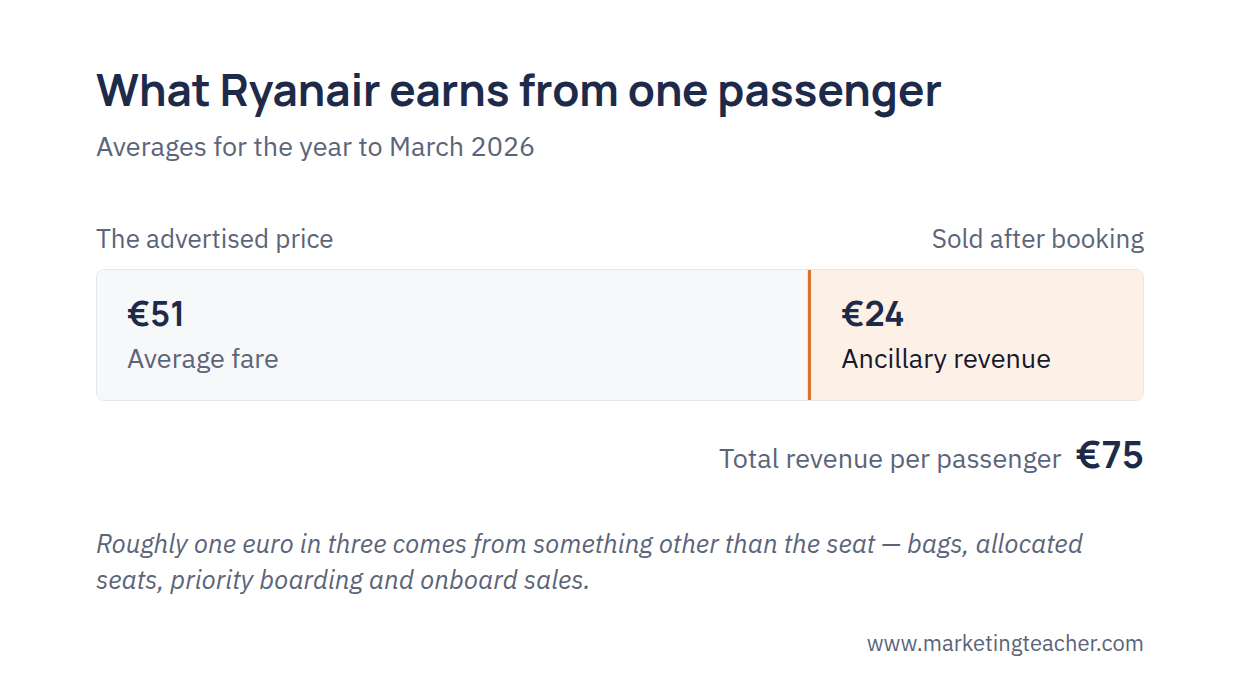
The average fare in the year to March 2026 was roughly €51. Ryanair describes its approach as load-active, yield-passive: it manages the aircraft to be full and accepts whatever yield that produces, rather than holding out for higher fares and flying with empty seats. The result was a 94 per cent load factor (Ryanair Holdings plc, 2026).
This matters because the headline fare is not really the price of the journey. It is the price of getting the passenger on board, where the rest of the mix can go to work.
Place
Ryanair sells overwhelmingly through its own website and app, and it defends that channel hard. A passenger who books direct creates a myRyanair account, which gives the airline the contact details, the payment relationship and the ability to sell to that person again.
The interesting development is the Approved OTA programme. Rather than fight every online travel agent, Ryanair now partners with selected ones — Booking Holdings, Trip.com, Omio and others — on condition that the agent passes the customer’s real contact and payment details straight through, so the passenger still lands in a myRyanair account. It is a neat piece of channel design: third parties get to sell the seats, and Ryanair keeps the customer relationship rather than renting it.
Physically, the network runs from 95 bases across 220-plus airports in 36 countries. Secondary airports have historically been part of the cost story — lower landing fees, faster turnarounds, less congestion — though the airline now operates from plenty of primary ones too.
Promotion
Ryanair spends remarkably little on conventional advertising for a company of its size. The work is done on social media, in a voice its Chief Marketing Officer describes as “straight to the point, very direct, very honest” and “cheeky, charming, and not afraid to be self-deprecating” (Skift, 2025).
The strategic logic is not just that jokes are cheap. A brand that is openly, unapologetically basic cannot disappoint you by being basic. The self-mockery does the expectation-setting that an airline promising comfort would have to spend money defending. The current line, “Low Fares, Great Care”, softens that slightly, but the underlying position has held for more than three decades (Skift, 2025).
People, Process and Physical Evidence
A flight is a service, not a product you can inspect before buying, so the standard four Ps are not enough. Booms and Bitner (1981) extended the mix with three more elements for services, and all three are visible at Ryanair.
People. Cabin crew are not only a safety and service function; they sell. Onboard retail is part of the ancillary line, and crew productivity per passenger is among the highest in European aviation. Ryanair has had well-documented disputes with unions over pay and conditions, which is part of the same cost equation and part of why the model attracts criticism.
Process. This is where the cost advantage is actually manufactured. Fast turnarounds keep aircraft in the air earning money rather than sitting at a gate. Check-in is done by the passenger, online, with a penalty for failing to do so. Boarding, baggage drop and seat selection are all self-service. Every step that the customer performs is a step Ryanair does not pay for.
Physical evidence. The blue-and-yellow livery is unmistakable, the app is the main point of contact, and the boarding pass is the proof of purchase. The on-time arrival fanfare played in the cabin is physical evidence in its purest form — an audible claim about punctuality, made at the exact moment the passenger can verify it.
Where the Model Is Under Pressure
Ryanair targets 300 million passengers a year by 2034 (Ryanair Holdings plc, 2026), which depends on aircraft arriving on time — and Boeing delivery delays have already reshaped its schedule once. European airport capacity is constrained, which limits where growth can go. And the cost discipline now extends to the fuel market: about 80 per cent of the coming year’s jet fuel was hedged at $668 per tonne (Ryanair Holdings plc, 2026), locking in a cost advantage that rivals buying at spot prices cannot match.
There is also a reputational question worth putting to students. A mix built on charging separately for things travellers once assumed were included produces real irritation, and Ryanair has monetised that irritation rather than resolving it. Whether that is sustainable is a genuinely open argument.
Summary
Ryanair’s marketing mix is a single idea expressed seven ways. Product is a deliberately stripped seat on one aircraft type. Price is a low advertised fare, managed for load rather than yield. Place is direct distribution defended through the Approved OTA programme. Promotion is cheap, loud and self-aware. People sell as well as serve, process pushes work onto the customer, and physical evidence makes punctuality audible. The elements are not independent choices; they are one choice, made seven times.
The slides, worksheet, lesson plan and poster for this lesson are free to download and free to use in your course — no sign-up, no permission needed.

