
What Is the AIDA Model?
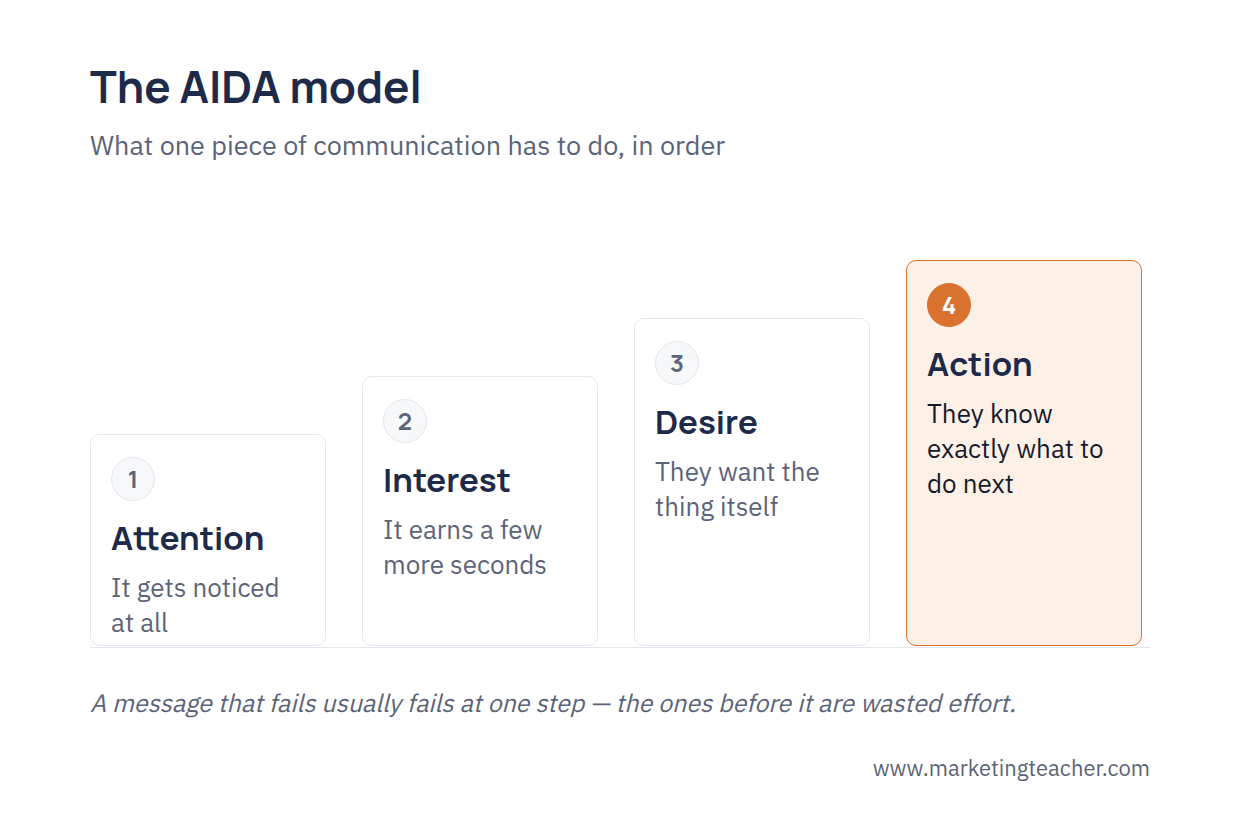
AIDA stands for attention, interest, desire and action. It describes the sequence a single piece of marketing communication has to move somebody through: first it has to be noticed, then it has to hold them long enough to say something, then it has to make them want the thing, and finally it has to get them to do something about it.
Kotler and Armstrong (2018) put it plainly: a message should get attention, hold interest, arouse desire and obtain action. It is one of the oldest ideas in marketing communications, and it has lasted because it is short enough to remember and strict enough to be useful. Chaffey and Ellis-Chadwick (2022) describe it as the classic hierarchy of response model, created originally to explain how individuals respond to advertising.
The word hierarchy is doing real work in that description. AIDA claims the stages happen in order, and that none of them can be skipped. You cannot be interested in something you have not noticed. You cannot want something you know nothing about. And almost nobody acts on a want they have not yet felt. That ordering is what makes the model useful as a diagnostic: when a piece of communication fails, it usually fails at one identifiable stage, and the stages before it are wasted effort.
Attention or Awareness?
You will see the first A written both ways, and neither is a mistake. Kotler and Armstrong (2018) use attention, describing a message that should get attention, hold interest, arouse desire and obtain action. Chaffey and Ellis-Chadwick (2022) write it as Awareness–Interest–Desire–Action.
The difference is worth understanding rather than memorising. Attention is an event: this particular advert, email or post was noticed at this moment. Awareness is a state: the audience knows the brand exists at all, whether or not they have just seen something from it. The original advertising version of the model means attention, because it was describing what a single advert has to achieve. The version you meet in digital marketing tends to mean awareness, because it is being used to describe a whole audience moving through a funnel rather than one message doing its job. If an exam question or a textbook uses one term, use theirs.
The Four Stages
Attention. The message has to be seen or heard at all. This is a competition for a fraction of a second, and it is won by the parts of the communication that work before anyone has decided to pay attention: the headline, the first frame, the subject line, the thing in the shop window.
Interest. Having been noticed, the message has to earn a few more seconds. Interest is usually won by relevance rather than by cleverness. The audience is asking, quietly, whether this has anything to do with them.
Desire. Interest is a state of mind about the message; desire is a state of mind about the product. This is where benefits do the work rather than features, and where proof, demonstration and reassurance move somebody from thinking it is interesting to wanting it.
Action. The final stage is the one most often left out. Action means telling the audience exactly what to do next and making that next step as small as possible. A message that creates real desire and then leaves people with nowhere to go has wasted everything that came before it.
What AIDA Is Actually For
It is worth being precise about the job AIDA does, because it is often stretched well past it. Kotler and Armstrong (2018) introduce the model in the part of the communication process concerned with designing a message, not the part concerned with planning a campaign or mapping a customer relationship. AIDA is a checklist for one advert, one email, one landing page, one poster.
They are also candid about how often it fully succeeds: in practice, few messages take the consumer all the way from awareness to purchase, but the framework still suggests the desirable qualities of a good message (Kotler & Armstrong, 2018). That is the honest version of AIDA. It is not a promise that a good advert produces a sale. It is a way of checking that a piece of communication has not skipped a step.
Where AIDA Runs Out
Two limitations matter, and knowing both is what separates using the model from reciting it.
The first is that four stages are a coarse description of a mind being changed. Kotler and Armstrong (2018) set out six buyer-readiness stages instead, which consumers normally pass through on the way to a purchase: awareness, knowledge, liking, preference, conviction and purchase. The extra detail matters because AIDA collapses a great deal into “desire”. Liking a brand, preferring it to a competitor, and being convinced it is the right choice are three different problems needing three different kinds of communication, and a model with one box for all three cannot tell you which one you have.
The second is that AIDA stops at the purchase. It was built to explain how somebody responds to an advertisement, and it has nothing to say about what happens afterwards. Chaffey and Ellis-Chadwick (2022) make this point directly, noting that AIDA does not relate to the overall process of digital marketing for achieving customer acquisition, retention and brand goals, and proposing RACE (reach, act, convert, engage) as a framework that follows the whole customer lifecycle rather than a single message. Where AIDA ends at the sale, RACE keeps going into retention.
Neither limitation makes AIDA wrong. They define its range. It is a good model of a message and a poor model of a relationship.
Summary
AIDA breaks a piece of marketing communication into four stages that have to happen in order: attention, interest, desire and action. Its value is diagnostic, because a message that is not working is almost always failing at one identifiable stage while the others are doing their jobs. Its limits are equally clear: four stages compress a lot of persuasion into one box called desire, and the model says nothing at all about what happens after somebody buys. Used for what it is, a checklist for a single message, it remains one of the most useful ideas in marketing communications.
The slides, worksheet, lesson plan and poster for this lesson are free to download and free to use in your course — no sign-up, no permission needed.

