
What Is Digital Sales Promotion?
Sales promotion is classically defined as a short-term incentive designed to encourage the purchase of a product or service (Kotler and Armstrong, 2018), and digital sales promotion is simply that same idea delivered online, designed to encourage an immediate action, such as a purchase, a sign-up, or a share, rather than to build a brand’s image over a longer period the way content marketing typically does. Almost every offline sales promotion technique, from a discount voucher to a free trial, has a digital equivalent, and many now exist only online. Because digital sales promotion is usually easy to track, an advertiser can measure precisely how many people redeemed a code, entered a contest, or claimed a free trial, which makes it simple to test one promotional idea against another (Chaffey and Ellis-Chadwick, 2019).
Classifying Common Digital Sales Promotion Techniques
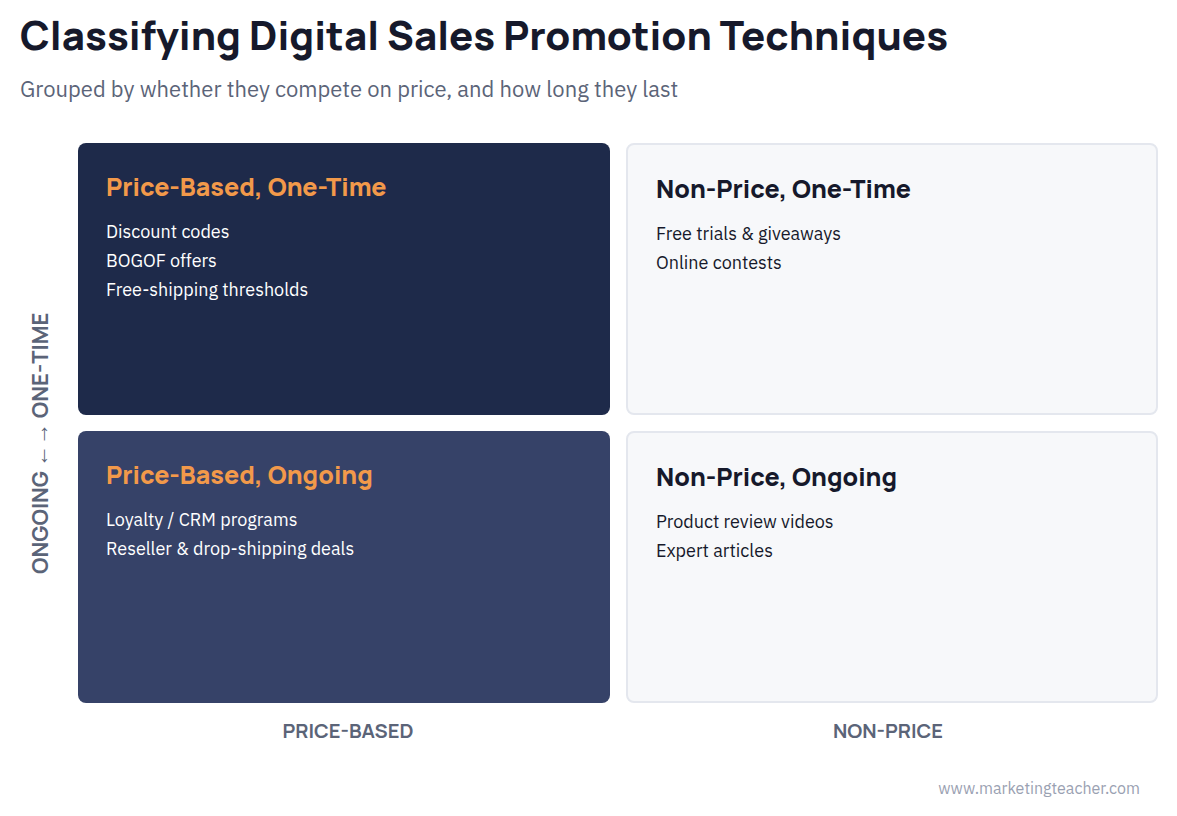
Digital sales promotion techniques differ along two useful dimensions: whether they are based on price or on something else, and whether they are a one-time offer or part of an ongoing relationship with the customer. Price-based, one-time techniques include discount codes, Buy One Get One Free (BOGOF) offers, and free-shipping thresholds. Price-based, ongoing techniques include loyalty programs integrated with customer relationship management (CRM) systems, and reseller or drop-shipping arrangements where a supplier’s product is sold at a promotional rate through another retailer’s site. Non-price, one-time techniques include free trials, giveaways, and online contests or competitions. Non-price, ongoing techniques include product review videos, expert articles, and other content built specifically to promote a product indirectly rather than through a straightforward discount.
Why Sales Promotions Need a Clear Purpose
A price-based promotion, such as a discount code or a site-wide sale, can quickly generate a spike in sales, but running these too often risks training customers to wait for the next discount rather than buying at full price, which can erode a brand’s margins and its perceived value over time. A well-designed sales promotion campaign usually has a specific, limited purpose, such as clearing older stock, encouraging a first purchase from a new customer, or increasing average order value, rather than being used as a routine substitute for regular pricing. Combining a promotion with other digital marketing communications, such as email marketing to announce it to existing subscribers, generally performs better than running the promotion in isolation.
Measuring Whether a Promotion Actually Worked
Because digital sales promotions are so easy to track, it is worth measuring more than just the redemption rate, the proportion of people who actually used a code or claimed an offer. A promotion that generates a large number of redemptions can still be a poor result if most of those sales would have happened anyway at full price, a problem known as cannibalization. A more useful comparison is incremental sales, the additional revenue a promotion generated above what the business would reasonably have expected without it, set against the cost of running the promotion itself, including any margin given up through the discount. Tracking this properly usually means comparing the promotional period against a similar period without a promotion, or against a control group of customers who were not shown the offer at all.
Choosing Techniques That Fit the Goal
The right technique depends heavily on what the promotion is actually meant to achieve. A business trying to acquire new customers might favor a free trial or a giveaway, since both let a prospective customer experience the product with little risk before committing to pay. A business trying to retain existing customers is usually better served by a loyalty program, since it rewards repeat behavior rather than simply discounting the next purchase. A business with excess inventory to clear might run a straightforward, clearly time-limited discount, since urgency is the main lever needed rather than any deeper engagement. Sites such as Groupon still operate on the coupon and voucher model for businesses wanting broad, one-time exposure to a new audience, while free-shipping incentives, long used by large retailers such as eBay and Amazon, remain one of the most consistently effective price-based promotions precisely because shipping cost is such a common reason for an online shopper to abandon a purchase.
Summary
Digital sales promotion covers any short-term, trackable incentive delivered online (Kotler and Armstrong, 2018), from discount codes and free trials to loyalty programs and contests, and these techniques can be classified by whether they compete mainly on price and whether they are one-time or ongoing. Choosing the right technique for a specific goal, such as acquiring new customers or clearing stock, and combining it with other digital marketing communications such as email marketing, generally performs better than running a promotion in isolation or relying on price-based discounting as a routine substitute for regular pricing.

