
What Is Content Marketing?
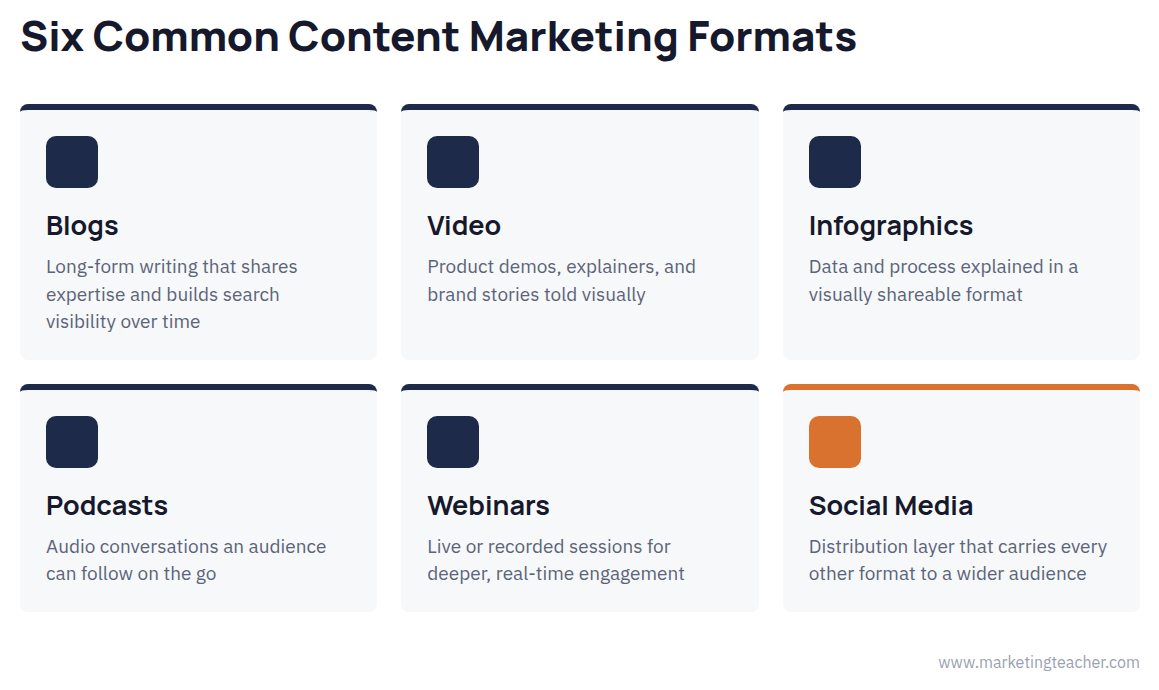
Content marketing is the creation and sharing of valuable, relevant material, text, video, images, or anything else a visitor might engage with, in order to attract and hold an audience’s attention and support a longer-term relationship with them, rather than pushing a direct sales message. The Content Marketing Institute (2021) describes it as a strategic approach built on consistently providing content an audience genuinely values, on the understanding that trust and engagement earned this way eventually drive profitable customer action. Unlike a single advert, a piece of content marketing rarely asks for a sale outright; its job is to be useful, informative, or entertaining enough that the audience keeps coming back, and keeps the brand in mind when they are ready to buy.
Where Content Marketing Happens
Content marketing is not limited to a single platform. It might live on a social network such as Facebook, as audio or video streaming through a service like Spotify or YouTube, as long-form writing on a blog or company website, as a collaboratively maintained knowledge resource like Wikipedia, or as a product listing surfaced through a shopping-focused search tool like Google Shopping. It can also spread through community and sharing platforms such as Reddit and Pinterest, where an audience actively discovers and redistributes content it finds valuable. The common thread across all of these channels is that the audience chooses to engage with the content rather than having it forced upon them, which is precisely what separates content marketing from traditional advertising.
Choosing the Right Content and Channel
Before producing content, a marketer needs to work through a series of practical questions. How does the target audience actually access content: through traditional print media, a single social network, or several platforms at once? How will they participate once they find it: by playing a game, posting a comment, or forwarding it to a friend? Can the content be syndicated elsewhere, for example through an RSS feed that lets other sites embed it automatically? And which medium genuinely suits the audience and the connection they are likely to have, since a rich video file downloads very differently over a fast home Wi-Fi connection than over a mobile data connection, particularly in markets where connection speeds vary widely? Answering these questions properly, rather than defaulting to whichever format is easiest to produce, is usually what separates content that gets ignored from content that actually gets consumed.
Measuring Whether Content Marketing Is Working
Because content marketing rarely asks for an immediate sale, it needs a different way of judging success than a direct-response advert does. Raw reach numbers, such as how many people saw or shared a piece of content, are easy to measure but can be misleading on their own: a video that reaches a million uninterested viewers is usually worth less than one watched all the way through by a thousand people who genuinely care about the topic. More useful signals include how long someone actually spends with the content, whether they return for more of it later, and whether people who engage with the content go on to become customers at a higher rate than those who never encountered it at all. Tracking that longer path, from first genuine engagement through to an eventual purchase, is harder than counting likes or views, but it is the only way to know whether the content is actually building the kind of trust it is meant to build, rather than just generating noise.
Summary
Content marketing is the creation and sharing of genuinely valuable content, across channels ranging from blogs and social networks to video, podcasts, and webinars, in order to attract and hold an audience’s attention over the long term. The Content Marketing Institute (2021) frames this as a strategic approach built on trust rather than direct selling, while HubSpot (2021) highlights just how many different formats that trust can be built through. Choosing the right format and channel for a specific audience, rather than defaulting to whatever is easiest to produce, is what determines whether content marketing actually builds a lasting relationship with customers.
The slides, worksheet, lesson plan and poster for this lesson are free to download and free to use in your course — no sign-up, no permission needed. See the teacher resources →
Assign this lesson to your class:
Using Canvas, Blackboard or Moodle? Copy the link and paste it into your course page or assignment. More ways to add lessons to your LMS.

