
What Is Social Media Advertising?
Social media advertising is paid promotion delivered inside a social media platform, such as Facebook, Instagram, LinkedIn, or X (formerly known as Twitter), rather than on the open web the way display advertising is. It differs from ordinary organic social media activity, where a business posts content for free and hopes its existing followers see it, because a paid advert can be shown to people who have never followed or even heard of the business before. Because social platforms hold detailed, first-party data about their own users, gathered directly from what people like, share, follow, and click, social media advertising can target an audience with a precision that most other advertising channels struggle to match.
How Social Platforms Narrow a Broad Audience Down to a Specific Person
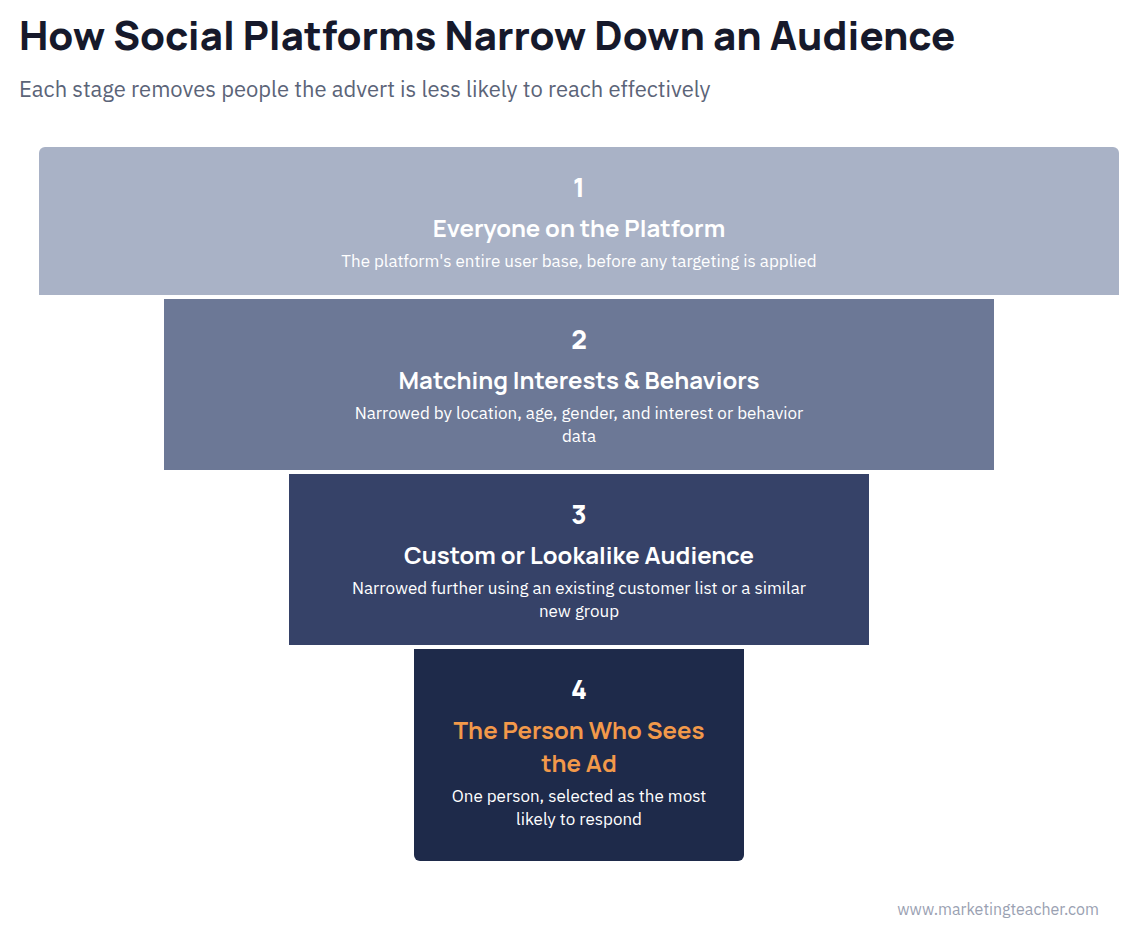
Every social platform starts with its entire user base and narrows that audience down in stages before an advert is finally shown. An advertiser first chooses broad targeting criteria, such as location, age, gender, or a general interest category, and the platform can narrow this further using a custom audience, a list of existing customers uploaded by the advertiser, or a lookalike audience, a new group of people the platform’s own algorithm identifies as sharing similar characteristics with that existing customer list (Tuten and Solomon, 2017). The result is that two people using the same platform at the same moment can be shown completely different adverts, each one selected because the platform’s data suggests that particular person is more likely to respond to it.
Choosing the Right Platform and Ad Format
Different social platforms suit different goals and audiences, so the format of a social media advert usually needs to match the platform it appears on. Instagram and TikTok favor short, visual, often vertical video content designed to be watched in a feed or between Stories, and tend to work well for consumer brands. LinkedIn advertising is generally better suited to business-to-business campaigns, where the platform’s professional targeting data, such as job title or industry, is more useful than the interest-based targeting typical of consumer platforms. Meta Ads Manager, the tool now used to build and manage advertising campaigns across both Facebook and Instagram, offers a genuinely quick way to launch a first campaign, though many businesses with larger budgets choose to work with a specialist social media advertising agency instead.
Measuring Whether a Social Media Campaign Is Working
Most social media advertising platforms report the same core metrics: reach, the number of people the advert was shown to; click-through rate, the proportion of people who saw the advert and then clicked it; and cost per result, which might mean cost per click, cost per booking, or cost per sale depending on what the advertiser actually wants the campaign to achieve. A campaign with a high click-through rate but a poor conversion rate once people land on the business’s own website usually points to a mismatch between what the advert promised and what the landing page actually delivers, rather than a problem with the targeting itself. Checking these numbers regularly, rather than only at the end of a campaign, lets a business adjust its targeting, budget, or creative while the campaign is still running.
Weighing the Benefits and Risks of Social Media Advertising
Social media advertising offers real advantages: precise, first-party audience targeting, a comparatively low barrier to entry for a small business, and the possibility that a well-received advert gets extra, free reach through likes, comments, and shares on top of what was actually paid for. Against this, a business running social media advertising is dependent on a platform it does not control: a change to a platform’s algorithm, its advertising policies, or its available targeting options can affect a campaign’s performance overnight, through no fault of the advertiser. Audiences can also grow fatigued by seeing the same advert repeatedly, and, as with display advertising, an advert that is technically well-targeted can still be ignored if it is poorly designed or irrelevant to the mood of the platform it appears on.
Summary
Social media advertising is paid promotion delivered inside a platform such as Facebook, Instagram, LinkedIn, or X, using the platform’s own first-party data to narrow a broad audience down to a custom or lookalike group most likely to respond (Tuten and Solomon, 2017). Choosing the right platform and ad format for the campaign’s goal matters as much as the targeting itself, and tools such as Meta Ads Manager make launching a first campaign straightforward. Used well, as in a small local business targeting a narrow, relevant audience, social media advertising can be highly cost-effective, but because it depends on a platform’s own algorithm and policies, it carries real risks that a business running the campaign cannot fully control (Chaffey and Ellis-Chadwick, 2019).
See also: Content Marketing
The slides, worksheet, lesson plan and poster for this lesson are free to download and free to use in your course — no sign-up, no permission needed.

