
What Is Email Marketing?
Email marketing is a form of direct digital communication in which a business sends electronic messages to a list of subscribers, customers or prospects with the aim of informing, engaging or persuading them (Chaffey and Smith, 2017). A single email might carry a product announcement, a discount code, an invitation to a webinar, or simply a useful piece of content, but every email marketing message shares the same underlying goal: to move the recipient a step closer to some desired action, whether that is a first purchase, a repeat purchase, or simply staying engaged with the brand. Because a business owns its email list outright, rather than renting attention on a platform it does not control, email marketing gives marketers a direct line to their audience that survives changes to a social platform’s algorithm, policies or advertising costs.
Why Email Marketing Still Works
Despite competition from social media, messaging apps and paid search, email remains one of the most cost-effective channels available to marketers. Rettie (2002) identifies several factors behind its enduring success: it is inexpensive to send at scale compared with print or broadcast media, it reaches almost anyone with an internet connection regardless of which social platforms they personally use, and unlike a message posted to a shared social feed, it is delivered directly and privately to an individual inbox rather than competing for attention in an algorithmically ranked timeline. Modern email platforms add a further advantage that Rettie’s original account could only anticipate: near-total measurability. A marketer can see exactly how many recipients opened a message, clicked a link, or went on to complete a purchase, and can use that data to refine subject lines, timing and content before the very next campaign, something far harder to do with a printed mailshot or a billboard.
Email Marketing and Customer Relationship Management (CRM)
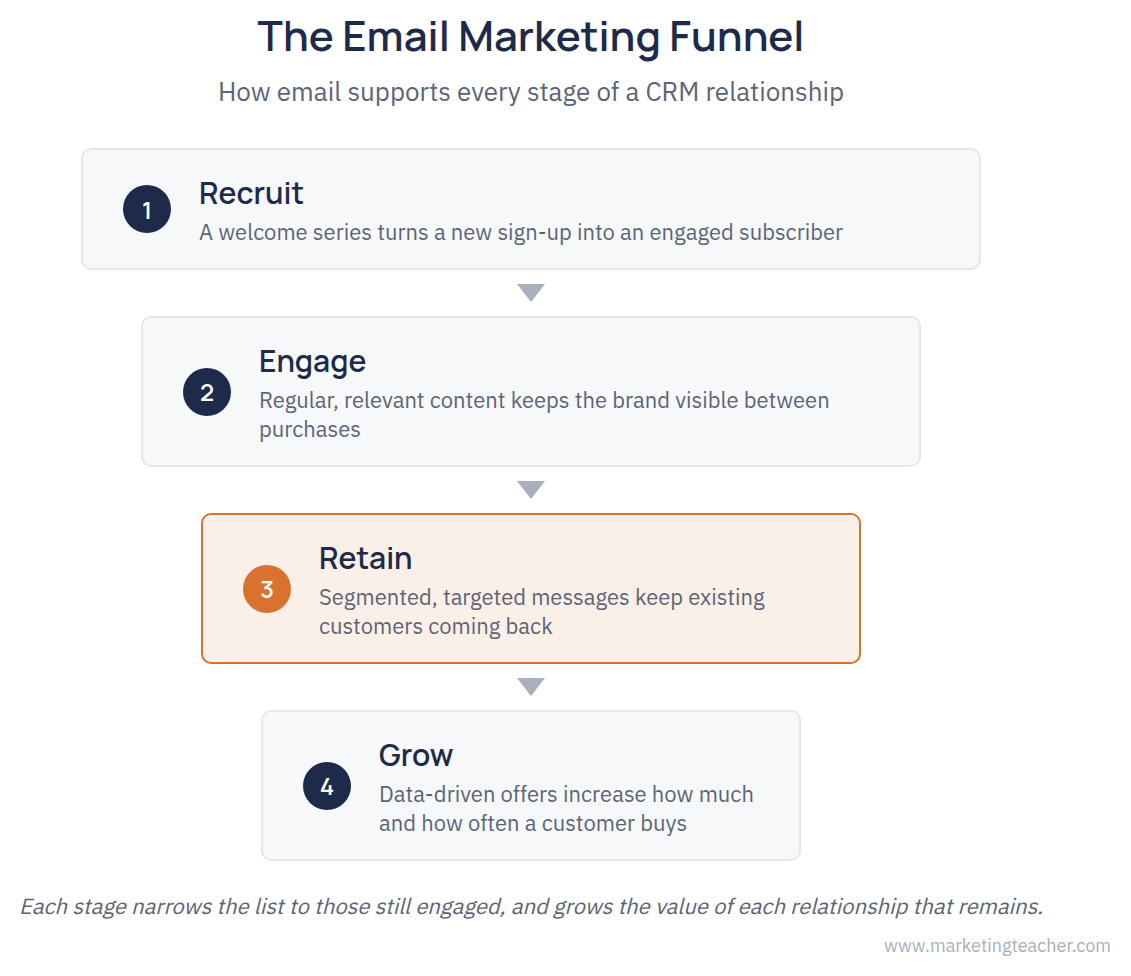
Email marketing is one of the main tools a business uses to put a customer relationship management (CRM) strategy into practice. CRM is concerned with building, maintaining and growing long-term relationships with customers rather than treating every sale as a one-off transaction, and email supports every stage of that relationship. A welcome series recruits a new subscriber into the relationship; regular, relevant newsletters retain existing customers by keeping the brand visible between purchases; and targeted offers based on past purchase behaviour grow the value of a relationship over time by encouraging a customer to buy more, or more often, than they otherwise would. Because most email platforms integrate directly with a business’s customer database, the same list that drives a single campaign can also become a live, ongoing record of how engaged each individual customer currently is.
Building an Effective Email Campaign
A handful of practical principles separate an email campaign that gets read from one that gets deleted unopened. Segmentation matters more than volume: a list split by past purchase, engagement level or stated interest lets a business send a more relevant message to each group, rather than one generic email to an entire list regardless of relevance. The subject line does most of the work of getting an email opened at all, so it needs to be specific and give a genuine reason to open it rather than resorting to vague hype that recipients quickly learn to ignore. Every email should carry one clear call to action rather than several competing requests, since a recipient asked to do too many things at once often ends up doing none of them. Consent also matters for reasons beyond simple courtesy: an email list built from genuine opt-ins, rather than purchased or scraped contacts, is both more likely to engage and less likely to be filtered as spam before it ever reaches an inbox. Finally, a business that treats each campaign as a small experiment, testing one variable such as a subject line, image or send time against a previous version, improves its results incrementally at almost no added cost.
Summary
Email marketing is the direct sending of electronic messages to a list of subscribers or customers to inform, engage or persuade them, and it remains one of the most cost-effective digital marketing channels precisely because it is direct, measurable, and independent of any single platform’s rules or algorithm. It supports customer relationship management by recruiting new subscribers, retaining existing customers through regular contact, and growing customer value through targeted, relevant offers. A well-run campaign depends less on sending more emails than on segmenting the list, writing subject lines that earn an open, giving each message one clear action, and testing continuously to improve results over time.

The slides, worksheet, lesson plan and poster for this lesson are free to download and free to use in your course — no sign-up, no permission needed. See the teacher resources →
Assign this lesson to your class:
Using Canvas, Blackboard or Moodle? Copy the link and paste it into your course page or assignment. More ways to add lessons to your LMS.

