
What Is Digital Public Relations?
Digital public relations (digital PR) is the use of digital and social technologies to manage a company’s reputation and public understanding of its brand, through the deliberate, purposeful influence of exposure across digital media (Chaffey and Ellis-Chadwick, 2019). It draws on many of the same tools covered elsewhere in digital marketing, since content marketing, permission marketing, and ongoing customer engagement all sit close to the centre of a public relations effort, alongside more traditional public relations tools such as the media release or press release, now distributed digitally rather than by post or fax. Traditional media, such as newspapers, television, and magazines, still matter in a digital PR strategy too, since a story that first appears online is often picked up and amplified by these more established outlets, extending its reach well beyond the audience it originally reached on social media or a company blog.
Classifying Digital PR Techniques as Paid, Owned, or Earned Media
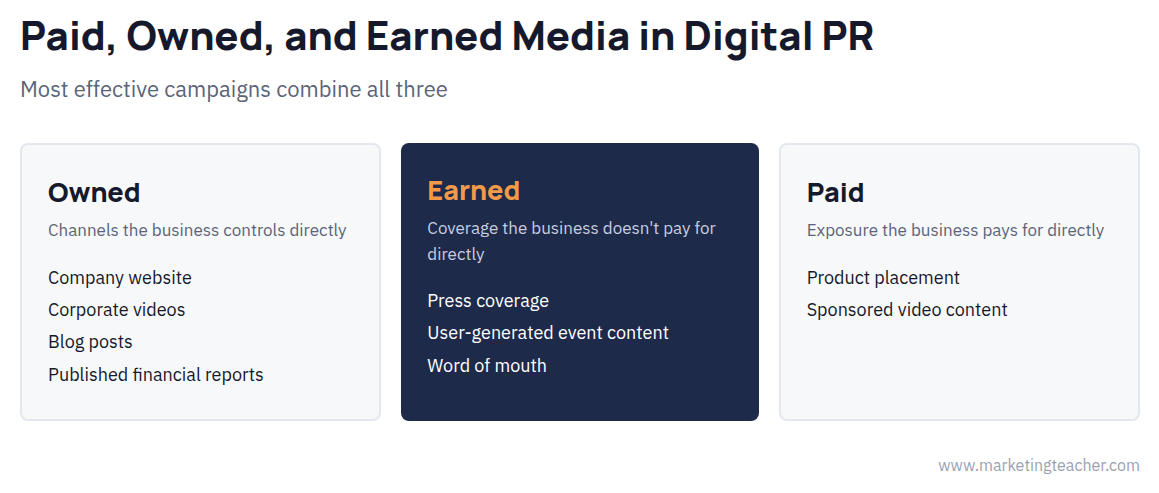
A useful way to organize digital PR techniques is the paid, owned, and earned media framework (Forrester Research, 2009). Owned media is anything a business controls directly, such as its own website, corporate videos, blog posts, and published financial reports. Earned media is coverage or attention a business does not pay for directly, such as a press release picked up by a news outlet, user-generated content from a publicity event shared on social media, or word of mouth generated by a charitable partnership. Paid media includes techniques such as product placement in a game or film, and sponsored video content, where a business pays directly for the exposure rather than earning or owning it. Most real digital PR campaigns deliberately combine all three, since owned content gives a business something to point to, earned coverage lends it independent credibility, and paid placement fills in the reach that owned and earned media alone cannot guarantee.
Measuring Whether Digital PR Is Working
Because earned media cannot simply be bought in a set quantity the way advertising can, measuring digital PR is less straightforward than measuring a paid campaign, but it is not impossible. The simplest metric is the number of media mentions a story generates, though this on its own says little about quality or impact. A more useful measure is referral traffic, the number of visitors who click through to a business’s own website from an article or social post about it, since this shows how many people a piece of coverage actually moved to action rather than merely reached. Larger organizations also track sentiment, whether the coverage a story generates is broadly positive, negative, or neutral, and share of voice, the proportion of all coverage on a topic that mentions their own brand compared with competitors. A digital PR campaign that generates a large number of mentions but consistently negative sentiment is generally a worse outcome than a smaller number of mentions that are strongly positive.
Digital Lobbying and Its Reputational Risks
Lobbying, in which individuals or organizations attempt to influence politicians or policy on a specific issue, is one of the more reputationally sensitive forms of digital public relations. An industry trade body representing a particular sector, for example, might run a digital lobbying campaign combining a dedicated website, a social media presence, and customer surveys or polls designed to demonstrate public support for its position to policymakers. Because lobbying is inherently about persuading people in positions of power on a contested issue, it tends to attract far more public scrutiny and criticism than other forms of digital PR, and a lobbying campaign that appears to misrepresent public opinion, or that becomes public before an organization intended it to, can damage the very reputation the wider public relations effort was meant to protect.
Summary
Digital public relations uses digital and social technologies to manage a company’s reputation and public understanding of its brand (Chaffey and Ellis-Chadwick, 2019), and its techniques can be classified as owned media, earned media, or paid media (Forrester Research, 2009), with most effective campaigns combining all three. Earned media, such as a press release that gets picked up more widely than expected, often delivers reach and credibility that owned channels alone cannot match, while techniques such as digital lobbying carry reputational risks that a business needs to weigh carefully before pursuing them.

