
What Is Permission Marketing?
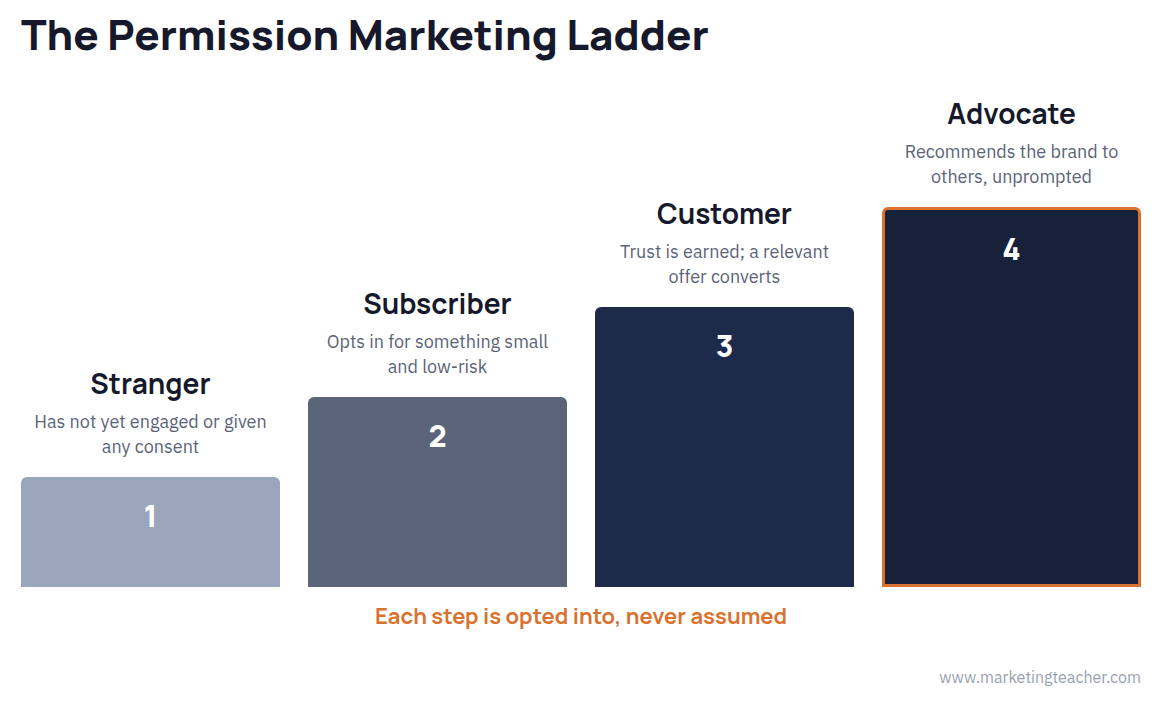
Permission marketing is a term coined by Seth Godin (1999) in his book Permission Marketing: Turning Strangers into Friends, and Friends into Customers. The concept is simple: rather than interrupting people with unsolicited adverts, a business asks for a customer’s permission first, most commonly by having them opt in or sign up, and then earns the right to keep communicating with them over time. In the earliest days of email marketing, that permission was often as basic as agreeing to receive a newsletter. Today, with far more channels and far more regulation around consent, permission marketing has grown into something broader: an ongoing, two-way relationship built on communication, conversation, and genuine participation, not a one-time box ticked at sign-up.
Why Permission Marketing Works
Godin’s original argument centred on a simple observation: consumers were already exposed to an overwhelming volume of marketing messages every single day, from adverts on television and in the street to banners on nearly every website they visited. That volume has, if anything, grown substantially since 1999 across digital channels alone. Godin called the traditional approach “interruption marketing,” competing for attention by inserting a message wherever an audience happened to be, regardless of whether they wanted it. Permission marketing works because it does the opposite: it earns attention rather than demanding it, so the messages that do get through are ones the recipient has already agreed they want to receive. This is also why a permission-based list, even a small one, is usually worth more to a business than a much larger list acquired without genuine consent: engagement and trust matter more than raw reach.
Permission Marketing and Today’s Opt-In Rules
What was once a matter of good practice is now, in many markets, also a matter of law. Chaffey and Ellis-Chadwick (2019) note that modern data protection regulation, including the EU’s General Data Protection Regulation and similar rules elsewhere, requires businesses to obtain clear, informed, and specific consent before sending marketing communications, and to make withdrawing that consent just as easy as giving it. A genuine double opt-in, where a new subscriber confirms their email address after signing up, is now standard practice precisely because it protects both the subscriber and the business: it proves consent was real, reduces spam complaints, and keeps a list made up of people who actually want to hear from the business. Godin’s original insight, that permission has to be earned rather than assumed, turns out to have anticipated a regulatory environment that now requires exactly that.
Permission Marketing Is Not the Same as Spam
It is worth being precise about the difference between permission marketing and spam, since the two are sometimes confused. Spam is marketing sent without any genuine consent, often to a purchased or scraped list, frequently with a misleading subject line designed to get the message opened under false pretences. Permission marketing is the deliberate opposite of this on every count: the recipient asked to be there, the subject line accurately describes what is inside, and unsubscribing is simple and immediate, not buried behind a confusing process. In the United States, the CAN-SPAM Act has required commercial email to meet exactly these standards, including an honest subject line and a working, easy opt-out, since 2003, well before Godin’s original argument became conventional wisdom in digital marketing. A business that treats these requirements as a compliance checkbox rather than the whole point of permission marketing is missing what made the concept work in the first place: people stay subscribed, and stay receptive, because they trust that the relationship is genuinely theirs to end at any time.
Summary
Permission marketing, a term coined by Seth Godin (1999), argues that businesses should earn the right to communicate with customers through opt-in consent rather than interrupting them with unsolicited messages. Building that permission in careful stages, starting with a small, low-risk request and only introducing an offer once trust is established, produces a smaller but far more engaged and responsive audience. Chaffey and Ellis-Chadwick (2019) point out that this approach is no longer just good practice: modern data protection regulation now legally requires the kind of clear, specific, and revocable consent that permission marketing was built around from the start.
The slides, worksheet, lesson plan and poster for this lesson are free to download and free to use in your course — no sign-up, no permission needed. See the teacher resources →
Assign this lesson to your class:
Using Canvas, Blackboard or Moodle? Copy the link and paste it into your course page or assignment. More ways to add lessons to your LMS.

