
What Is the Digital Marketing Communications Mix?
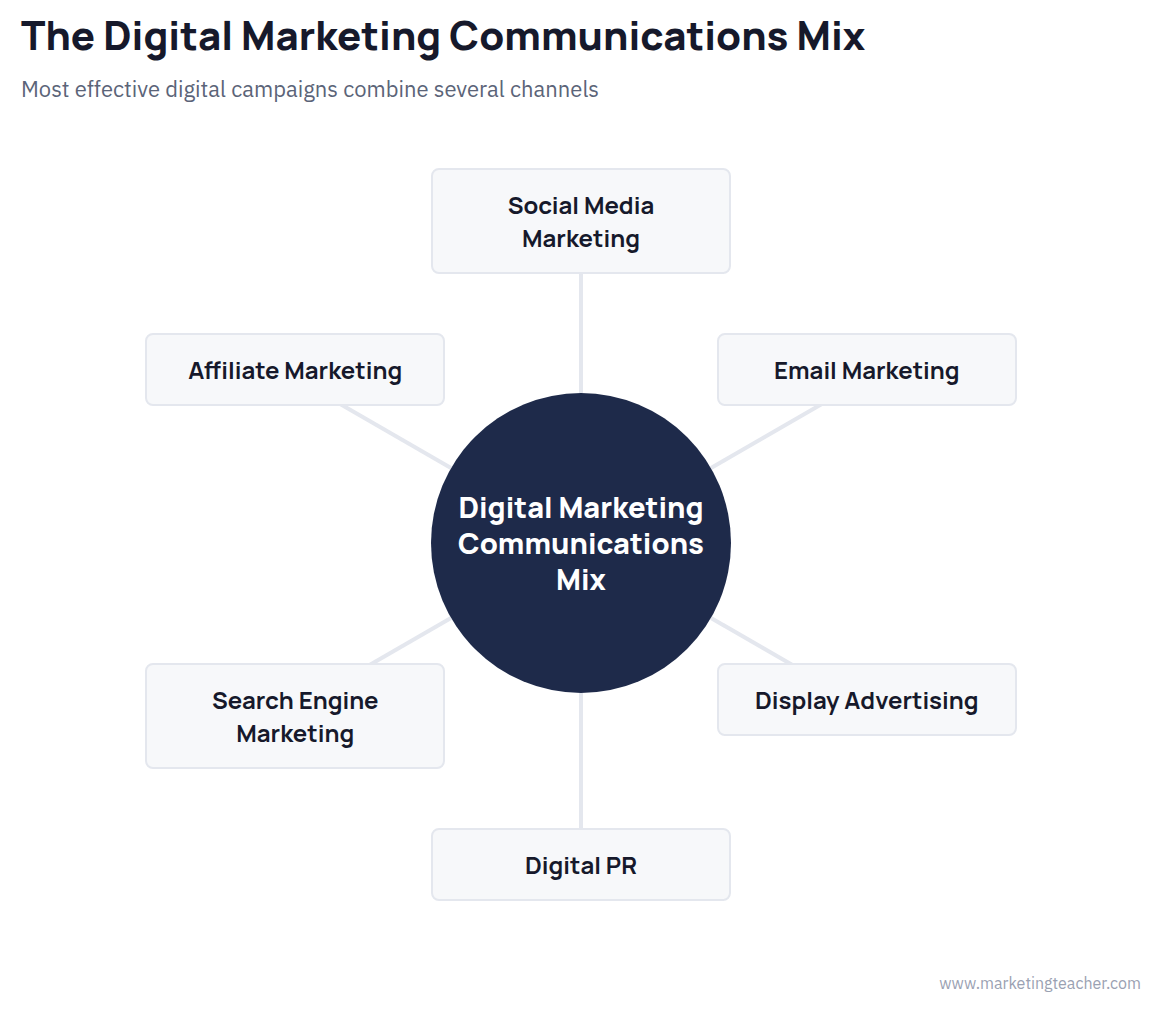
The traditional marketing communications mix combines tools such as advertising, public relations, sponsorship, personal selling, direct marketing, and sales promotion to reach and persuade an audience (Kotler and Armstrong, 2018). The digital marketing communications mix is the online equivalent: the same underlying goals, pursued through digital media channels that did not exist when the traditional mix was first defined (Chaffey and Ellis-Chadwick, 2019). Most of these digital channels have a direct off-line ancestor, such as digital public relations standing in for a traditional press release, but a few, such as search engine marketing and affiliate marketing, have no close off-line equivalent at all and are genuinely native to the digital environment.
The Channels That Make Up the Mix
A typical digital marketing communications mix draws on several channels at once, each covered in its own detail elsewhere on this site. Social media marketing reaches an audience inside platforms such as Facebook, Instagram, and X, often using the platform’s own ad-buying tools to narrow a broad audience down to a specific type of person. Email marketing reaches people who have already agreed to hear from a business, typically through an opt-in sign-up, making it one of the more cost-effective channels once a list has been built. Display advertising covers the banner, image, and video adverts a visitor sees on other websites, usually bought through a program such as Google Ads. Digital public relations manages a business’s reputation and public image online, and search engine marketing works to gain a business the best possible position in search results for the terms its customers actually search. Affiliate marketing pays independent site owners a commission for sales or leads they generate on a business’s behalf.
Why the Channels Need to Work Together
A customer rarely encounters just one digital channel before making a decision; they might notice a display advert, later see the same product mentioned by a friend on social media, and eventually search for the brand by name before buying. Integrated marketing communications is the principle that every channel in the mix should carry a consistent message, tone, and visual identity, so that each new encounter reinforces the last one rather than confusing the customer with a different story every time (Kotler and Armstrong, 2018). A business that runs a cheerful, discount-led social media campaign while its email marketing takes a formal, premium tone is working against itself, even if both channels individually perform well by their own metrics. Keeping the channels aligned is as much a part of managing the mix as choosing which channels to use in the first place.
Choosing the Right Mix for the Goal
There is no single correct communications mix; the right combination depends on the goal, the audience, and the budget available. A business trying to build broad awareness of a new product might lean more heavily on display advertising and social media marketing, since both can reach a large audience quickly. A business trying to convert people who are already close to a purchase decision might lean more heavily on search engine marketing and affiliate marketing, since both tend to reach people actively looking for a solution rather than simply browsing. Email marketing sits well alongside either goal, since it can nurture new contacts toward a first purchase or bring existing customers back for a repeat one. Tracking which channel actually drove a result, rather than assuming based on total spend or reach, is essential to refining the mix over time, since a channel that reaches the most people is not always the channel that converts the most of them. Simple tools such as unique tracking links for each channel, or comparing cost per click-through against cost per completed sale, are usually enough to show which parts of the mix are pulling their weight and which are quietly underperforming.
Summary
The digital marketing communications mix is the online equivalent of the traditional marketing communications mix (Kotler and Armstrong, 2018), made up of digital media channels such as social media marketing, email marketing, display advertising, digital public relations, search engine marketing, and affiliate marketing (Chaffey and Ellis-Chadwick, 2019). There is no single right combination of these channels; the best mix depends on the business’s goal, audience, and budget, and is refined over time by tracking which channels actually deliver results rather than simply which ones reach the most people.
The slides, worksheet, lesson plan and poster for this lesson are free to download and free to use in your course — no sign-up, no permission needed.

