
Learning outcome
What Is Customer Lifetime Value (CLV)?
Every customer a business serves is worth more than the receipt in their hand. Customer lifetime value (CLV) is an estimate of the total value a customer will bring to a business over the whole of their relationship with it — not just today’s purchase, but every purchase they’re likely to make for as long as they keep buying (Kotler & Armstrong, 2018). It’s one of the most useful numbers in marketing, because it forces a business to think beyond the next sale and ask a far more valuable question: what is this relationship actually worth, and how much is it worth spending to keep it?
How CLV is estimated
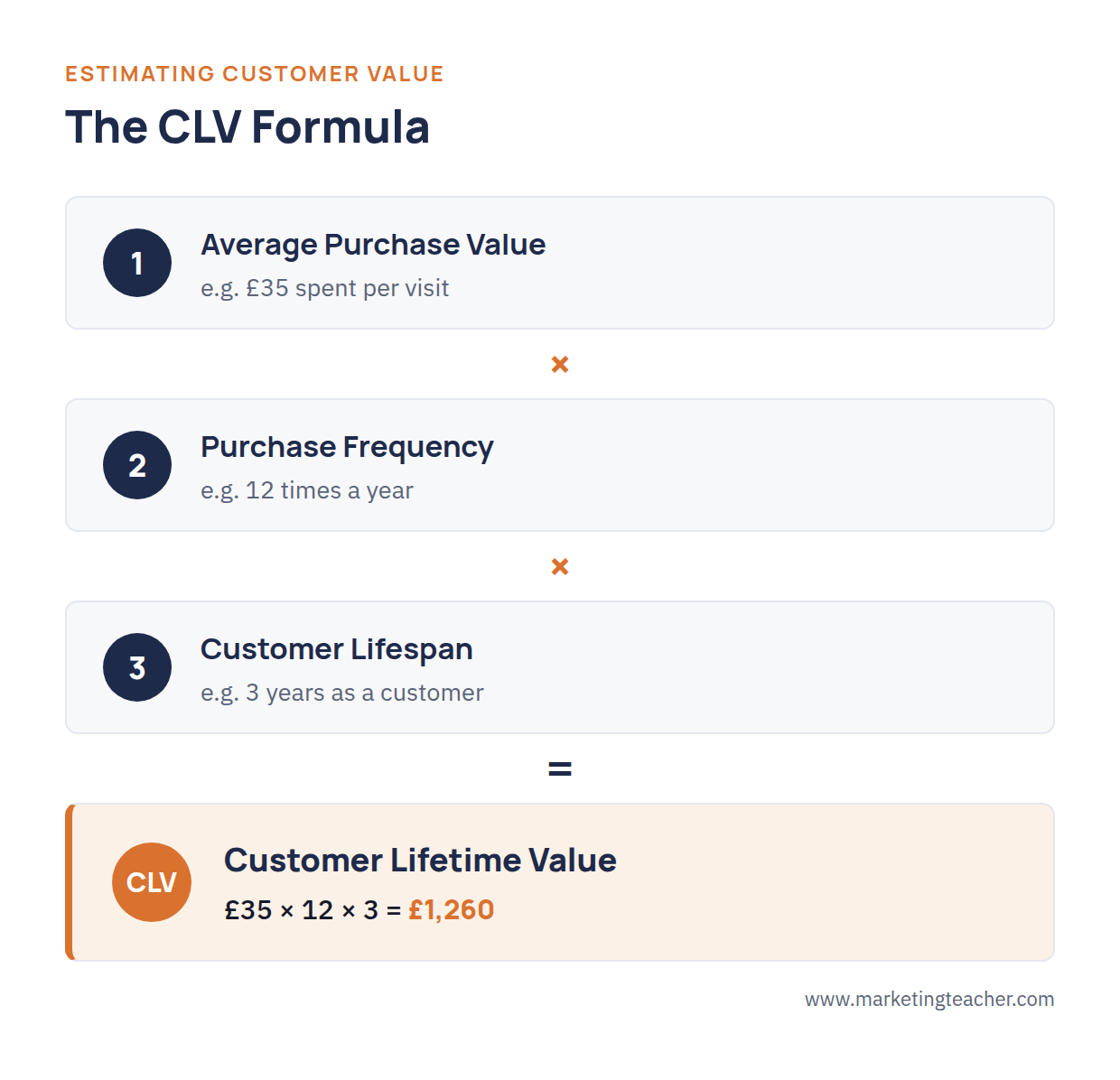
CLV is usually built from three simpler figures: average purchase value (how much a customer spends each time they buy), purchase frequency (how often they buy, typically measured per year), and customer lifespan (how many years they’re likely to keep buying before they leave). Multiplying these three together gives a rough estimate of what a customer is worth across the whole of their relationship with the business, rather than on any single visit.
Example: Customer Lifetime Value (CLV)
This changes how a business should think about spending. A single sale might look barely profitable once marketing and discount costs are subtracted — but if that same customer goes on to buy for the next three or five years, the true return looks very different. CLV is what lets a business justify spending more to win or keep a customer than the value of any one transaction alone would suggest is sensible, and it’s the reason many businesses will happily lose money on a customer’s very first order (Kotler & Armstrong, 2018).
CLV versus customer acquisition cost
CLV is almost always considered alongside customer acquisition cost (CAC) — what it costs, in advertising and sales effort, to win a new customer in the first place. A healthy business wants its CLV to comfortably exceed its CAC; if it costs £50 in advertising to win a customer who is only ever going to spend £40, the business is losing money on every new customer regardless of how good its product is (Kotler & Armstrong, 2018). Comparing the two numbers is one of the simplest ways to check whether a marketing budget is actually being spent well.
Businesses can also actively grow CLV rather than just measure it, usually in one of three ways: increasing how much a customer spends per purchase (upselling, bundling), increasing how often they buy, or extending how long they stay a customer before leaving (retention). Because retention tends to have the biggest effect on CLV over time, many businesses — subscription services and loyalty schemes especially — are built almost entirely around keeping existing customers rather than constantly chasing new ones.
Summary
Customer lifetime value estimates the total worth of a customer across their entire relationship with a business, built from how much they spend, how often, and for how long. Comparing CLV against customer acquisition cost shows whether a marketing budget is actually paying off, and understanding what drives CLV — spend per purchase, purchase frequency, and retention — gives a business a clear, practical way to decide where to focus its marketing effort.
Quiz

The slides, worksheet, lesson plan and poster for this lesson are free to download and free to use in your course — no sign-up, no permission needed.

