
What Is Interactive Video Marketing?
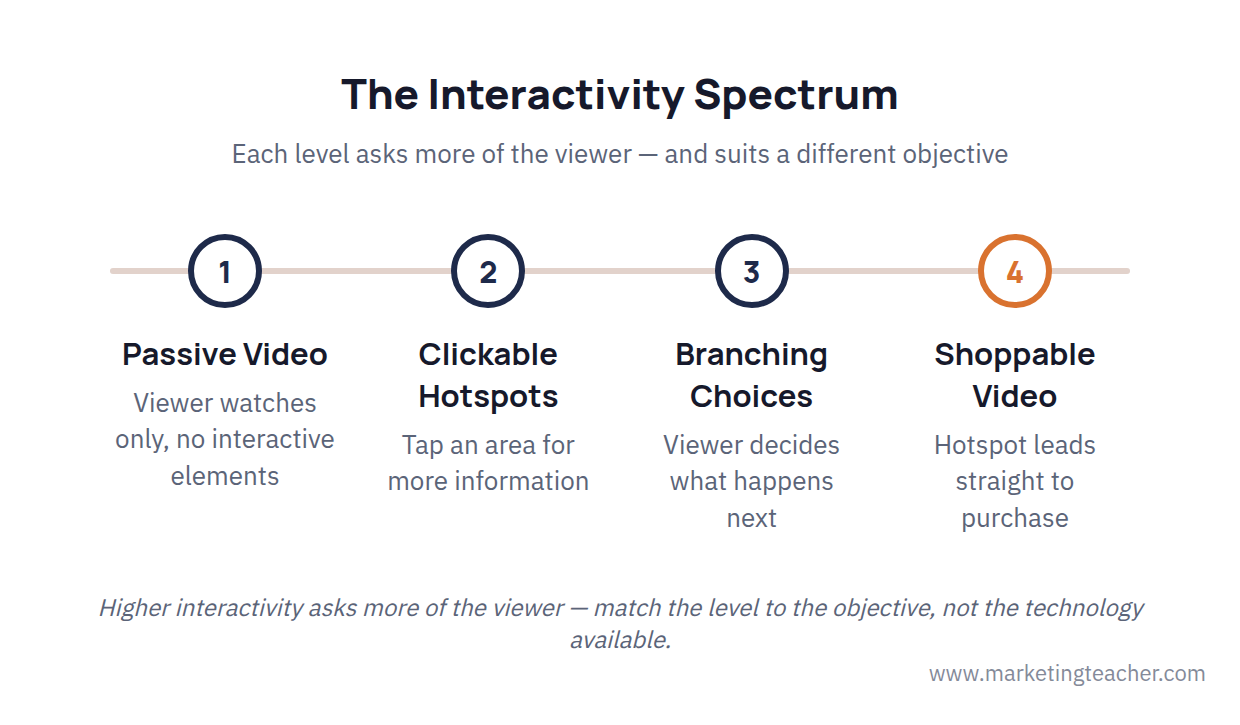
Interactive video marketing turns a video from something a viewer only watches into something a viewer also does something with, whether that means clicking, choosing, or buying without ever leaving the player. Gu et al. (2022) studied real interactive video advertising campaigns and found that the specific interactive elements a video offered, not simply the presence of interactivity in general, shaped how positively viewers responded to it. That finding is a useful starting point: interactivity is not one single feature to switch on, it is a set of different techniques, and each suits a different marketing objective rather than being interchangeable.
The Main Levels of Interactivity
At the simplest level, a clickable hotspot lets a viewer tap a specific area of the frame, a product, a logo, a face, to reveal extra information or jump to a related video, without interrupting playback for anyone who ignores it. A step up from this, a branching or decision-point video pauses at key moments and asks the viewer to choose what happens next, turning a single piece of source footage into several possible viewing paths. The most commercially direct level is shoppable video, where a hotspot leads straight to a product page or an in-player checkout, collapsing the distance between seeing a product and buying it into a single click. Which level suits a campaign depends on the objective: a hotspot suits a product demonstration, a branching structure suits a story-led brand campaign, and a shoppable format suits a straightforward conversion goal, so choosing the right level matters more than adding interactivity for its own sake.
Why Interactivity Increases Engagement
Oh and Sundar (2015) found that interactivity persuades largely through cognitive absorption: an interactive choice asks a viewer to actually think about the content in front of them, rather than simply letting it pass by, and that extra step of active processing is what tends to translate into stronger recall of the brand or message afterward. This does not mean that more interactive elements automatically means a better result. A video cluttered with too many choices can break the sense of absorption it is trying to create, asking for so much active decision-making that a viewer disengages instead of leaning in. The practical implication is to interrupt a viewer deliberately and sparingly, at the moments that genuinely matter to the message, rather than scattering hotspots throughout a video simply because the technology allows it.
Getting Interactive Video Right
Interactive video needs a platform that actually supports it: a hosting player with built-in hotspot and branching tools, such as those offered by dedicated interactive video platforms, or a custom build for a business with the development resources to justify one, since a plain, unmodified video file cannot carry interactive elements on its own. It also needs a genuinely responsive design, so the same interactive experience works whether a viewer is on a desktop browser or a phone screen, since a hotspot sized for a large display can become nearly unusable on a small one. Before production begins, it is worth deciding what a video needs to achieve and choosing a level of interactivity to match: a campaign aiming for pure brand engagement can afford a more exploratory, branching structure, while a campaign aiming for direct sales should generally favour the more direct hotspot-to-product-page route of shoppable video. Once live, the metrics worth tracking shift accordingly, away from simple view counts and toward interaction rate, the specific paths viewers choose through a branching video, and, for shoppable formats, the actual click-to-purchase conversion rate.
Summary
Interactive video marketing covers a range of techniques, from simple clickable hotspots through branching, decision-point narratives to fully shoppable video, each suited to a different marketing objective rather than being a single interchangeable feature. Gu et al. (2022) found that the specific interactive elements offered shape viewer response, and Oh and Sundar (2015) found that interactivity persuades chiefly by increasing active cognitive processing rather than through novelty alone. Used deliberately, at moments that genuinely matter to the message and matched to a clear objective, interactivity can meaningfully improve engagement and conversion, but used indiscriminately it risks breaking the very absorption it is meant to create.
The slides, worksheet, lesson plan and poster for this lesson are free to download and free to use in your course — no sign-up, no permission needed. See the teacher resources →
Assign this lesson to your class:
Using Canvas, Blackboard or Moodle? Copy the link and paste it into your course page or assignment. More ways to add lessons to your LMS.

