
Learning outcome
What Is the Marketing Process?
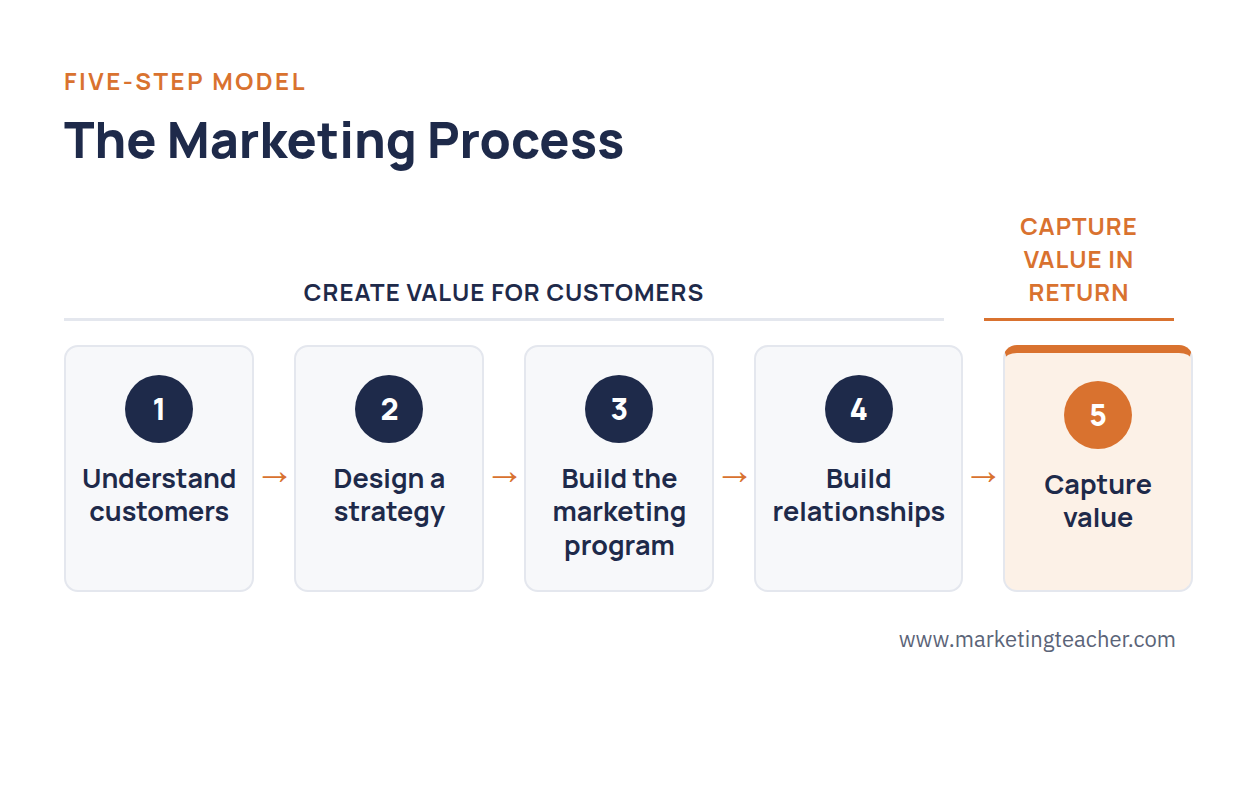
Marketing is often mistaken for the parts people can see: adverts, social media posts, a persuasive salesperson. But behind all of that sits a process — a repeatable sequence of steps that takes a business from not knowing its customers at all to earning long-term profit from them. Kotler and Armstrong (2018) define marketing as “the process by which companies engage customers, build strong customer relationships, and create customer value in order to capture value from customers in return.” That definition contains the whole model in miniature: value has to be created before it can be captured, and there’s a clear order to how a business gets there. It’s a useful corrective to how marketing gets taught informally, as a bag of separate tricks — a good advert here, a clever promotion there — when in practice it’s a single connected process, and doing the steps out of order is usually why marketing efforts fail to stick.
The Five Steps
The marketing process runs through five steps, and they build on each other in a fixed sequence (Kotler & Armstrong, 2018). The first four are about creating value for customers; only the fifth is about the business capturing value back — and it can only happen once the first four have actually been done properly.
1. Understand the marketplace and customer needs and wants. Before a business can sell anything, it has to know who it’s selling to — what people need, what they want, and what’s already available to them from competitors. This usually means talking to customers directly, watching how they actually behave, and resisting the temptation to assume the business already knows best. Skip this step and everything after it is guesswork.
2. Design a customer value-driven marketing strategy. With that understanding in hand, the business decides which customers to serve and how it will deliver more value to them than competitors do. This is where a business chooses its target market and its position within it — a small, well-served niche is usually a stronger strategy than trying to be everything to everyone.
3. Construct an integrated marketing program. The strategy becomes real through an actual marketing mix — product, price, place, and promotion — all working together rather than pulling in different directions. A premium positioning strategy paired with discount pricing, for example, undermines itself at this exact step.
4. Engage customers, build profitable relationships, and create customer delight. Marketing doesn’t stop at the first sale. This step is about turning a one-off buyer into a returning customer, and a returning customer into someone who recommends the business to others — through good service, consistent quality, and the kind of small extra touches customers remember.
5. Capture value from customers in return. Only now, after value has genuinely been created, does the business collect its reward: sales, profit, and long-term customer loyalty. Kotler and Armstrong describe this final reward as coming in two forms — the profit earned today, and the customer equity built up over time as loyal customers keep buying.
Example: The Marketing Process
Why the Order Matters
It’s tempting for a business to jump straight to step 5 — to focus on selling harder rather than understanding customers better. This is the mistake behind what’s sometimes called the “selling concept”: pushing products on customers rather than building something customers actually want. It tends to work only in the short term, if at all, because a customer who feels sold to rather than understood rarely comes back. The five-step model puts capturing value deliberately last, because in a genuinely customer-focused business, it’s the outcome of the first four steps rather than something pursued directly. A business that consistently creates real value for customers earns the right to capture value in return — sales follow from that, not the other way around. This is also why the model is worth returning to whenever a business’s results start to slip: a drop in sales is a step 5 problem on the surface, but the real fault almost always sits earlier, in a strategy or program that has drifted away from what customers actually need.
Summary
The marketing process is a five-step model: understanding the marketplace and customer needs, designing a customer value-driven strategy, constructing an integrated marketing program, engaging customers to build relationships, and finally capturing value in return. The first four steps create value for the customer; only the last step lets the business capture value for itself — and it only works in that order.
Quiz

The slides, worksheet, lesson plan and poster for this lesson are free to download and free to use in your course — no sign-up, no permission needed.

