
What Is the Marketing Mix?
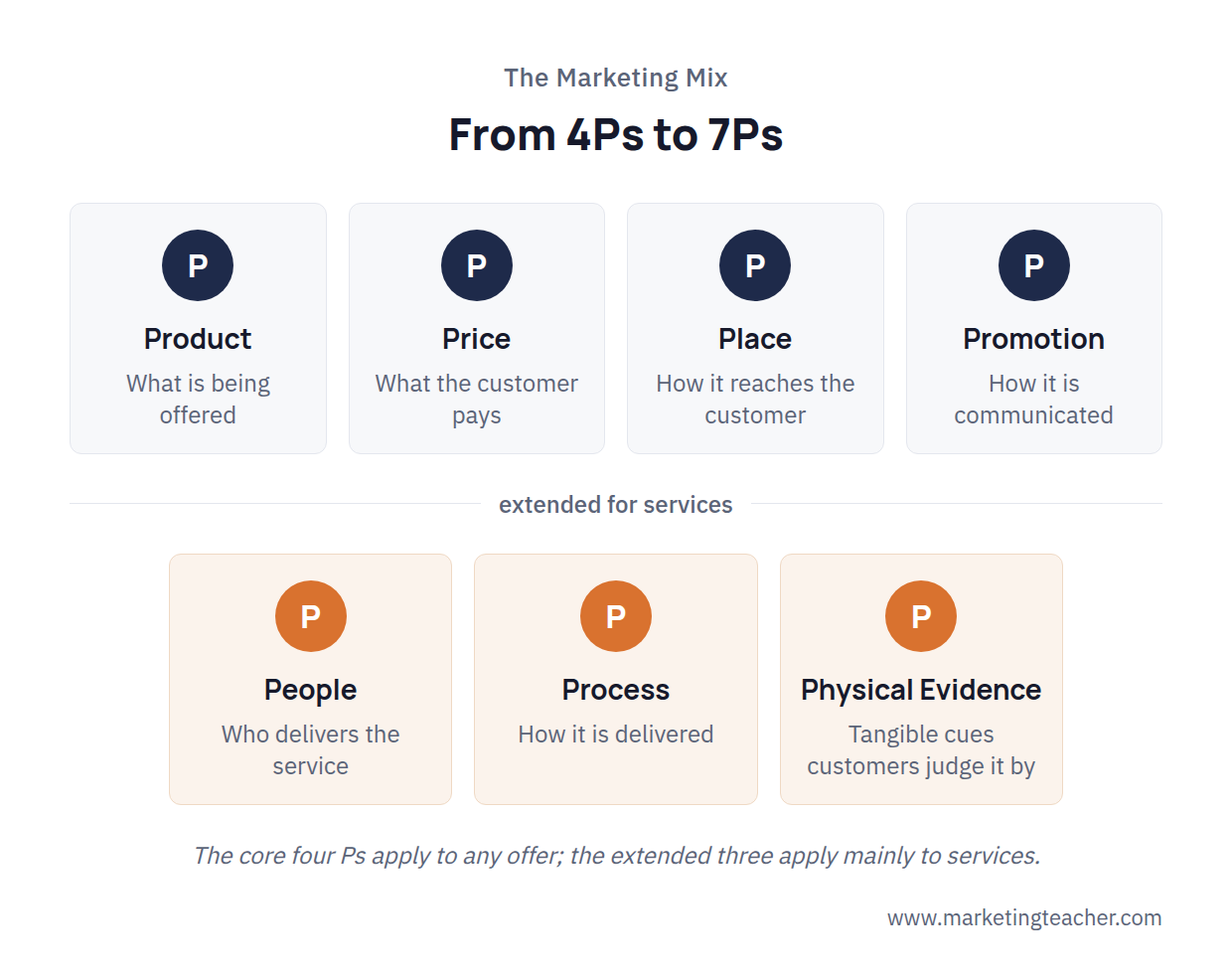
Once a business has chosen a target market through segmentation and targeting, it still has to decide exactly how it will reach that market. The marketing mix is the set of controllable tools a business combines to do this: what it sells, what it charges, where it makes the product available, and how it communicates with customers. The idea traces back to Culliton (1948), who described the marketing executive as a “mixer of ingredients,” and was developed into the term “marketing mix” itself by Borden (1964). McCarthy (1960) then organised the mix into four clear categories that businesses could plan around: Product, Price, Place, and Promotion, commonly called the 4Ps. Because McCarthy’s four-part framework was published a few years before Borden’s own paper naming the concept, the now-famous 4Ps classification actually reached print first, even though Borden is credited with developing the broader marketing-mix idea earlier through his own teaching.
The Four Ps
Each of the four elements below is covered in its own lesson, but together they form one coordinated plan rather than four separate decisions:
- Product — what is actually being offered, including its features, quality and branding. See Three Levels of a Product.
- Price — what the customer pays, and the strategy behind that figure. See Pricing Strategies.
- Place — how and where the product reaches the customer. See Marketing Place.
- Promotion — how the business communicates the offer to its target market. See Promotion.
A change to any one of the four Ps usually forces a rethink of the others. A premium price only works alongside a product, distribution channel and promotional message that all signal quality — cutting the price without adjusting the rest of the mix can undermine the very positioning the business is trying to build.
Why the Mix Was Extended to 7Ps
McCarthy’s original four Ps describe a physical product well, but they leave out something crucial for a service: the fact that a customer often experiences the service being delivered, not just the end result. Booms and Bitner (1981) proposed extending the mix with three further elements for services businesses: People (the staff who deliver the service and shape the customer’s experience of it), Process (the steps and systems used to deliver the service consistently), and Physical Evidence (the tangible cues — décor, uniforms, paperwork, a website’s design — that let a customer judge a service they cannot inspect in advance). See Physical Evidence – Marketing Mix for a closer look at that last element. A hotel, an airline, or an online bank all rely on this extended mix as much as their core four Ps, since what customers remember about a service is often shaped as much by how it was delivered as by what was actually promised.
Choosing the Right Mix for the Target Market
There is no single correct marketing mix — the right combination depends entirely on the target market a business has chosen and the position it wants to hold in that market’s mind. A business aiming at a price-sensitive mass market will build a very different mix from one aiming at a small, premium niche, even if both sell a similar underlying product. This is why the marketing mix decisions covered in this lesson are usually made only after segmentation and targeting are settled, not before — the mix is how a chosen strategy gets carried out, not how the strategy itself gets chosen.
Common Mistakes When Building a Marketing Mix
A few recurring problems show up when a marketing mix is put together carelessly:
- Treating each P separately. Product, price, place and promotion decisions are often assigned to different people or teams, and without coordination they can quietly pull in different directions.
- Copying a competitor’s mix wholesale. A mix that works for one business assumes that business’s target market, cost base and brand position — copying it without checking those still fits your own strategy usually backfires.
- Setting the mix once and never revisiting it. A product’s position in the market changes as it ages and as competitors respond, so the mix that suited a new launch often needs adjusting well before the product is retired.
- Ignoring the extended mix for a service element. A business selling a hybrid product-and-service offer (a software subscription with support, for example) still needs to think about people, process and physical evidence, not just the original four Ps.
Summary
The marketing mix is the set of tools — Product, Price, Place and Promotion — that a business combines to reach the target market it has chosen. Booms and Bitner (1981) extended this to seven elements for services, adding People, Process and Physical Evidence. Whichever version applies, every element needs to work together and point toward the same target market and position, rather than being decided in isolation.

The slides, worksheet, lesson plan and poster for this lesson are free to download and free to use in your course — no sign-up, no permission needed. See the teacher resources →
Assign this lesson to your class:
Using Canvas, Blackboard or Moodle? Copy the link and paste it into your course page or assignment. More ways to add lessons to your LMS.

