
Learning outcome
What Is Customer Equity?
Customer equity is the total combined customer lifetime value of all of a company’s current and potential customers (Kotler & Armstrong, 2018). Where customer lifetime value looks at one customer — the entire stream of purchases that person might make over a lifetime of buying from a business — customer equity zooms out to the whole customer base at once. It reframes a familiar question. Instead of asking “how much did we sell this quarter?” it asks “how valuable are the relationships behind those sales, and how long will they last?” A business with lower sales today but a large base of loyal, high-potential customers can have stronger customer equity than a rival selling more right now to customers who are about to leave.
Why Customer Equity Beats Sales as a Measure
The best-known illustration of this idea compares two car brands with very different customer bases. One well-known American luxury brand built a loyal following, but that following was aging — the average buyer was around 60 years old, and few younger drivers were entering the brand’s customer base to replace them as older customers eventually stopped buying. A German luxury rival, by contrast, deliberately cultivated younger drivers, on the logic that a driver who buys the brand in their 30s might buy from it for another 40 years, while a 60-year-old loyal customer has a much shorter runway left. Judged purely on this year’s sales, the two brands might look comparable. Judged on customer equity — the value of the relationships still to come — the brand with younger, longer-tenured customers is worth far more, even if its current sales numbers don’t show it yet.
Share of Customer
A related idea is share of customer: the percentage of a customer’s total spending in a category that goes to one company, rather than its competitors (Kotler & Armstrong, 2018). A grocery chain grows its share of customer by encouraging shoppers who currently split their grocery spending between two or three stores to do more of that spending in one place — through loyalty programs, better assortment, or simply a more convenient experience. Growing share of customer is often cheaper than acquiring a brand-new customer from scratch, because the relationship, and the trust that comes with it, already exists.
Example: Customer Equity
The Four Customer Relationship Groups
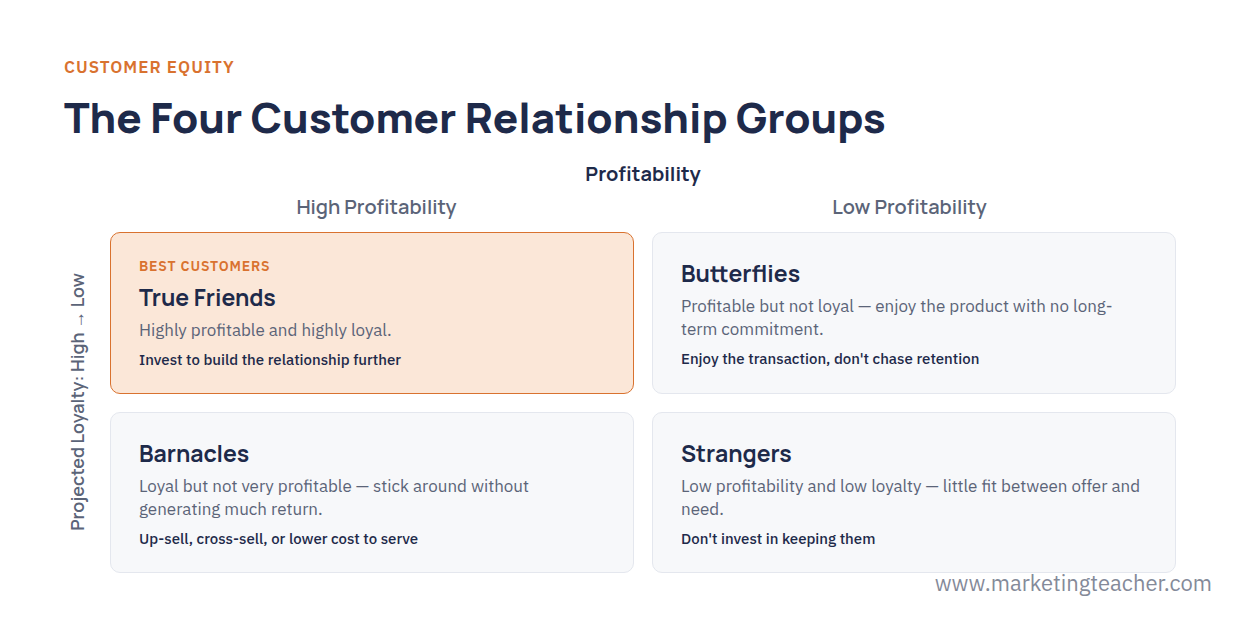
Not every customer is worth the same investment, and treating them as if they were is one of the most common mistakes in customer relationship management. A useful way to sort customers is along two dimensions: how profitable they currently are, and how loyal they are likely to remain (Kotler & Armstrong, 2018). That gives four groups.
Strangers show low potential profitability and low projected loyalty — there’s little fit between what the business offers and what they need, and no reason to invest in keeping them. Butterflies are profitable but not loyal: they enjoy the product but have no long-term commitment to the brand, like a shopper who buys a designer item once during a sale. The right strategy with butterflies is to enjoy the transaction while it lasts, not to spend heavily trying to convert them into a long-term relationship that may never happen. True friends are both profitable and loyal — the most valuable group, worth real investment in building the relationship further, since both the current returns and the future returns are strong. Barnacles are loyal but not very profitable: they stick around, but their business doesn’t generate much return, and sometimes costs more to service than it earns. The right approach with barnacles is to look for ways to make the relationship more profitable — up-selling, cross-selling, or lowering the cost of serving them — rather than either investing heavily or abandoning them outright.
Summary
Customer equity is the total combined lifetime value of a company’s current and potential customers — a measure of the whole customer base’s future worth, not just its current sales. Two businesses with identical revenue can have very different customer equity depending on how loyal and long-lasting their customer relationships are. Sorting customers into strangers, butterflies, true friends, and barnacles — based on their profitability and their likely loyalty — helps a business decide where to invest, where to simply enjoy the transaction, and where to look for a more efficient relationship instead.
Quiz

The slides, worksheet, lesson plan and poster for this lesson are free to download and free to use in your course — no sign-up, no permission needed.

