
Learning outcome
What Is Not-for-Profit Marketing?
Marketing is often pictured as something businesses do to sell products for a profit. But some of the most sophisticated marketing in the world comes from organizations that aren’t trying to make a profit at all — hospitals, charities, universities, museums, and government agencies. Not-for-profit marketing applies the same tools used to sell soft drinks or smartphones — audience research, brand building, storytelling, paid advertising — toward a different kind of “sale”: a donation, a volunteer hour, a vote, a change in public behavior like recycling or wearing a seatbelt (OpenStax, 2023). The product isn’t a physical good. It’s a cause, and the customer’s “purchase” is their attention, trust, or money.
Why Not-for-Profits Need Marketing Too
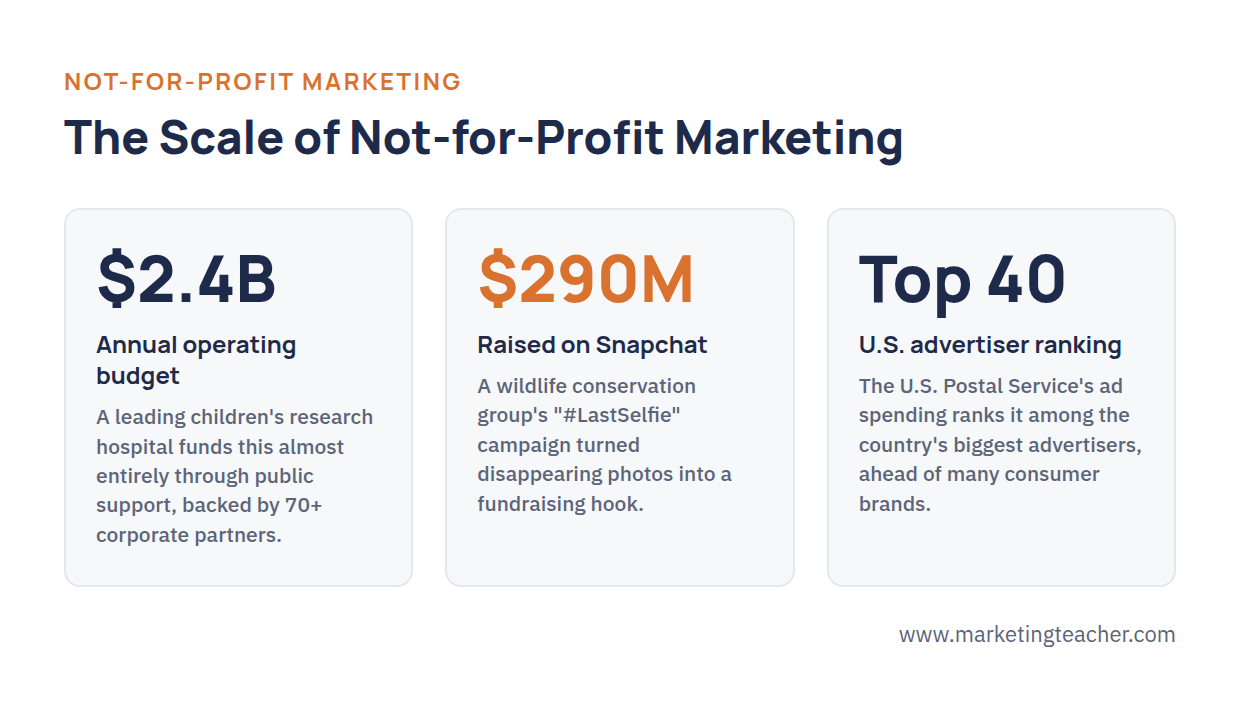
It might seem like a good cause should sell itself, but not-for-profits compete just as hard for support as businesses compete for customers — arguably harder, since donors and volunteers have unlimited causes to choose from and only so much time or money to give (OpenStax, 2023). A well-run charity has to explain clearly what it does, prove its money is well spent, and make potential donors feel that their specific contribution matters. That takes the same marketing discipline — clear messaging, consistent branding, and campaigns built around a specific audience — that any major consumer brand relies on. The scale involved can be enormous: one of the best-known children’s research hospitals in the United States operates on a budget of roughly $2.4 billion a year, funded almost entirely through public support rather than patient billing, backed by more than 70 corporate partners who help spread its message. That level of funding doesn’t happen by accident; it happens because the organization markets its mission as deliberately as any Fortune 500 company markets its products.
Example: Not-for-Profit Marketing
Government Is a Marketer Too
Government agencies are also major marketers, even though people rarely think of them that way. Military recruitment campaigns are built with the same audience research and creative planning as any consumer ad campaign, because filling recruitment targets each year depends on it. The agency that operates America’s postal service spends hundreds of millions of dollars a year on advertising to stay competitive as mailing habits change. In fact, one federal government agency’s annual advertising spending is large enough to rank it among the roughly 40 biggest advertisers in the entire country — ahead of many well-known consumer brands. Public health campaigns promoting vaccination, seatbelt use, or quitting smoking follow the same logic: government isn’t selling a product, but it is still competing for attention and trying to change behavior, which is exactly what marketing is built to do.
Universities and Museums Compete Too
Not-for-profit marketing isn’t limited to charities and government. Universities market themselves to prospective students the same way a consumer brand courts customers, with campus tours designed like showrooms, admissions campaigns built around a clear brand story, and social media accounts run by dedicated marketing staff — because tuition-paying enrollment is the revenue that keeps the institution running. Museums do the same to drive ticket sales and membership renewals, competing not just with other museums but with every other way a family could spend a Saturday afternoon. In both cases, the organization has a mission that isn’t about profit, but the marketing behind it looks, and is budgeted, very much like a business’s.
What Makes Not-for-Profit Marketing Different
The tools are the same, but the goals are not. A business measures success mostly in sales and profit. A not-for-profit has to satisfy multiple audiences at once: donors who want to see impact, the people the organization actually serves, and often government regulators who oversee how charitable funds are used (OpenStax, 2023). That means not-for-profit marketing has to work harder to build trust and demonstrate impact, since a donor who feels misled about how their money was used rarely gives again — and is far more likely to say so publicly than a dissatisfied customer of an ordinary retail brand.
Summary
Not-for-profit and government organizations rely on marketing just as much as businesses do, even though what they’re “selling” is a cause, a behavior change, or public trust rather than a product. Major charities and government agencies run sophisticated, well-funded marketing operations, using the same tools as any consumer brand to compete for a limited pool of donations, volunteers, and attention. What sets not-for-profit marketing apart isn’t the toolkit — it’s the goal, and the higher bar for proving that support was well spent.
Quiz

The slides, worksheet, lesson plan and poster for this lesson are free to download and free to use in your course — no sign-up, no permission needed.

