
How Is a Brand’s Value Actually Calculated?
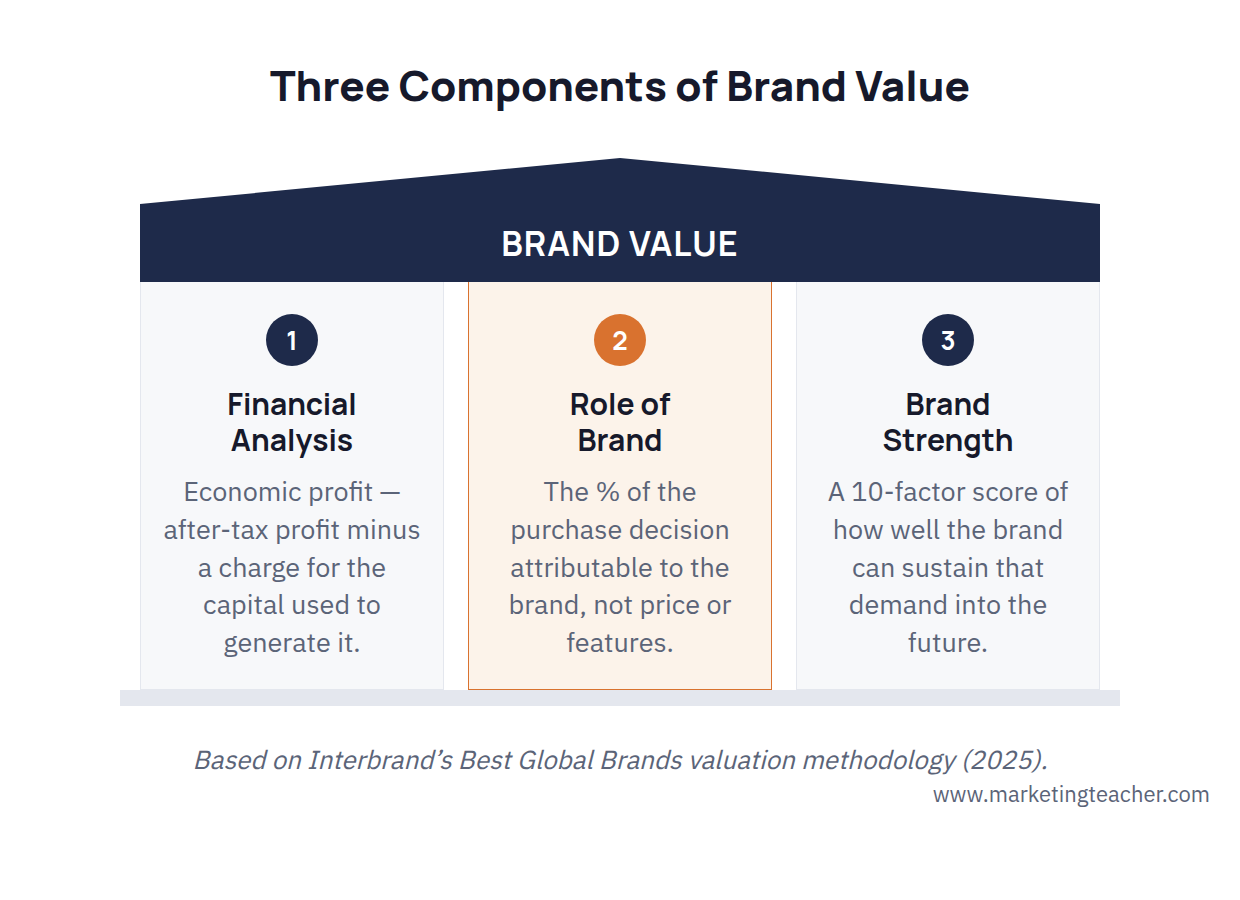
Every year, rankings of the world’s most valuable brands attach a specific dollar figure to household names, and the figures run into the tens of billions. Behind each number sits a defined methodology, not a guess. Interbrand, the consultancy that pioneered brand valuation in 1988 and was the first company to have its methodology certified compliant with the ISO 10668 standard for monetary brand valuation, breaks the task into three components: an analysis of the brand’s financial performance, an assessment of the role the brand plays in the purchase decision, and a measure of the brand’s ongoing strength (Interbrand, 2025). Understanding these three parts explains why two brands with identical revenue can end up with very different valuations.
Component One: Financial Analysis
The starting point is economic profit: the after-tax operating profit generated by the branded product or service, minus a charge for the capital used to generate it. This step has nothing to do with the brand itself. It simply asks how much genuine financial return the business built around the brand is producing, once the cost of the capital tied up in stock, premises and working capital has been subtracted from the raw profit figure. A brand attached to a loss-making business, however famous, contributes little here, whatever its recognition might suggest.
Component Two: Role of Brand
Not every pound of that economic profit is down to the brand. A cheap flight might get booked because of price, a laptop bought for a specific feature, a coffee chosen because it’s the nearest shop. The Role of Brand Index (RBI) quantifies, as a percentage, how much of the purchase decision is attributable to the brand itself rather than to factors like these (Interbrand, 2025). Depending on the brand, this percentage is worked out through commissioned market research, by benchmarking against RBI scores from similar brands in the same industry, or through expert panel assessment. Five underlying dimensions feed into the judgement: Identification, Performance, Experience, Ecosystem and Leadership (Interbrand, 2025) — in plain terms, whether customers recognise the brand at all, whether it delivers on its promise, what it’s actually like to deal with, how well it connects across products and partners, and whether it leads or follows its category.
Component Three: Brand Strength
The first two components describe value today. Brand Strength is the forward-looking piece: it measures a brand’s ability to keep creating loyalty, and therefore sustainable demand and profit, into the future. Interbrand assesses this across ten factors, benchmarked against both direct competitors and other world-class brands globally, and expresses the result as a Brand Strength Score out of 100 (Interbrand, 2025). The score matters beyond the valuation itself. A Brand Strength Score of 50 or above is one of six qualifying criteria a brand must meet before it can even be considered for Interbrand’s annual Best Global Brands ranking, alongside tests on revenue spread outside its home region, global presence, publicly available financial data, expected long-term profitability and public awareness.
Why Put a Number on a Brand at All?
A methodology this detailed exists because a brand value figure has to do real work once it exists. Interbrand describes four uses for the output: as a measurement system that tracks brand performance consistently year over year, as a diagnostic tool that pinpoints specific strengths and weaknesses, as a way of quantifying the brand’s financial significance to business outcomes, and as a prescriptive framework for correcting course (Interbrand, 2025). A finance team can use the same figure to defend a marketing budget that a brand team uses to decide which of the five Role of Brand dimensions most needs investment. That shared number is precisely the point: it lets two departments that usually speak different languages argue from the same evidence.
Summary
Calculating what a brand is worth is not a single figure pulled from a balance sheet. Interbrand’s methodology (2025) breaks it into three parts: Financial Analysis, which measures the economic profit the branded business generates; Role of Brand, which isolates the percentage of the purchase decision the brand itself is responsible for, across five dimensions; and Brand Strength, a ten-factor, forward-looking score of how resilient that contribution is likely to be. Together, the three components turn a brand, something a marketer might otherwise only be able to describe in words, into a number a finance director can put on a balance sheet.
The slides, worksheet, lesson plan and poster for this lesson are free to download and free to use in your course — no sign-up, no permission needed.

