
What Is Big Data-Driven CRM in an International Market?
Customer relationship management, at its simplest, means using what a business knows about its customers to keep them, serve them better and grow revenue from them over time. Big data changes what a business can actually know: transaction histories, browsing behaviour, social media activity and app usage combine into a picture of the customer that is far richer than a spreadsheet of names and purchase dates.
Going international adds a particular version of this challenge. A 2022 review of the academic literature on big data and CRM found that businesses expanding into new countries need to build the same detailed customer picture across markets they do not yet understand, usually with less local knowledge to fall back on than they have at home (Del Vecchio, Mele, Siachou & Schito, 2022). Big data, used well, can close some of that gap – but only if a business gets four separate things right at the same time.
The Four Building Blocks: Why, What, Who and How
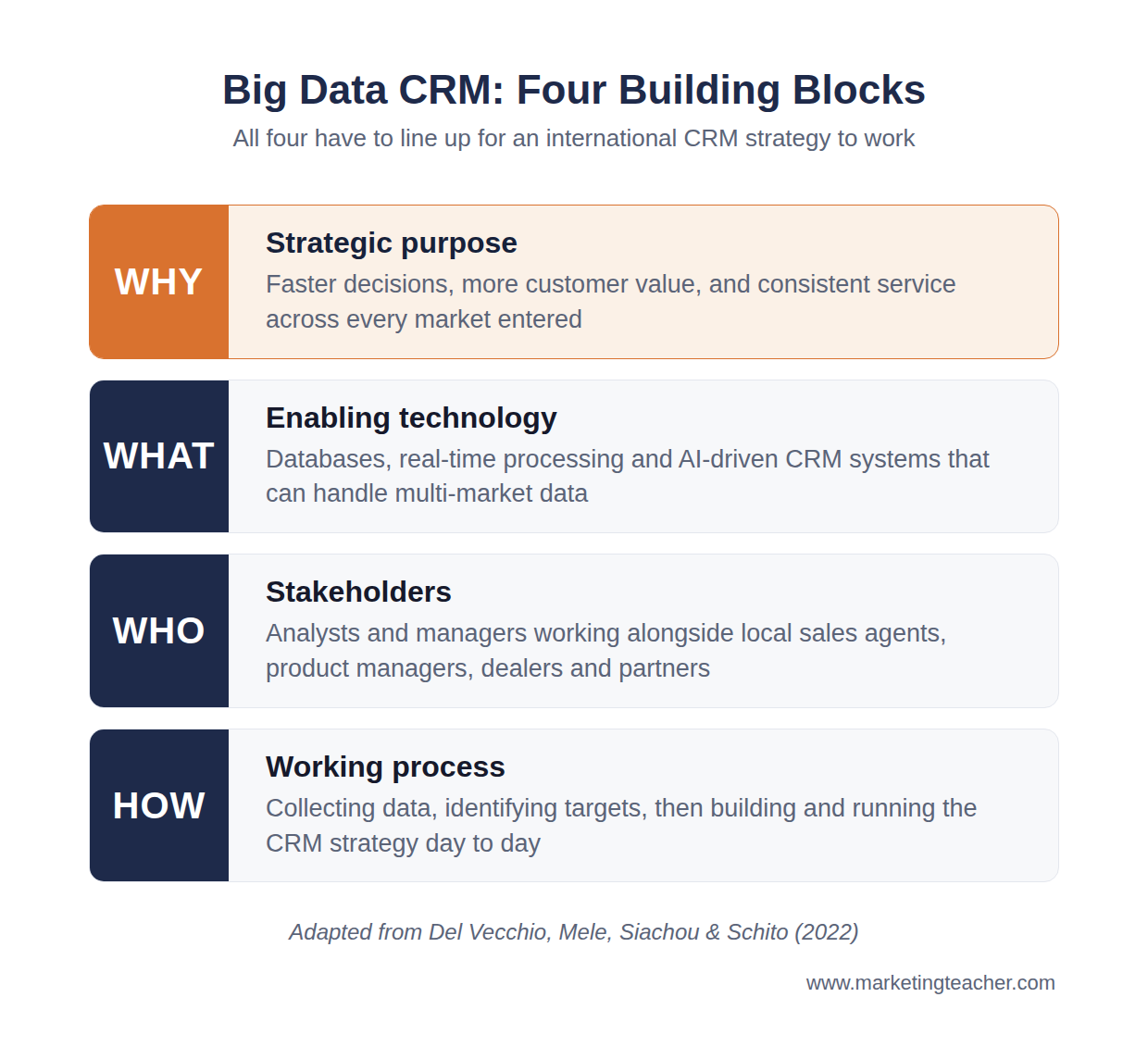
Reviewing several years of published research on big data and CRM, Del Vecchio et al. (2022) grouped the recurring themes into four building blocks that need to line up before a big-data CRM strategy can work internationally: why the business is doing this, what technology it needs, who has to be involved, and how the process runs day to day. Skip any one of the four and the strategy tends to stall. A business with excellent technology but no clear purpose ends up collecting data nobody uses, and a business with a clear purpose but no proper process never turns that data into a working system.
Why: The Strategic Purpose
The “why” has to come first. Businesses use big data in CRM to make faster, better-informed decisions, to increase the value each customer delivers over time, and to make marketing and service more consistent across markets that used to need separate, manual approaches (Del Vecchio et al., 2022). Without a clear purpose, big data becomes a cost rather than an asset: it is expensive to collect, store and process, and a business that cannot say which decision the data is meant to improve has no way of judging whether the investment paid off.
What: The Technology Behind the Strategy
The “what” covers the infrastructure that makes big-data CRM possible: databases that can hold data from many countries and formats, systems that can process information close to real time, and the CRM software itself, increasingly built on artificial intelligence to sort and act on the data automatically. None of this technology creates value on its own – it exists to support the purpose already agreed in the “why” stage, not to replace it.
Who: The People Who Have to Work Together
Big-data CRM is not only a technical project. A wide cast of stakeholders needs to be involved for it to succeed internationally: data analysts and managers who understand the technology, but also the sales agents, product managers, dealers and partners on the ground in each market who understand the customer. A business that leaves data analysis to a technical team working in isolation from local sales and product staff tends to produce insights that nobody local can actually act on.
How: Turning Data Into a Working Process
The “how” is the everyday process that ties the other three together: collecting data consistently across markets, using it to identify the right target customers, and then developing and implementing an actual CRM strategy rather than leaving the data as a static report (Del Vecchio et al., 2022). This is the stage most businesses underestimate. The review found that the great majority of published studies in this field were built around real case studies rather than theory alone – a sign that turning big data into a functioning CRM strategy is where most of the practical difficulty, and most of the value, actually sits.
Summary
Big data gives international businesses the raw material to understand customers they have never met, in markets they do not yet know well. Raw material on its own changes nothing. Del Vecchio et al.’s (2022) review of the field found that the businesses that succeed are the ones that treat big-data CRM as four connected building blocks rather than a single piece of software: a clear strategic purpose (why), the right infrastructure (what), the right people working together across markets (who), and a disciplined process for turning data into decisions (how). Align all four, and big data becomes a genuine advantage when entering a new market, rather than an expensive pile of numbers nobody quite knows what to do with.
The slides, worksheet, lesson plan and poster for this lesson are free to download and free to use in your course — no sign-up, no permission needed. See the teacher resources →
Assign this lesson to your class:
Using Canvas, Blackboard or Moodle? Copy the link and paste it into your course page or assignment. More ways to add lessons to your LMS.

