
Does Formal Marketing Planning Actually Improve Performance?
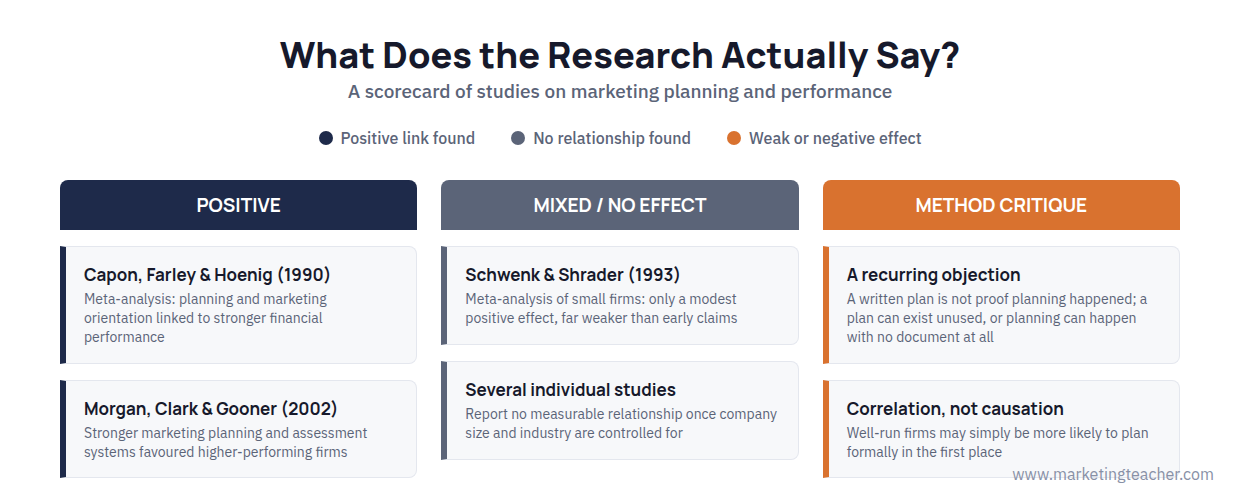
Marketing planning theory contends that a formalized, systematic planning process helps a business improve its performance. It is an appealing idea: write down objectives, analyse the situation, decide a strategy, and performance should follow. But marketing is not a precise science, and this particular claim has been tested by researchers many times over several decades with results that point in more than one direction. Some studies find a clear positive link between formal planning and business success. Others find no relationship at all, and a few find planning associated with worse outcomes. Understanding why the evidence is this mixed, rather than assuming the theory is simply true, is the more useful lesson, and it matters well beyond the classroom: a manager deciding whether to invest time in a formal planning process, or a small-business owner wondering whether a plan is worth writing down at all, is making exactly the decision this research bears on.
The Case for a Positive Link
Several well-known studies do find planning associated with stronger performance. Capon, Farley and Hoenig (1990) conducted a meta-analysis, a study that statistically combines the results of many earlier studies, and found that a stronger planning and marketing orientation was one of several factors linked to better financial performance across the businesses examined. Morgan, Clark and Gooner (2002) likewise found that a more developed marketing planning and performance-assessment dimension benefited higher-performing firms more than lower-performing ones, in a comparison of medium and large companies. Findings like these are the basis for the theory’s continued popularity: a business that plans formally, sets clear objectives, and tracks results against them does, in a meaningful number of studies, tend to outperform one that does not.
The Case Against a Simple Link
Other researchers find no such benefit, or find it disappears under closer examination. Schwenk and Shrader (1993) conducted a meta-analysis specifically of formal strategic planning in small firms and found a positive but modest overall effect on financial performance, one considerably weaker than early advocates of formal planning had claimed. Other individual studies reviewed in this literature have found no measurable relationship between planning and performance at all, and a handful have found a negative association. A recurring methodological criticism is that many studies treat the mere existence of a written plan as proof that real planning took place, when a business can hold thorough, effective planning discussions without ever producing a formal document, and can equally produce a polished document that nobody actually uses to guide decisions.
Why the Evidence Is So Hard to Pin Down
Part of the difficulty is that “marketing planning” is not one single, standardised activity across every study. Studies vary in company size, industry, the exact definition of performance used (sales growth, profitability, market share, or survival all measure something different), and how rigorously “planning” itself was measured. A study of large manufacturers is not directly comparable to one of small retail firms, and the two groups may genuinely experience planning differently: a small firm’s plan is often carried in the owner’s decisions day to day, while a large firm’s plan is a coordination document across many people who never meet. Rather than looking for a single verdict, it is more useful to treat formal marketing planning as one input among several that can support good performance, alongside execution, market conditions, and plain competitive advantage, rather than a guaranteed cause of it on its own. It is also worth remembering that most of this research measures correlation, planning alongside performance, rather than proving that planning caused the performance; a business that is already well-run in other respects is also more likely to plan formally in the first place, which can make planning look more powerful than it actually is.
Summary
The theory that formal marketing planning improves business performance is intuitive and has real support: Capon, Farley and Hoenig (1990) and Morgan, Clark and Gooner (2002) both found planning-related measures linked to stronger performance. But Schwenk and Shrader’s (1993) meta-analysis found only a modest effect in small firms, and other studies have found no relationship, or a negative one. The safest conclusion is that a written marketing plan is a tool that can support performance when it is genuinely used to guide decisions and checked with real marketing audit controls, rather than a document whose mere existence guarantees a result.
The slides, worksheet, lesson plan and poster for this lesson are free to download and free to use in your course — no sign-up, no permission needed. See the teacher resources →
Assign this lesson to your class:
Using Canvas, Blackboard or Moodle? Copy the link and paste it into your course page or assignment. More ways to add lessons to your LMS.

