
What Is a Marketing Plan?
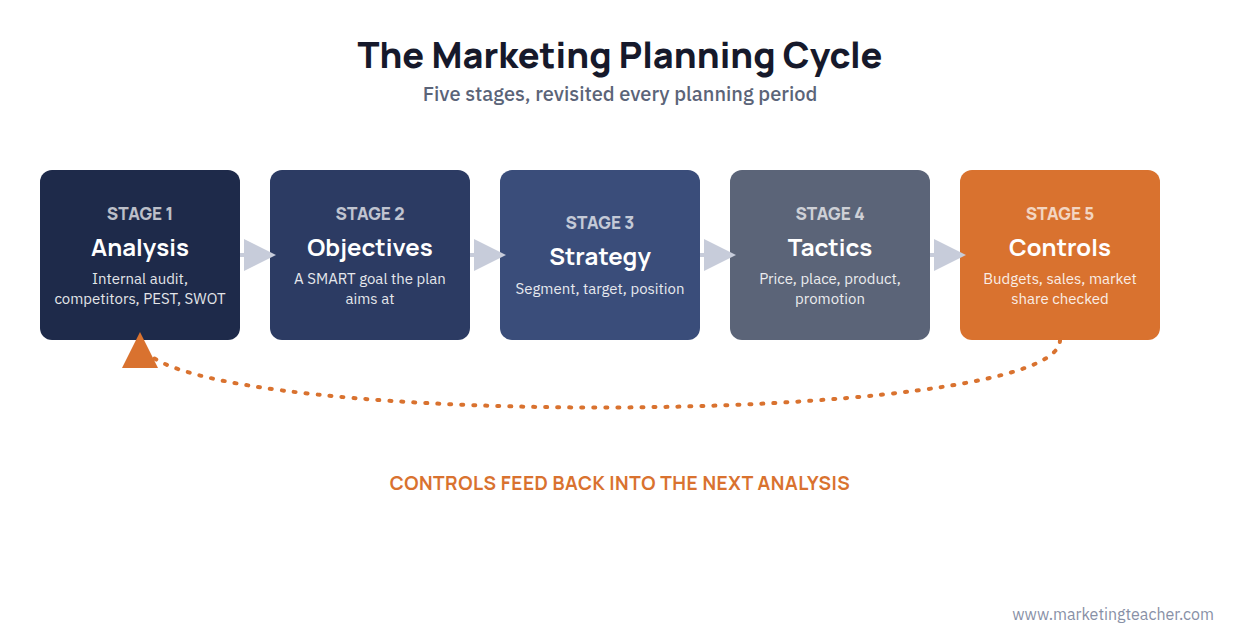
A marketing plan is a written document that focuses a business on what it intends to achieve and how it plans to achieve it. Kotler and Armstrong (2018) describe marketing planning as the stage where a business’s broader strategy gets translated into a specific set of actions, budgets and controls for a defined period. There are many ways to structure a marketing plan, but most versions move through the same five stages in the same order: analysing the current situation, setting objectives, deciding a strategy, choosing tactics, and building in controls.
Stage One: Situation Analysis
A plan has to start with an honest picture of where a business actually stands before it decides where to go next. This usually means auditing the internal business, its resources, experience and past marketing performance, alongside the external environment: competitors’ own plans and activity, the wider marketing environment covered by tools like PEST analysis and Five Forces analysis, and how the business’s strengths and weaknesses line up against the opportunities and threats a SWOT analysis would surface. Skipping this stage, or rushing it to get to the more exciting parts of the plan, is one of the most common reasons a plan’s later objectives turn out to be unrealistic.
Stage Two: Setting SMART Objectives
Doran (1981) proposed that a well-written objective should be SMART: specific about exactly what is to be achieved, measurable so progress can actually be tracked, achievable given the resources available, realistic in the sense of being resourced with the people, money, machinery, minutes and materials the plan actually has, and timed with a clear deadline. An objective that fails any one of these tests tends to be too vague to guide the rest of the plan, and every later stage, the strategy, the tactics and the controls, is built to serve whatever the objectives say, so a weak objective here weakens everything that follows it.
Stage Three: Target Market, Strategy and Tactics
With objectives set, a plan defines which market segment to pursue and why, then converts that strategy into tactics, the specific choices that make up the marketing mix: pricing decisions such as whether to skim, penetrate or match the competition; place decisions about direct sale versus agents or distributors; product decisions about how something is packaged, bundled or sold; and promotion decisions about which media actually reach the target segment. These four elements work together rather than in isolation, since changing one, a lower price, say, without adjusting the promotion or place decisions built around the original price point, can undermine a strategy that looked sound on paper.
Stage Four: Marketing Controls
A plan without controls has no way of knowing whether it is working. Controls typically track start-up costs against budget, monthly spend against the plan, sales figures against forecast, and market share against competitors, feeding each result back into decisions about whether to continue, adjust or abandon a tactic. This feedback loop is what separates a living plan from a document that gets written once and never revisited: a marketing budget gives the controls something concrete to measure spending against, and a periodic marketing audit is the more formal version of the same checking process, run less often but in greater depth. What controls reveal often sends a business straight back to stage one, not because the original plan was poorly written, but because the situation it was written for has genuinely moved on, which is exactly why the five stages are better understood as a cycle a business returns to each planning period than a document produced once and filed away.
Summary
A marketing plan moves through situation analysis, objectives, strategy, tactics and controls, in that order, because each stage depends on the one before it (Kotler & Armstrong, 2018). A SMART objective (Doran, 1981) gives the rest of the plan something specific to aim at, the marketing mix translates strategy into tactics a customer actually experiences, and controls turn the whole plan into something that can be checked and adjusted rather than simply hoped for. A short summary at the front of the finished document, with supporting detail moved to an appendix, helps anyone outside the process understand what the plan intends to do without reading every page.
The slides, worksheet, lesson plan and poster for this lesson are free to download and free to use in your course — no sign-up, no permission needed. See the teacher resources →
Assign this lesson to your class:
Using Canvas, Blackboard or Moodle? Copy the link and paste it into your course page or assignment. More ways to add lessons to your LMS.

