
What Is the Mobile App Customer Journey?
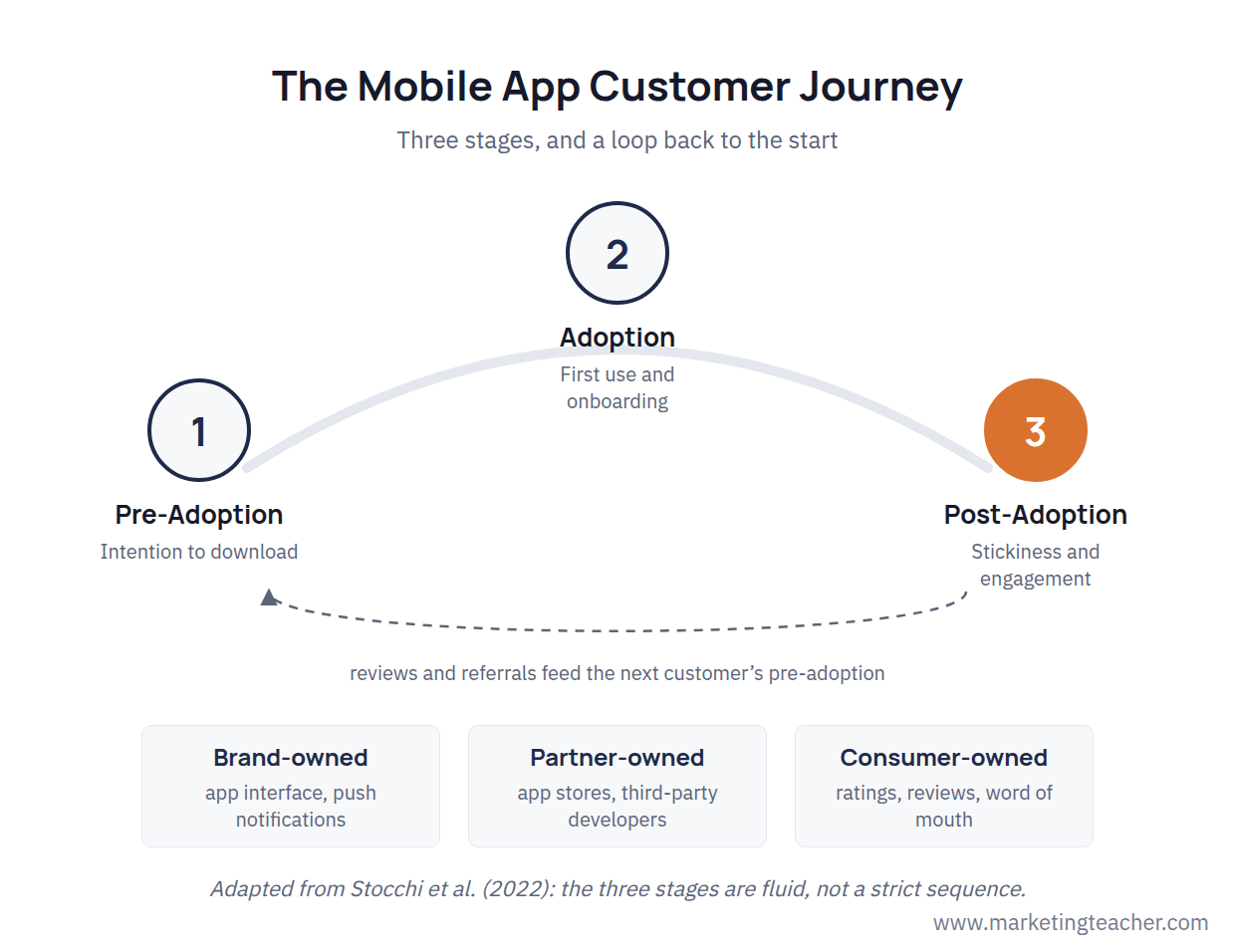
Mobile apps are now central to how many brands reach customers, whether the app supports an existing product or the app is the product itself. A large integrative review of marketing research on apps by Stocchi et al. (2022) argues that the clearest way to understand how a customer engages with an app is to treat it as a journey rather than a single decision to download, building on Lemon and Verhoef’s (2016) influential model of the customer journey to divide the app experience into three stages: pre-adoption, adoption, and post-adoption. Each stage raises different questions for the customer, and each therefore calls for a different marketing response.
 \n\n
\n\n
Stage One: Pre-Adoption
Pre-adoption covers everything that happens before someone downloads an app. Stocchi et al. (2022) identify two things that especially shape a person’s willingness to adopt an app at this stage: the technological features and benefits they expect it to deliver, such as ease of use, usefulness, and novelty, and their own individual characteristics, including how experienced they already are with similar apps and how much risk they are comfortable taking on. Marketers can influence this stage through app-store visibility, advertising, and word of mouth. The research also flags a gap worth noting: most existing studies explain why people intend to adopt an app, but far fewer test what actually persuades them to follow through and do so.
Stage Two: Adoption
Adoption is the stage in which a customer actually downloads an app and begins using it. First impressions carry a lot of weight here: an app that feels unfamiliar, slow, or unnecessarily complicated can lose a new user within the first few sessions, before it has had any real chance to prove its value. Firms shape this stage directly through onboarding flows, tutorials, and the design choices built into the app itself, and indirectly through the positioning and expectations set up during pre-adoption. Because adoption is where a customer’s earlier predispositions are tested against reality, it is also the stage where an app’s design has to deliver on whatever its marketing promised.
Stage Three: Post-Adoption
Post-adoption covers everything that happens after first use: does the customer keep opening the app, and does that ongoing use actually benefit the brand? Stocchi et al. (2022) group post-adoption outcomes under two headings: stickiness, meaning a customer’s intention to keep using the app and how often they return to it, and engagement, meaning a customer’s voluntary contribution to the brand that goes beyond simply using the app, such as leaving a review, sharing content, or recommending the app to a friend. This is usually the stage marketers pay the least attention to relative to its importance, since acquiring a new user is generally treated as the harder problem than retaining one who is already there.
Who Controls the Experience? Three Types of Touchpoint
The same review also classifies the touchpoints that shape an app’s customer journey into three types: brand-owned touchpoints, which a company designs and controls directly, such as the app’s own interface and its push notifications; partner-owned touchpoints, shared with other organisations such as app stores or third-party developers; and consumer-owned touchpoints, which the brand cannot directly control, such as a customer’s own ratings, reviews, and recommendations to friends. All three touchpoint types operate across all three journey stages at once. An app-store rating, for example, shapes a new customer’s pre-adoption decision while also being a post-adoption outcome created by an existing one. A marketing team that focuses only on acquisition can easily miss how much of its post-adoption experience is quietly doing the work of the next customer’s pre-adoption stage.
Summary
An app’s customer journey runs through three stages – pre-adoption, adoption, and post-adoption – each shaped by different customer questions and different combinations of brand-owned, partner-owned, and consumer-owned touchpoints. Marketers who focus only on driving downloads risk overlooking the stage, post-adoption, where much of an app’s long-term value or failure is actually decided, and where the outcomes customers create loop back to shape the next customer’s decision to adopt at all.
The slides, worksheet, lesson plan and poster for this lesson are free to download and free to use in your course — no sign-up, no permission needed. See the teacher resources →
Assign this lesson to your class:
Using Canvas, Blackboard or Moodle? Copy the link and paste it into your course page or assignment. More ways to add lessons to your LMS.

