
What Is Search Marketing?
Search marketing covers the two main ways a business gets found on a search engine: search engine optimization, which earns a high organic ranking without paying for the position, and paid search, most often run as pay-per-click, or PPC, advertising. Search engine optimization is covered in its own lesson on this site, so this lesson focuses on paid search: the adverts that appear above or alongside the organic results and that a business pays for directly, most commonly through Google Ads or Microsoft Advertising, the platform that also serves paid search ads across Yahoo, since Yahoo’s results and ads run on Microsoft’s infrastructure. Paid search works a little like traditional advertising in that a business pays for a prominent position, but unlike a magazine advert, that payment is only triggered when someone actually clicks, not simply when the advert is shown. That single difference changes the economics of the whole channel: a business can gain considerable free exposure just from being seen, and only pays once a genuinely interested visitor takes the extra step of clicking through.
How a Pay-Per-Click Auction Actually Works
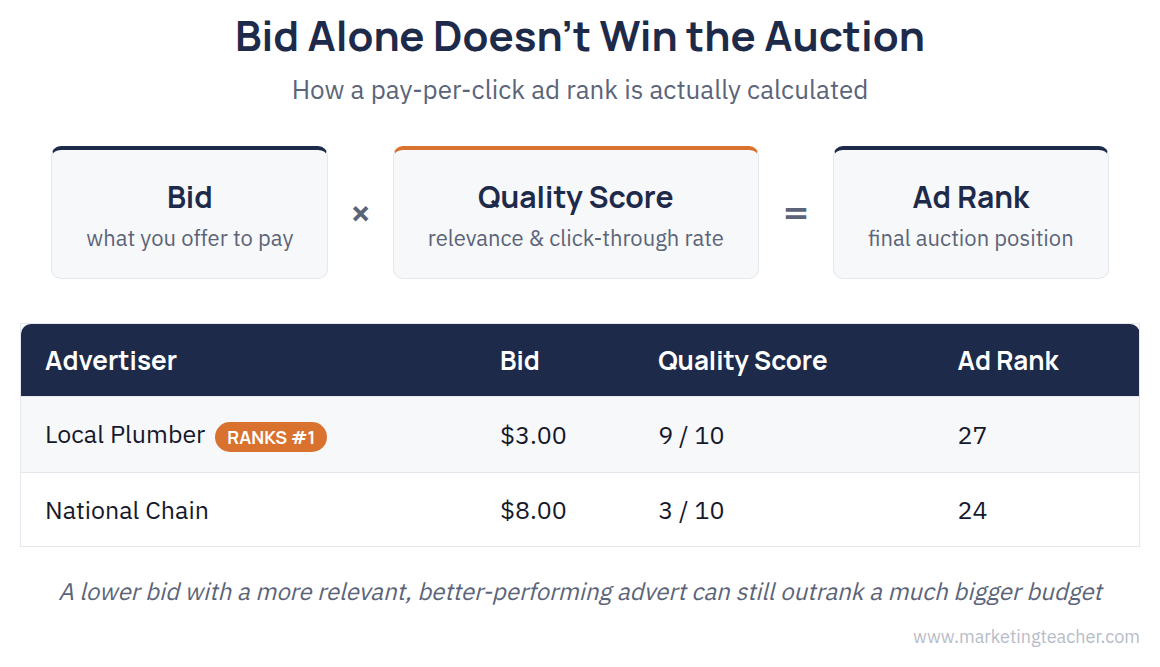
It is a common misconception that the highest bidder always wins the top advertising position, but the reality is more interesting. Edelman, Ostrovsky, and Schwarz (2007) formally described the auction mechanism behind platforms like Google Ads, showing that an advert’s final position depends on a combination of the advertiser’s bid and a quality score reflecting how relevant and well-written the advert is, together with how likely people are to actually click it. In practice this means a smaller advertiser with a lower budget can still outrank a larger competitor if their advert is more relevant to the search and earns a better click-through rate, and Google keeps rewarding that relevance because a more clicked-on advert makes the platform more money too, even at a lower price per click. This also explains why the price paid per click can vary so widely, from a few cents to ten dollars or more, depending on how competitive and valuable a particular keyword is.
Weighing the Benefits and Risks of Paid Search
Paid search has real advantages over both traditional advertising and organic SEO. Chaffey and Ellis-Chadwick (2019) note that a major strength of paid search is how targetable and measurable it is: a business can target by time of day, geographic location, device, and specific keywords, then measure the exact return on investment from the campaign, something far harder to do with a billboard or a magazine advert. Because payment is only triggered by an actual click, a business also benefits from free brand exposure every time its advert is shown but not clicked. Against this, paid search carries real risk. Popular keywords in competitive industries can become extremely expensive, and it is possible to spend a disproportionate amount chasing a keyword during a busy period without a matching increase in actual sales. Unlike organic search rankings, which persist once earned, a paid position disappears the moment a business stops paying for it, so paid search is an ongoing cost rather than a one-time investment. For a very small business with a limited budget, cheaper local advertising may sometimes be more cost-effective than competing in an expensive keyword auction. Running a sensible daily budget cap and monitoring which keywords actually convert into sales, rather than simply which ones generate clicks, is usually what separates a paid search campaign that pays for itself from one that quietly drains a marketing budget without a business ever noticing why.
Summary
Search marketing covers both unpaid search engine optimization and paid search, most commonly run as pay-per-click advertising through Google Ads or Microsoft Advertising. Edelman, Ostrovsky, and Schwarz’s (2007) description of the underlying auction shows that bid amount alone does not decide an advert’s position; relevance and click-through rate matter just as much, which is why a smaller advertiser can still outrank a bigger one. Chaffey and Ellis-Chadwick (2019) point to the targetability and measurability of paid search as its real strength, but that strength comes with an ongoing cost: a paid position, unlike an earned organic ranking, disappears the moment a business stops paying for it.
The slides, worksheet, lesson plan and poster for this lesson are free to download and free to use in your course — no sign-up, no permission needed.

