
What Are Social Networks, and Why Do Businesses Use Them?
A social network is a digital platform built around personal or professional profiles, connections between them, and a constant stream of content that those connections can see, comment on, and share. Kaplan and Haenlein (2010) define social media broadly as internet-based applications that let users create and exchange content, and it is precisely that two-way exchange, rather than one-way broadcasting, that makes social networks so valuable to marketers. A business page on a social network lets a brand hold an ongoing dialogue with customers rather than simply advertising at them: customers can ask questions, share their own experiences, and spread a business’s content to their own connections at no extra cost to the business. That combination of reach, dialogue, and low cost of entry is why almost every marketing communications plan now includes a social media element, even though the specific platforms in fashion change over time, a point worth keeping in mind, since a platform popular today is not guaranteed to still exist in a decade.
Choosing the Right Platform for the Message
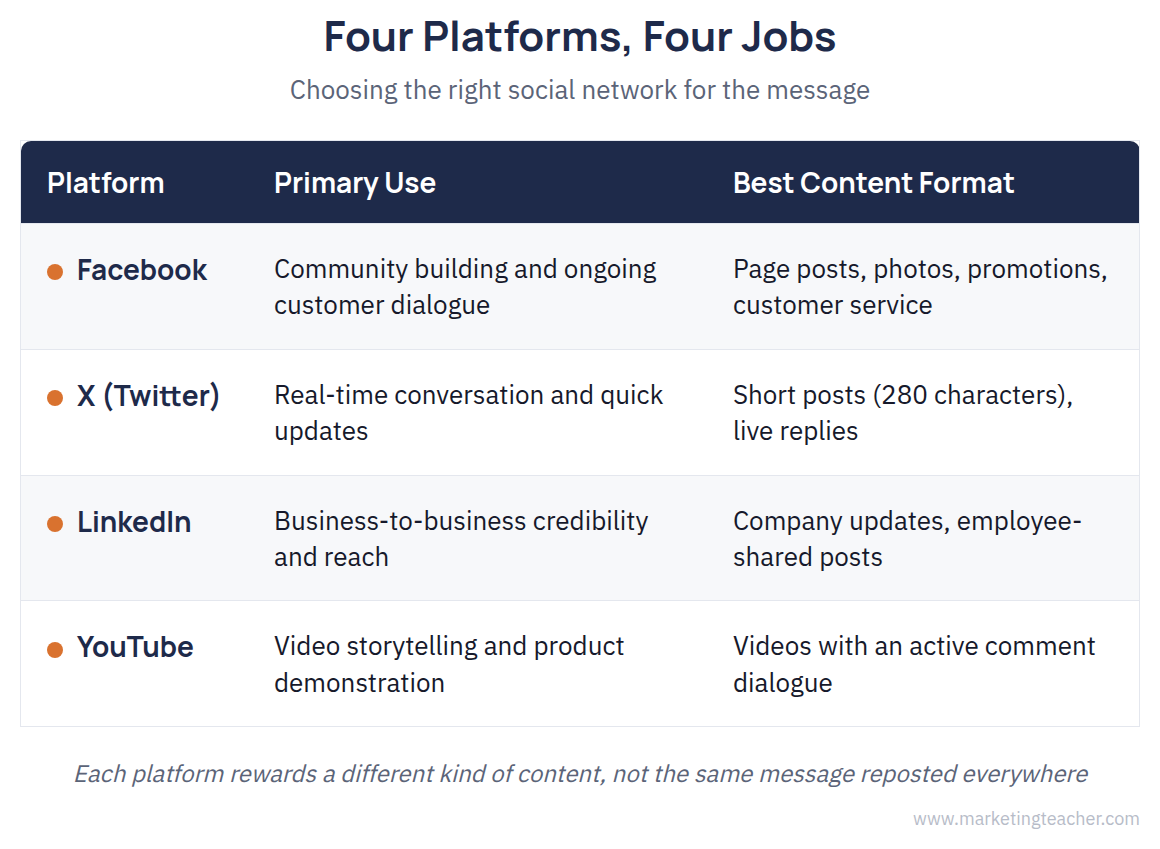
Each major platform suits a different kind of message and audience. A Facebook business page works well for building an ongoing community: customers can like a page, read and share its posts, and check back on updates, which makes it a natural home for customer service, promotions, and everyday brand content. X, formerly known as Twitter, is built for real-time conversation; a standard account is limited to 280 characters per post, which forces messages to be short and immediate, making it well suited to live commentary, customer service replies, and joining conversations that are already trending. LinkedIn is the platform for business-to-business marketing: a company page lets a business showcase what it does to other professionals, and its own employees become an important extension of that page’s reach when they follow it and share its updates with their own networks. YouTube channels give a business a home for video content, from product demonstrations to behind-the-scenes footage, and because a channel supports comments, it also becomes a genuine dialogue with viewers rather than a one-way broadcast.
Managing and Measuring a Multi-Platform Presence
Running a business page well on even one platform takes consistent effort, and most businesses maintain several at once, which is why social media management tools exist. Chaffey and Ellis-Chadwick (2019) note that coordinating messages across channels, rather than treating each platform as a separate silo, is central to an effective digital marketing strategy. Tools such as Hootsuite and Sprout Social let a business schedule posts across multiple platforms from one dashboard, while a link-shortening and tracking tool such as Bitly shows which shared links are actually generating clicks. None of this replaces judgement: a business still has to decide what to post and how quickly to respond to a comment, but the right tools make it realistic to maintain several active channels without a person watching each one around the clock. Once a presence is up and running, it also needs to be measured. Google Ads (previously known as Google AdWords) can support paid promotion of a business’s own social content, while dedicated social media analytics track which posts are actually reaching people, which platforms are driving real traffic back to the business’s own website, and where the strategy might need to change.
Summary
Social networks give a business the chance to build an ongoing, two-way dialogue with customers rather than simply advertising at them, but each major platform, Facebook, X, LinkedIn, and YouTube, suits a different kind of message and audience. Kaplan and Haenlein’s (2010) definition of social media as content people create and exchange helps explain why dialogue, not broadcasting, is the real value here, while Chaffey and Ellis-Chadwick (2019) point to coordinated, cross-channel management as what separates an effective social media strategy from a scattered one. Management tools such as Hootsuite, Sprout Social, and Bitly, paired with genuine analytics, let a business run several platforms at once without losing track of what is actually working.
The slides, worksheet, lesson plan and poster for this lesson are free to download and free to use in your course — no sign-up, no permission needed.

