
What Are the Seven Brand Approaches?
A brand is often defined as a set of mental associations held by the consumer, which add to the perceived value of a product or service, made up of elements such as a name, logo, symbol, or package design that identify a product and distinguish it from others (Knudtzen, Bjerre & Heding, 2020). But how a business is supposed to build and manage those associations has changed a great deal since marketing academics first started studying brands seriously.
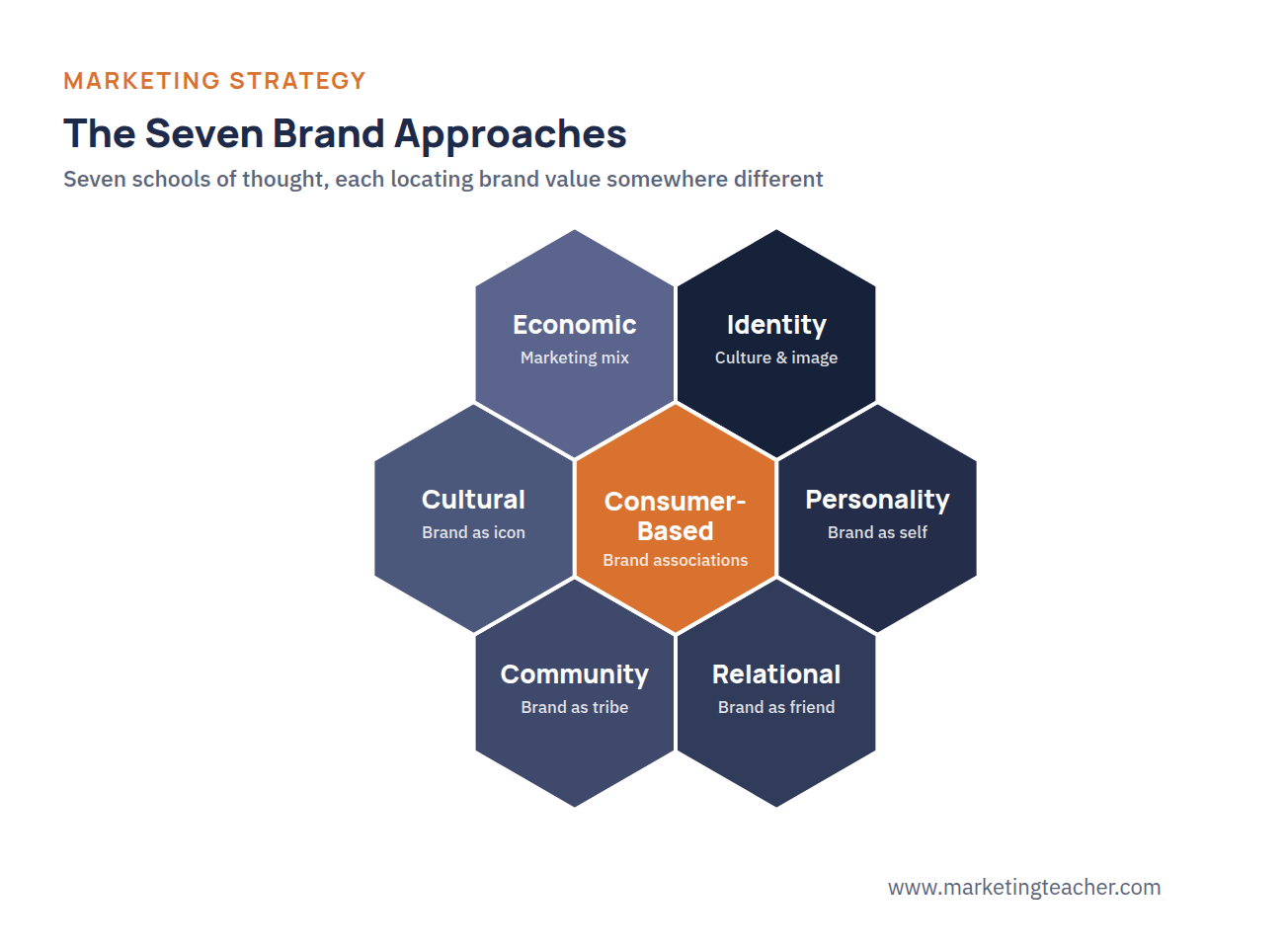
Researchers who reviewed more than 500 academic articles on branding (Knudtzen, Bjerre & Heding, 2020) found that thinking about brands has moved through seven distinct approaches, or “schools of thought,” roughly in chronological order from before 1985 through to the early 2000s. Each approach isn’t simply a replacement for the last one; each carries its own academic tradition, its own view of what a consumer actually is, and its own idea of where brand value comes from. Many businesses still draw on more than one approach at once.
Each approach also comes with its own answer to a deceptively simple question: who is the consumer, really? The earliest approach pictures a rational shopper weighing up price and features. Later approaches picture a stakeholder, a psychological being expressing identity, a member of a tribe, or a participant in wider cultural life. Tracking how that picture of the consumer changed is one of the clearest ways to understand why brand management looks so different today from how it looked sixty years ago.
The Seven Approaches
The economic approach, dating from before 1985, treats the consumer as a rational “economic man” weighing up price and features. Value comes from getting the marketing mix right: product, price, place, and promotion.
The identity approach, emerging in the mid-1990s, shifts the focus inward, treating the whole organisation, not just the product, as the source of the brand. Value comes from aligning a company’s culture, vision, and image so that what it says about itself matches what it actually is.
The consumer-based approach, formalised in 1993, is built around the associations that exist in a customer’s mind: brand image, brand awareness, and the mental links a customer forms with a brand. Value comes from managing and strengthening those associations over time.
The personality approach, from 1997, treats a brand as though it has a human personality that consumers can relate to, borrow from, or use to express who they are. Value comes from how strongly a customer sees their own personality reflected in the brand’s.
The relational approach, from 1998, treats the connection between a brand and a customer as a genuine two-way relationship, similar to a friendship, that can be strong or weak, close or distant. Value comes from the quality of that relationship over time, not from a single transaction.
The community approach, from around 2001, recognises that meaning is often created between consumers, not just between a brand and a single customer. A “brand community” can form when at least two consumers interact around a shared brand, creating value the marketer doesn’t fully control.
The cultural approach, also from around 2000, treats brands as carriers of cultural meaning, sometimes becoming icons that comment on the tensions and contradictions within society itself. Value comes from a brand’s willingness to take a genuine cultural position rather than just sell a product.
A Closer Look: The Community Approach
Of the seven, the community approach represents one of the clearest breaks from the earlier, more marketer-controlled thinking (Knudtzen, Bjerre & Heding, 2020). Instead of a straight line running from marketer to consumer, it describes a “brand triad”: a marketer and at least two consumers, all shaping what the brand means together. Once that triad exists, meaning is created in the company of others, and networks of consumers can generate brand meaning independently of anything the marketer publishes or intends.
Why the Approaches Still Matter Together
Because the seven approaches developed one after another, it’s tempting to think each new one made the last one obsolete. In practice, most brands still rely on ideas from several approaches simultaneously. A business still needs the right product at the right price (the economic approach), a coherent internal culture and image (the identity approach), and strong mental associations in the customer’s mind (the consumer-based approach), even if it’s also trying to build relationships, communities, or cultural relevance on top of that foundation.
Summary
Brand management has developed through seven distinct approaches since the 1960s: economic, identity, consumer-based, personality, relational, community, and cultural. Each treats the consumer differently, from a rational decision-maker to a member of a self-organising community, and each locates the source of brand value somewhere different, from the marketing mix to shared cultural meaning. Understanding all seven gives a much richer picture of how a brand actually creates value than relying on any single approach alone.
Quiz

The slides, worksheet, lesson plan and poster for this lesson are free to download and free to use in your course — no sign-up, no permission needed.

