
What Is Marketing?
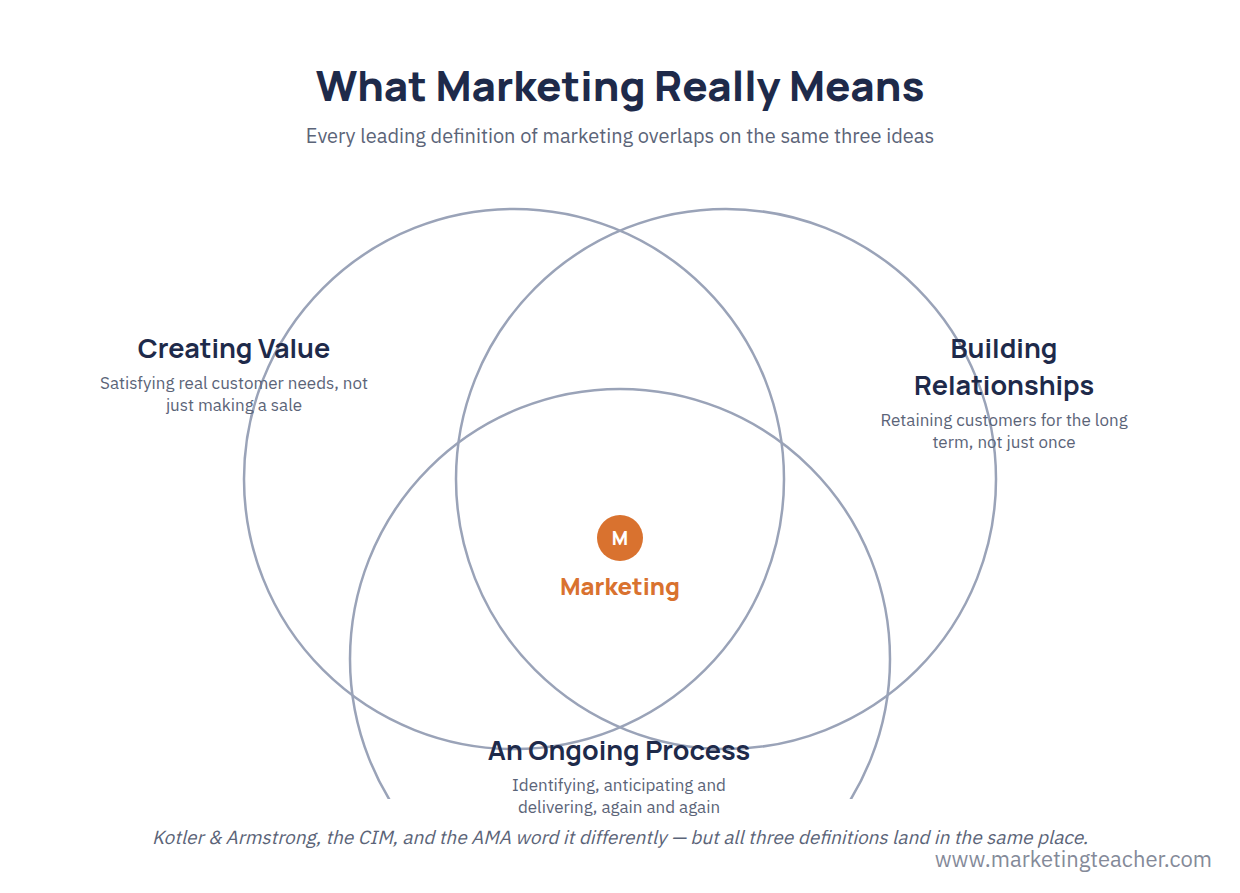
Ask ten people what marketing is and you will likely get ten different answers — adverts, social media posts, a logo, a sales pitch. Academics and professional bodies have spent decades refining a more precise answer, and although they word it differently, their definitions converge on the same core idea: marketing is the process of creating value for customers in order to build strong, lasting relationships with them (Kotler & Armstrong, 2018). Selling something once is not the goal. Understanding what a customer actually needs, meeting that need better than the alternatives, and keeping that customer coming back is.
Marketing Is Not Just Selling and Advertising
This is one of the most common misconceptions about the subject, and it is worth clearing up early. Selling and advertising are just two of the many tools marketing uses to communicate with customers — they are the visible tip of a much larger process that starts long before a product is advertised and continues long after it is sold. A business can advertise heavily and still fail if the underlying product does not meet a real customer need; equally, a business with a genuinely well-matched product can succeed with comparatively little advertising because word of mouth and repeat custom do the work instead. Marketing includes researching what customers want, designing a product or service around that want, pricing and distributing it appropriately, and only then communicating it — selling and advertising sit at the end of that chain, not at the start of it.
How the Experts Define It
Kotler and Armstrong offer two versions of their definition, one broad and one narrower. The broad version describes marketing as the social process by which individuals and organisations obtain what they need and want by creating and exchanging value with others. The narrower, business-facing version is more specific: the process by which companies create value for customers and build strong customer relationships in order to capture value from customers in return (Kotler & Armstrong, 2018). Both versions share the same two ingredients — value, and an exchange between two parties — but the second makes explicit that a business only benefits from marketing once it has already given the customer something worth having.
The Chartered Institute of Marketing (CIM), the UK’s professional body for the discipline, defines marketing as the management process responsible for identifying, anticipating and satisfying customer requirements profitably. This definition adds a detail the others leave implicit: marketing is not just reactive. A well-run marketing function anticipates what customers will want before they ask for it, rather than only responding once a need becomes obvious. The American Marketing Association (AMA) reaches a similar conclusion from a different angle, defining marketing as the activity, set of institutions, and processes for creating, communicating, delivering, and exchanging offerings that have value for customers, clients, partners, and society at large (American Marketing Association, 2007). Three professional definitions, three different emphases — value creation, anticipation, and a wider set of institutions and processes — but not one of them mentions selling as the starting point.
Marketing Is a Process, Not a One-Off Event
Every definition above treats marketing as an ongoing process rather than a single activity, which is why it is best understood as a repeating cycle: identifying what customers need, anticipating how those needs might change, creating and delivering something that meets them, and then using the relationship that builds to understand the customer even better next time round. This is the same logic behind the five-step marketing process model, which breaks the cycle down into concrete stages a business can actually follow. Marketing scholar Michael Baker made a related point in observing that marketing is one of humanity’s oldest activities, even though it is often mistaken for a purely modern invention (Baker, 1976) — traders have always tried to understand what buyers want and adjust what they offer accordingly; what has changed over time is the scale, the tools, and the amount of choice customers now have.
Summary
Kotler and Armstrong, the CIM, and the AMA each define marketing in slightly different words, but all three place value creation and customer relationships at the centre of the definition, not selling or advertising (Kotler & Armstrong, 2018). Understanding this distinction matters because it changes where a business focuses its effort: not on persuading harder, but on understanding customers well enough that persuasion becomes far less necessary.

The slides, worksheet, lesson plan and poster for this lesson are free to download and free to use in your course — no sign-up, no permission needed. See the teacher resources →
Assign this lesson to your class:
Using Canvas, Blackboard or Moodle? Copy the link and paste it into your course page or assignment. More ways to add lessons to your LMS.

