
Is There Always a Reason People Buy?
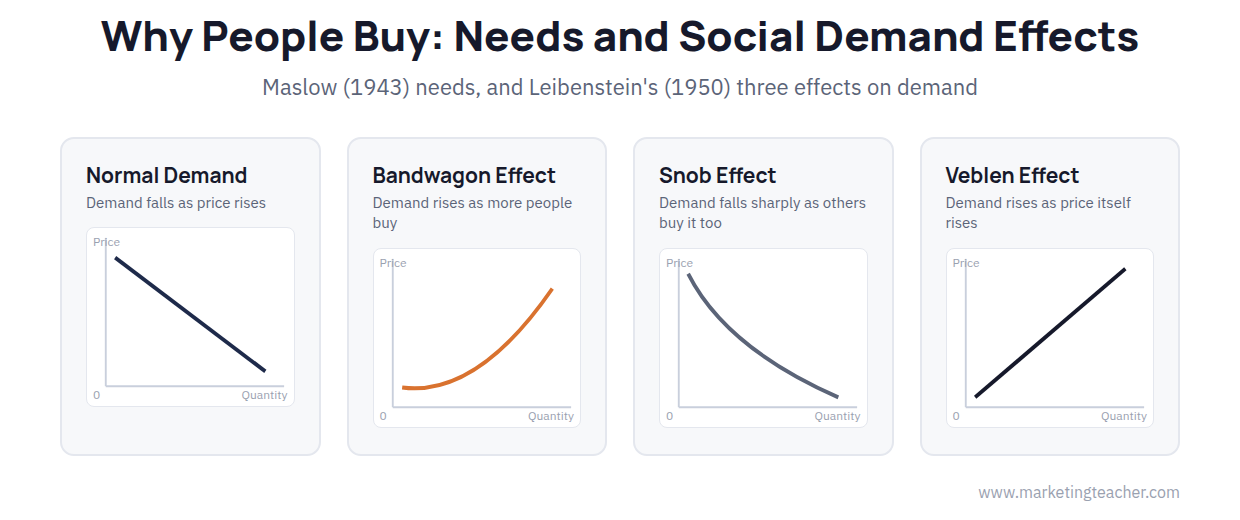
Marketers spend enormous amounts of time and money trying to understand why people buy the things they do. A purchase can sometimes look impossible to explain from the outside, but there is always a reason behind it, even when that reason is not fully conscious to the buyer themselves. Broadly, every purchase satisfies either a need, something required for basic functioning or survival, or a want, something desired but not strictly necessary. The same product, a bottle of water for example, can be a need for someone who is thirsty with no other option and a want for someone reaching for a specific brand out of habit or preference.
Needs as the Foundation of Buying
Maslow (1943) proposed that human needs are arranged in a hierarchy, starting with physiological needs such as food, water and shelter, followed by safety and security, before rising toward social belonging, esteem and self-actualisation. Many everyday purchases map directly onto the lower levels of this hierarchy: buying groceries satisfies a physiological need, while buying insurance or a secure lock satisfies a safety need. Purchases higher up the hierarchy, a gym membership pursued for confidence or a hobby pursued for personal growth, are harder to justify on pure necessity but make sense once the underlying need being satisfied is identified.
The Bandwagon, Snob and Veblen Effects
Not every purchase is driven by necessity or straightforward preference. Leibenstein (1950) described three effects that shape demand in ways ordinary supply-and-demand thinking does not fully capture. The bandwagon effect describes a desire to buy something because other people are buying it, where popularity itself increases the appeal of a product. The snob effect is the opposite: a desire to own something specifically because few other people have it, where scarcity or exclusivity drives the appeal. The Veblen effect describes preference for a product that increases, rather than decreases, as its price rises, because the high price itself signals status. A shopper drawn to a specific handbag purely because it is instantly recognisable as expensive is exhibiting a Veblen effect, not simply paying for higher functional quality.
Rational and Emotional Motives
Buying motives can also be separated by how consciously reasoned they are. A rational motive involves logical, thought-out reasoning, such as comparing prices and features before choosing a laptop. An emotional motive is driven more by feeling than by careful analysis, such as buying a gift because it feels right in the moment rather than because it was the objectively best option available. Most real purchases blend both: a car buyer might rationally compare fuel efficiency and price across several models, while still being emotionally drawn to one particular color or brand reputation that has little to do with the vehicle’s practical performance.
Practical and Impractical Purchases
Purchases can also be sorted by how essential they genuinely are. A practical purchase serves a clear, functional need, such as buying shoes to protect and support the feet, or medicine to treat an illness. An impractical purchase is not strictly necessary at all, bought instead for enjoyment, novelty or emotional satisfaction. Neither category is inherently better or worse from a marketing standpoint; a retailer selling practical goods succeeds by demonstrating reliability and value, while a retailer selling impractical, discretionary goods succeeds by tapping into exactly the emotional and social motives, including the bandwagon, snob and Veblen effects, described above.
What Buying Ultimately Aims to Do
Underneath these different motives, buying behavior generally aims to increase something the buyer values, whether that is convenience, pleasure or confidence, or to protect something they already have, such as their health, their family, or their financial position. Other purchases aim to reduce something unwanted, like risk, worry or wasted time, or to save a limited resource, such as money, time or energy. Framing a purchase this way, as an attempt to increase, protect, reduce or save something specific, gives marketers a clearer lens for understanding a customer’s real motivation than simply asking what product they bought.
Summary
There is always a reason behind a purchase, even when it is not immediately obvious. Maslow’s (1943) hierarchy of needs explains how buying satisfies needs ranging from basic survival to self-actualisation, while Leibenstein’s (1950) bandwagon, snob and Veblen effects explain demand that is driven by popularity, exclusivity or price itself rather than by practical need. Rational and emotional motives further shape how a purchase decision actually gets made, and understanding whether a customer is trying to increase, protect, reduce or save something gives marketers a genuinely useful way to understand buying behavior beyond the product itself.
The slides, worksheet, lesson plan and poster for this lesson are free to download and free to use in your course — no sign-up, no permission needed. See the teacher resources →
Assign this lesson to your class:
Using Canvas, Blackboard or Moodle? Copy the link and paste it into your course page or assignment. More ways to add lessons to your LMS.

