
What Is a Customer?
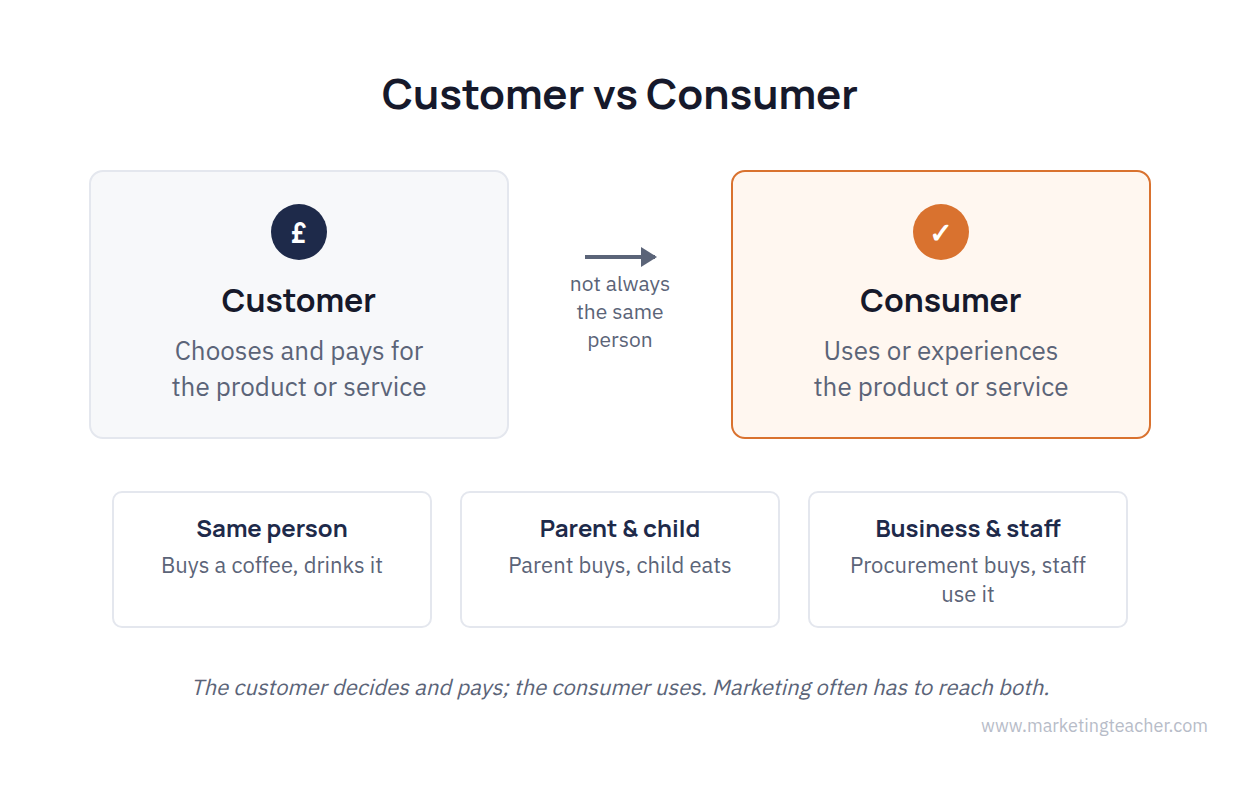
In everyday conversation “customer” and “consumer” are often used as if they mean the same thing, but marketers draw a real distinction between them. A customer is the person or organisation that actually purchases a product or service; a consumer is whoever ends up using it (Kotler & Armstrong, 2018). The two are frequently the same person — someone who buys a coffee and drinks it is both customer and consumer in one. But they can just as easily be different people, and recognising when that happens changes how a business should think about its marketing.
The Five Types of Markets
Not every customer is an individual shopper. Kotler and Armstrong (2018) group buyers into five broad types of markets. Consumer markets are individuals and households buying goods and services for their own use. Business markets buy goods and services to use in producing their own products, such as a bakery buying flour. Reseller markets buy goods purely to sell them on again at a profit, such as a supermarket. Government markets buy goods and services to carry out public functions, from stationery to infrastructure. International markets sit across all of the above, adding the extra layer of buyers, resellers and governments located in other countries. A business selling office furniture, for example, might serve a consumer market (a home-office worker), a business market (a growing start-up), a reseller market (a furniture retailer) and a government market (a local council), all with slightly different versions of the same product line.
Who Really Makes the Purchase Decision?
The sweet-shop example points to something marketers need to plan for directly: a single purchase can involve several different roles, not just “buyer” and “user.” Someone might initiate the idea of a purchase, someone else might influence which option gets chosen, someone else decides, someone else hands over the money, and someone else uses the end result — and any of these can be the same person, or five different people (Kotler & Armstrong, 2018). A family buying a holiday might have a child who first suggests the idea, both parents influencing the destination, one parent making the final decision and booking it, and the whole family as the eventual users. Understanding who plays which role is central to the Decision Making Unit and the wider Buyer Decision Process a customer works through before buying.
Needs, Wants, and Demands
Marketers also have to separate what a customer needs from what they want. A need is a basic requirement — food, warmth, belonging, status. A want is the specific form that need takes once it has been shaped by a person’s own experience and culture: someone who is hungry needs food, but wants a particular dish. When a want is backed by the ability and willingness to pay for it, it becomes a demand (Kotler & Armstrong, 2018). Confusing needs with wants is a common marketing mistake — a business that only listens to what customers say they want can miss the underlying need those wants are actually trying to satisfy, and end up building the wrong solution to the right problem.
Why This Distinction Matters for Marketing
Once a business knows its customer and its consumer might not be the same person, its whole marketing mix can change. A toy manufacturer advertises the fun of a toy directly to children, who have no money but plenty of influence, while designing the packaging, price and safety claims to reassure the parent who actually pays. A software company selling to businesses often markets to two very different audiences within the same organisation: the procurement team that negotiates the contract and signs off the spend, and the staff who will use the software every day, whose buy-in decides whether the purchase gets renewed. Deciding how to reach each of these groups starts with segmentation and choosing a target market — both begin with the same question: who, specifically, needs persuading?
Summary
A customer buys; a consumer uses — and while the two overlap constantly, treating them as identical can blind a business to who it should actually be persuading. Kotler and Armstrong’s (2018) five types of markets show that “the customer” can be an individual, a business, a reseller, a government body or an overseas buyer, each needing a different approach. And because a real purchase decision is rarely made by one person acting alone, understanding needs, wants, and the different roles people play before money changes hands is where good marketing starts.

The slides, worksheet, lesson plan and poster for this lesson are free to download and free to use in your course — no sign-up, no permission needed. See the teacher resources →
Assign this lesson to your class:
Using Canvas, Blackboard or Moodle? Copy the link and paste it into your course page or assignment. More ways to add lessons to your LMS.

