
What Are the Five Vs of Big Data?
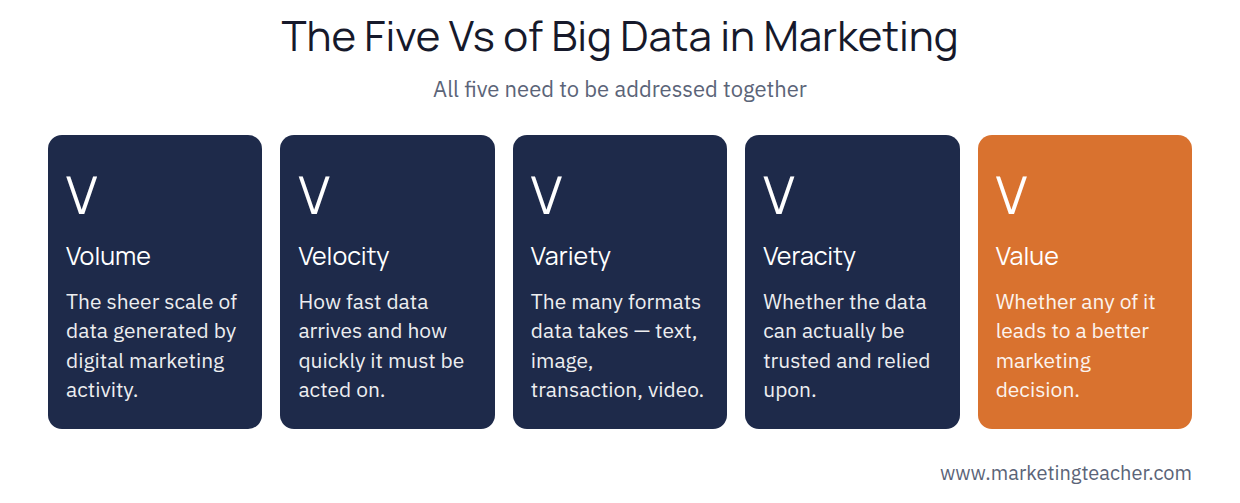
The five Vs — volume, velocity, variety, veracity and value — describe the characteristics that make big data genuinely different from the smaller, tidier datasets marketers worked with before digital channels existed. The framework’s origins trace back to an early description of data management challenges around volume, velocity and variety (Laney, 2001); veracity and value were added later as the practical and commercial stakes of working with large datasets became clearer. Applied to marketing specifically, the five Vs framework helps explain why simply having more customer data doesn’t automatically translate into better marketing decisions (Erevelles, Fukawa and Swayne, 2016).
Volume
Volume refers to the sheer scale of data generated by modern marketing activity. Every website visit, app interaction, social media engagement and online transaction adds to a dataset that can reach millions of records for even a modestly sized business. Handling that volume requires infrastructure built for it — a spreadsheet that works for a few thousand rows breaks down entirely at the scale most digital marketing now produces, which is why marketing analytics increasingly runs on dedicated data platforms rather than general-purpose office tools.
Velocity
Velocity describes how fast data is generated and how quickly it needs to be acted on. A customer abandoning a cart, a post going unexpectedly viral, or a sudden spike in support complaints can all demand a response within minutes or hours, not the weeks a traditional quarterly report cycle allowed for. Marketing teams that can only process data on a monthly reporting schedule miss the moment when a fast-moving trend or problem could still have been acted on.
Variety
Variety refers to the many different forms marketing data now takes: structured transaction records, free-text customer reviews, images and video shared on social platforms, and behavioural clickstream data, among others. Each format requires different tools to make sense of it — a review written in plain language needs text analysis, while transaction records fit naturally into a conventional database — and the real analytical challenge is usually combining insights from several formats into a single, coherent picture of a customer.
Veracity
Veracity is about how trustworthy the data actually is. Big datasets are rarely clean: duplicate customer records, bot traffic disguised as genuine visits, incomplete form submissions, and outdated contact details are all common, and a marketing decision built on unreliable data can be confidently wrong rather than simply imprecise. Before drawing a conclusion from a large dataset, it’s worth asking specifically how much of it can be trusted, not just how much of it there is — a smaller, well-audited dataset is often more useful than a much larger one nobody has checked.
Value
Value is the reminder that volume, velocity, variety and even veracity mean nothing on their own — a dataset only matters if it leads to a decision that wouldn’t otherwise have been made, or made as well. A business can have enormous amounts of fast-moving, varied, reasonably clean data and still extract no real value from it if nobody in the organisation acts differently because of it. Value is ultimately what separates big data as a genuine marketing asset from big data as an expensive storage bill.
Why the Five Vs Work Best Together
Treating any single V in isolation tends to produce a lopsided view of a marketing data programme. A business focused purely on volume without addressing veracity risks confidently acting on bad data at scale. One obsessed with velocity without variety may react quickly to incomplete signals. The framework is most useful as a checklist applied together — a way of asking whether a marketing data effort has genuinely covered scale, speed, format diversity, trustworthiness and, above all, whether any of it changes a real decision (Erevelles, Fukawa and Swayne, 2016).
Summary
The five Vs of big data — volume, velocity, variety, veracity and value — extend an original framework built around data-management challenges (Laney, 2001) into a lens specifically useful for marketing decisions (Erevelles, Fukawa and Swayne, 2016). Volume, velocity and variety describe the scale, speed and format diversity of modern marketing data; veracity asks whether that data can be trusted; and value asks whether any of it actually changes a decision. Marketing teams that address all five together get meaningfully more out of their data than those that focus on collecting more of it alone.
The slides, worksheet, lesson plan and poster for this lesson are free to download and free to use in your course — no sign-up, no permission needed. See the teacher resources →
Assign this lesson to your class:
Using Canvas, Blackboard or Moodle? Copy the link and paste it into your course page or assignment. More ways to add lessons to your LMS.

