
Learning Outcome: By the end of this lesson, you will be able to explain how TikTok’s short-form video format changes marketing strategy, describe what content characteristics drive engagement and purchase intent, and apply the research to a realistic brand scenario.
This lesson is part of our Foundations of Social Media Marketing course. Study the full course and earn a certificate →
What Makes TikTok Different From Other Video Platforms?
TikTok is built around short, vertical videos surfaced primarily through an algorithmic “For You” feed rather than a feed of accounts a user follows, which means a brand new to the platform can reach a large audience without first building a following – something far harder on most other social platforms. Xiao et al. (2023), in a big-data study published in the Journal of Retailing and Consumer Services, identified four features of short-form video advertising that significantly drive consumer engagement behaviour: performance expectancy, entertainment value, tie strength with the viewer, and the directness of the sales approach – and found that these effects vary depending on the type of product being advertised.
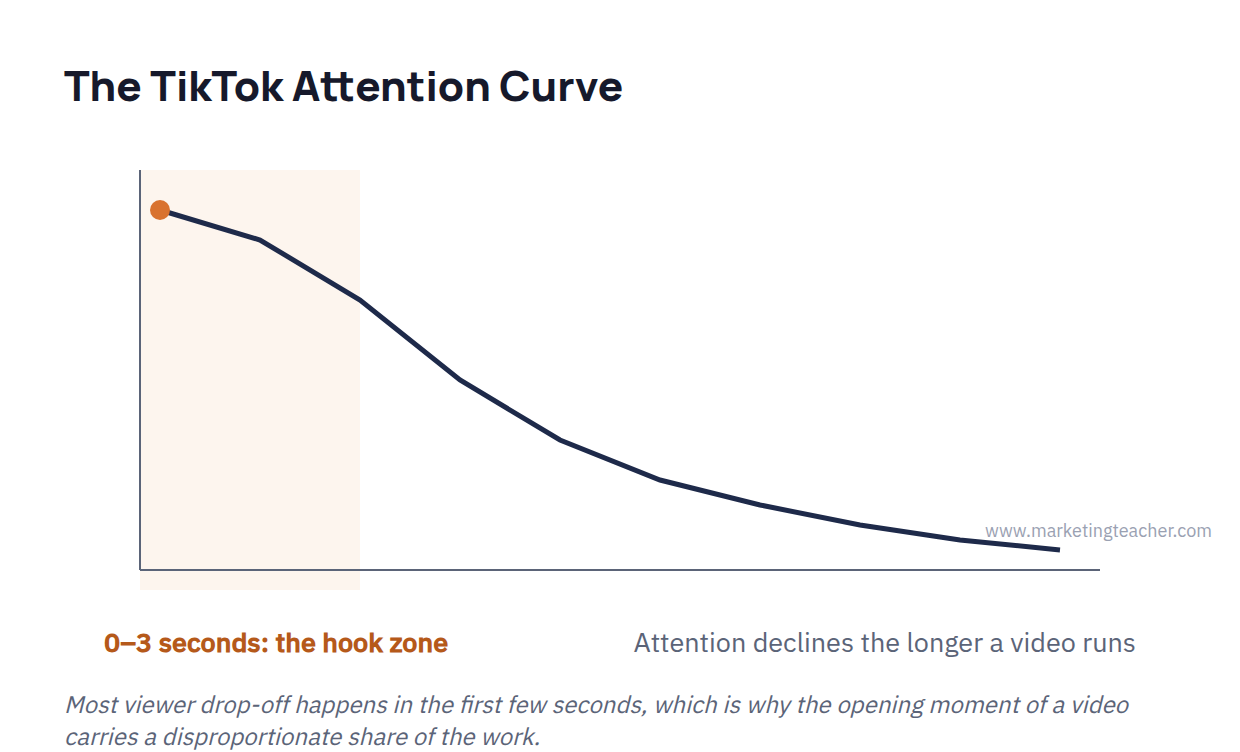
The First Few Seconds Decide Everything
Because TikTok’s feed is designed for rapid scrolling, a video has only a few seconds to earn a viewer’s attention before they swipe past. Meng et al. (2024), analysing 2,578 short-form video advertisements on TikTok in the Journal of Business Research, identified five content characteristics that shaped consumer purchase behaviour: trustworthiness, expertise, attractiveness, authenticity, and brand heritage – with trustworthiness, expertise, and attractiveness driving purchase intent in a straightforward way, while authenticity and brand heritage showed a more complex, U-shaped relationship. In practice, this means the opening moment of a video needs to signal quickly why it’s worth watching, before any of these deeper qualities can even register with a viewer.
Trends, Sounds, and Creator Culture
Much of what performs well on TikTok is tied to platform-specific trends: a popular sound, a recognisable format, or a challenge that other creators are also participating in. Brands that adapt a live trend to their own product, rather than posting generic advertising, tend to perform far better, because the platform’s audience actively seeks out content that feels native to TikTok’s culture rather than repurposed from another channel. This is also why creator partnerships are especially central to TikTok marketing: an established creator already understands the platform’s current visual and comedic language in a way a brand’s own marketing team often does not.
Example: Larchmont Outdoor Gear’s Trend-Led Launch
The fictional outdoor equipment brand Larchmont Outdoor Gear had no existing TikTok presence when it launched a new lightweight tent. Rather than posting a conventional product video, it partnered with three mid-sized outdoor creators to adapt a currently trending “unexpected item swap” format, replacing the expected item with the tent packing down to an implausibly small size. The three videos together generated over 40 times Larchmont’s typical organic reach on other platforms, and one clip was reposted widely enough to register a measurable spike in direct website traffic within 48 hours. No comparable spend on traditional product-demo advertising had come close to the same reach for Larchmont previously.
What Doesn’t Work
Content that reads as a straightforward advertisement, without adapting to TikTok’s native style, consistently underperforms – users can tell quickly when a video has simply been repurposed from another platform, and tend to scroll past it. Over-polished, studio-quality production can actually hurt performance here, since it signals “advertisement” rather than “content,” working against the platform’s culture of casual, creator-style video.
TikTok’s Wider Cultural Reach
TikTok’s influence increasingly extends beyond its own app, since a video that performs well there is often reposted or referenced on other platforms, and trends originating on TikTok have repeatedly shaped mainstream product demand – a phenomenon sometimes informally described as the “TikTok made me buy it” effect. This spillover means a brand’s TikTok activity should be considered alongside its wider social presence rather than treated as an isolated channel, since a single successful video’s influence rarely stays contained to the platform it was posted on.
Measuring Success Beyond Views
A high view count alone doesn’t guarantee commercial value; completion rate (how much of the video is watched), shares, and comments are stronger indicators of genuine resonance, since TikTok’s algorithm itself uses these signals to decide how widely to distribute a video further. A brand should track these engagement signals alongside any direct sales impact, rather than treating raw view count as the primary success metric.
Paid Promotion on TikTok
Alongside organic, trend-led content, TikTok also offers conventional paid advertising formats, including in-feed ads that appear within the For You feed and branded hashtag challenges that invite users to create their own content around a theme. These paid formats work best when they borrow the same native, entertainment-first sensibility that makes organic TikTok content succeed – a paid ad that looks and feels like a polished television commercial dropped into the feed tends to underperform relative to one built specifically for the platform’s own visual language.
Summary
TikTok’s algorithmic, trend-driven feed rewards content that feels native to the platform rather than repurposed advertising, with the opening seconds of a video doing most of the work in earning attention. Trustworthiness, entertainment value, and authenticity all shape whether a video converts into genuine engagement and purchase intent, and creator partnerships remain one of the most reliable ways for a brand to speak the platform’s native language.
Key Idea: TikTok doesn’t reward advertisements – it rewards content that feels like it belongs on TikTok. A trend-adapted, creator-led video will consistently outperform a repurposed traditional advert, no matter how well-produced the advert is.
More in this series: Marketing on the social platforms
Facebook Marketing · Instagram Marketing · Twitter Marketing · TikTok Marketing · Snapchat Marketing · Influencer Marketing · Social Networks
Teaching this topic?
The slides, worksheet, lesson plan and poster for this lesson are free to download and free to use in your course — no sign-up, no permission needed. See the teacher resources →
Assign this lesson to your class:
Using Canvas, Blackboard or Moodle? Copy the link and paste it into your course page or assignment. More ways to add lessons to your LMS.
Written by Marketing Teacher.
Online course · certificate on completion
Study the full Social Media Marketing course — and earn a certificate
Eleven modules on strategy, content, community, advertising and measurement, written at Level 4, with a short quiz after each.

