
What Is Social Media Prediction?
Every day, people post their opinions, plans and complaints on social media without knowing that a researcher somewhere might be mining that post to forecast something else entirely: a stock price, an election result, or a flu outbreak. Social media prediction is the practice of using the huge, constant stream of posts, likes, shares and search activity as raw material for statistical models that try to forecast a future outcome, rather than just describe the past. Rousidis, Koukaras and Tjortjis (2020) reviewed 43 academic studies published between 2015 and 2019 that attempted exactly this, and sorted the results into a simple map of where the technique is actually being tried.
Three Arenas Where the Technique Gets Used
Rousidis et al. (2020) group social media prediction into three broad categories, each covering three narrower fields. Finance covers stock markets, product pricing and real estate — using posts to anticipate price movements before they show up in the official numbers. Marketing covers customer needs, trends and entertainment, and product promotion — the category most directly relevant to this lesson, since it is where brands try to turn chatter into a forecast of demand. Sociopolitical covers elections, disease and public health, and natural phenomena — cases where the stakes are public rather than commercial, but the underlying method is the same.
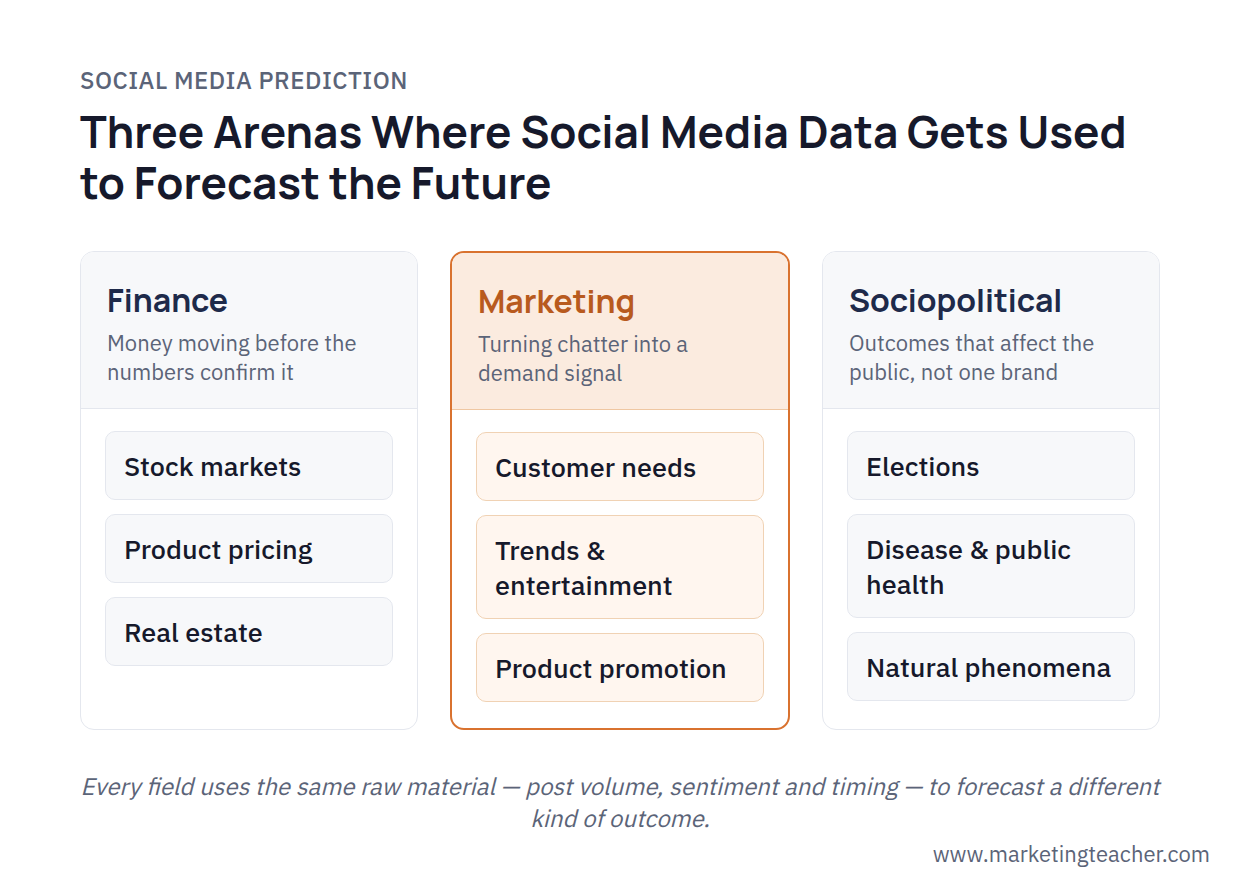
What ties all nine fields together is the data source, not the outcome being forecast: researchers take the volume, sentiment or timing of social media activity and feed it into a statistical or machine-learning model, then check whether the model’s forecast matched what actually happened.
How the Predictions Are Actually Built
The methods vary field to field, but a few patterns repeat. Sentiment analysis classifies posts as positive, negative or neutral and tracks how that balance shifts over time. Volume-based models simply count how often a topic is mentioned, on the reasoning that a sudden spike often precedes a real-world event. And increasingly, researchers combine social media with other live data sources — search-engine queries, Wikipedia page views, or even hospital admission records — because a single platform on its own is rarely reliable enough: studies combining two or more sources consistently outperformed single-source models, since each source captures a slightly different slice of public behaviour.
Day -4: 890 posts, 3,100 clicks
Day -1: 2,600 posts, 9,400 clicks
Launch day: 6,100 posts, 21,000 clicks, 4,300 units sold
When the Forecast Gets It Wrong
Social media prediction has a well-documented failure mode: political forecasting. Burnap, Gibson, Sloan, Southern and Williams (2016) built a model from around 14 million tweets to forecast the outcome of the UK’s 2015 general election, projecting 285 seats for the Conservative Party and 306 for Labour. The actual result was 330 seats for the Conservatives and 232 for Labour — a large miss in both directions. The problem was not a lack of data; it was that people who post about politics are not a representative sample of people who vote, and enthusiasm expressed online does not translate directly into turnout at the ballot box.
The same caution applies to marketing forecasts. A brand with an unusually vocal, online-heavy customer base can look far more predictable from its social data than a brand whose customers barely post at all — the gap says more about who is online than about whose sales are actually easier to forecast.
Summary
Social media prediction takes the volume, sentiment and timing of posts and uses them to forecast outcomes in finance, marketing and sociopolitical fields. It can genuinely work, as the diminishing but real link between online buzz and new-product sales shows, and it can genuinely fail, as the UK’s 2015 general election forecast showed. With just over half of studies validated outright, the safest way to use a social-media-based forecast is as one input alongside other evidence, not as a stand-alone answer.
The slides, worksheet, lesson plan and poster for this lesson are free to download and free to use in your course — no sign-up, no permission needed.

