
How Does the Affiliate Marketing Process Work?
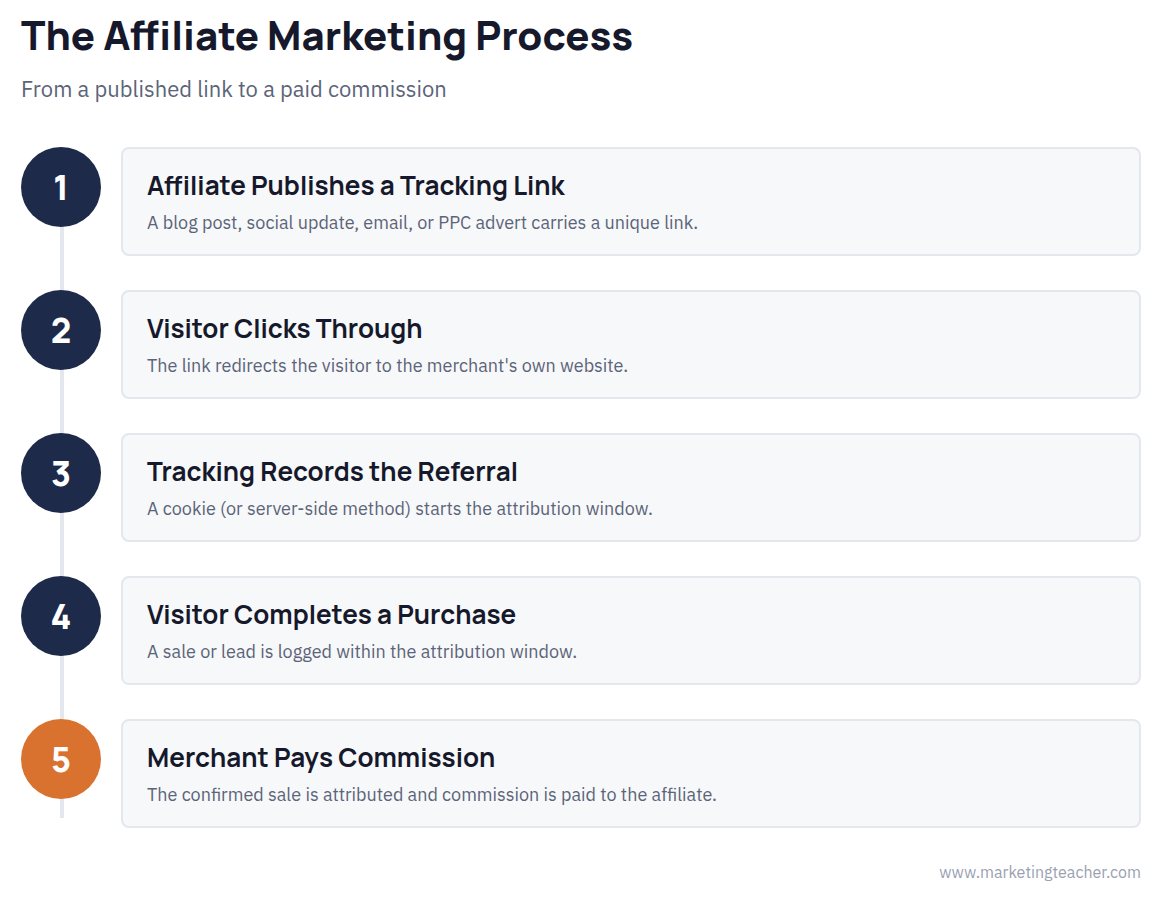
Affiliate marketing involves three parties: a merchant selling a product or service, an affiliate (or publisher) who promotes it, and the customer who eventually buys. What makes affiliate marketing distinctive among digital media channels is that the affiliate is paid only for measurable results, typically a completed sale or lead, rather than simply for showing an advert (Duffy, 2005). This performance-based structure means the whole arrangement depends on being able to trace a sale back to the specific affiliate who generated it, since without reliable tracking there would be no way to know who should be paid (Chaffey and Ellis-Chadwick, 2019).
The Steps From Click to Commission
A typical affiliate transaction follows the same basic sequence regardless of the platform involved. First, the affiliate publishes content containing a unique tracking link, whether that is a blog post, a social media update, an email newsletter, or a pay-per-click advert. Second, a visitor clicks that link and is redirected to the merchant’s own website, often landing on a page that looks identical to any other visitor’s experience. Third, a tracking mechanism, most commonly a cookie placed in the visitor’s browser, records which affiliate referred them and starts a countdown known as the attribution window. Fourth, if the visitor completes a qualifying action, such as a purchase or a sign-up, within that window, the action is logged against the affiliate’s account. Fifth, the merchant or the affiliate network confirms the sale and pays the affiliate their agreed commission, usually after any returns or cancellations period has passed.
How Affiliates Are Compensated
Commission structures vary depending on what the merchant actually wants the affiliate to generate. A cost-per-sale arrangement, often a percentage of the order value, is the most common model in retail affiliate programs and rewards the affiliate only when a purchase is completed. A cost-per-lead arrangement pays a fixed amount for a qualifying action short of a sale, such as a completed sign-up form or a requested quote, and suits businesses such as insurance or finance providers where the sale itself happens later, off-line, or through a different team. Many merchants manage these relationships through an affiliate network or dedicated software platform, which handles the tracking, calculates what each affiliate is owed, and processes payment on the merchant’s behalf, sparing individual affiliates and merchants from having to build this infrastructure themselves. The different types of affiliate arrangement, and how a business chooses between running its own program or joining an established network, are covered in more depth in the dedicated Affiliate Marketing lesson.
Why Tracking and Attribution Windows Matter
The length of the attribution window varies by affiliate program, from as little as 24 hours to 30 days or more, and it directly affects how much credit an affiliate receives for the customers they influence. A short window can under-credit an affiliate whose content genuinely persuaded a customer to buy days later, while a long window can occasionally credit an affiliate for a sale they had little real influence over. Tracking is also not perfectly reliable: a customer who clears their cookies, switches devices, or uses a browser that blocks third-party cookies by default, as several major browsers already do, can break the chain between the original click and the eventual sale. For this reason, many affiliate networks now supplement traditional cookie-based tracking with more resilient methods, such as server-to-server tracking that confirms a sale directly between the merchant’s and the network’s own systems rather than relying solely on the customer’s browser.
Summary
The affiliate marketing process depends on a chain of tracking that runs from a published link, through a click and a tracking cookie, to a completed sale and a confirmed commission (Duffy, 2005). Because affiliates are paid only for measurable results rather than simple exposure, this tracking chain is what makes the whole arrangement possible (Chaffey and Ellis-Chadwick, 2019). The attribution window that governs how long an affiliate can still be credited for a sale, and the growing use of tracking methods beyond the browser cookie, are both central to how modern affiliate programs are run.
The slides, worksheet, lesson plan and poster for this lesson are free to download and free to use in your course — no sign-up, no permission needed.

