
What Is Affiliate Marketing?
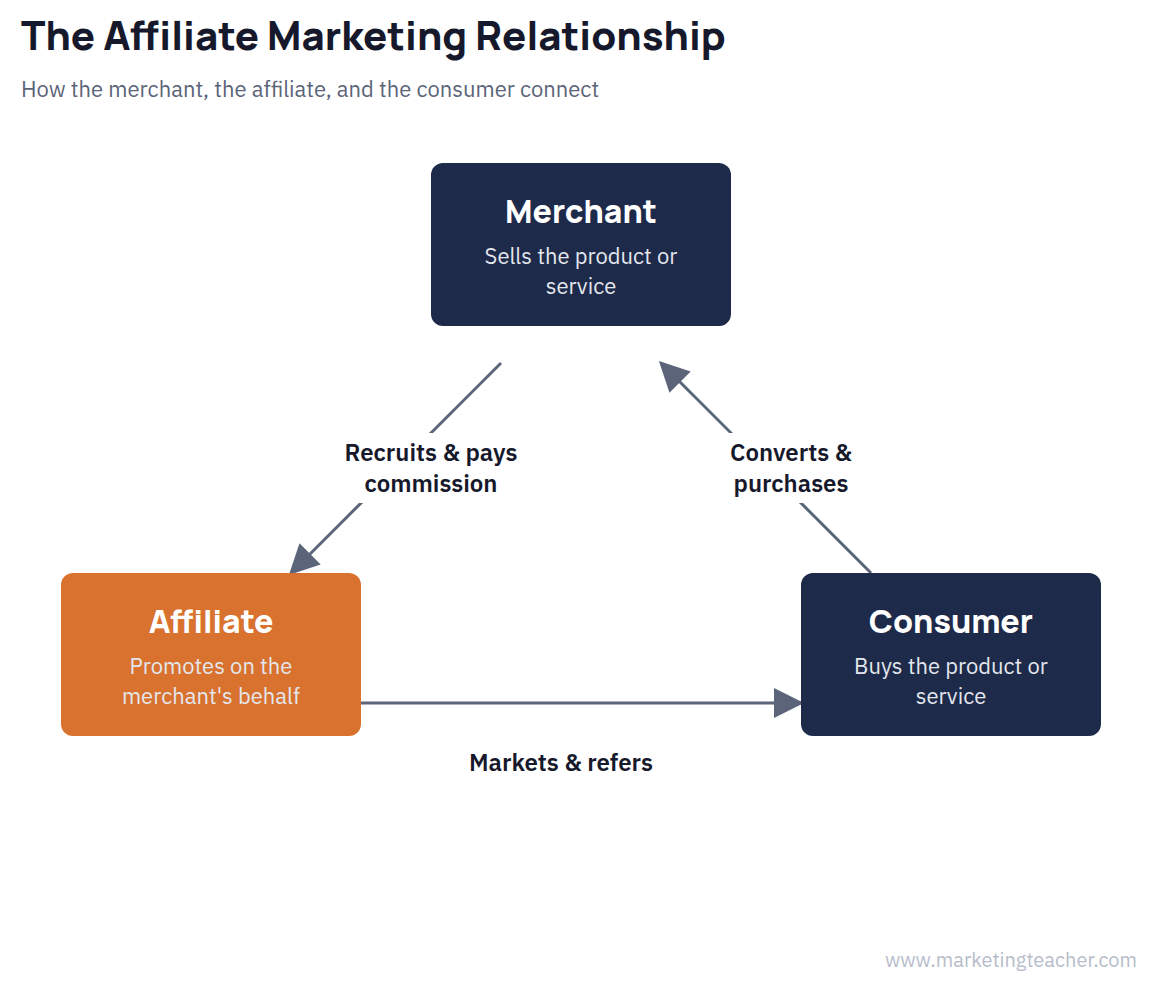
Affiliate marketing is an arrangement in which a merchant rewards a third party, the affiliate, for driving a specific action from a customer, rather than paying for advertising space or reach on its own (Duffy, 2005). That specific action is known as the conversion, and what actually counts as a conversion varies by merchant: for a retailer such as Amazon it is usually a completed sale, but for other businesses it might be placing an online bet, requesting an insurance quote, or booking a holiday. Because the affiliate is only rewarded when a conversion actually happens, the merchant’s marketing spend is tied directly to results rather than simple exposure (Chaffey and Ellis-Chadwick, 2019). The mechanics of exactly how a conversion gets tracked back to the right affiliate are covered in the dedicated Affiliate Marketing Process lesson.
The Three Roles in an Affiliate Relationship
Every affiliate arrangement involves three parties. The merchant is the brand or retailer selling the product or service, and affiliates today are recruited by businesses across almost every sector, including travel, gaming, technology, financial services, and the not-for-profit and voluntary sector. The affiliate acts as a kind of digital salesforce: rather than employing its own sales team, the merchant relies on affiliates who already own a website, a social media following, a blog, or a mailing list to recruit customers on its behalf. The consumer is the target customer at the end of this chain; a common example is a blog offering weight-training advice, where a reader learns how to lift weights and is then recruited as a customer for training programs or supplements supplied by a merchant the blog never owns or holds stock for, earning the blog a commission instead.
Why Merchants Use Affiliate Marketing
Affiliate marketing offers merchants several practical advantages over other ways of acquiring customers. Because every click, referral, and conversion is tracked, both the merchant and the affiliate can see exactly what has happened at each stage, which keeps both sides accountable to each other. Affiliate networks also give a merchant fast access to established audiences across many different industries, segments, and markets, both nationally and internationally, without having to build that reach from scratch. Entering a genuinely new market or channel directly is typically slow and carries real risk, so recruiting affiliates who already have an audience in that market is often a faster and lower-risk way in than building a new sales channel from the ground up. Because a merchant typically works with many affiliates at once rather than relying on a single advertising channel, affiliate marketing also spreads acquisition across a wider mix of sources, so the loss of any one affiliate, or a change to a single advertising platform’s rules, rarely threatens the whole customer pipeline.
Types of Affiliates
As affiliate marketing has become more common, distinct types of affiliate have emerged, each suited to a different part of the customer journey. Voucher code affiliates, such as Groupon, attract customers actively looking for a discount before they buy. Social networking affiliates operate inside platforms such as Facebook and X (formerly known as Twitter), which both carry substantial advertising and support affiliate-style promotion. Retargeting specialists use data on customers who have already viewed a product to try to sell them something else, an approach similar in spirit to customer relationship management. Paid search specialists bid on keywords through pay-per-click advertising on platforms such as Google or Bing, earning a margin between the sale they generate and what they spend on advertising. Content and review sites, such as those reviewing colleges or universities, attract visitors already researching a decision. Comparison sites, such as Moneysupermarket.com and comparethemarket.com, compare prices and products from multiple suppliers in one place, while loyalty and cashback sites, such as Quidco, reward shoppers directly based on their spending behaviour.
Summary
Affiliate marketing rewards a third-party affiliate for driving a tracked conversion on a merchant’s behalf, rather than simply paying for advertising exposure (Duffy, 2005). The relationship connects a merchant, an affiliate acting as a kind of digital salesforce, and a consumer, and it offers merchants accountable tracking, fast access to new markets, and lower risk than building a new sales channel directly (Chaffey and Ellis-Chadwick, 2019). Different types of affiliates, from voucher code and comparison sites to paid search and cashback specialists, suit different points in the customer’s journey toward a purchase.
The slides, worksheet, lesson plan and poster for this lesson are free to download and free to use in your course — no sign-up, no permission needed.

