
What Is Pay-Per-Click Advertising?
Pay-per-click (PPC) is a form of online advertising in which a business only pays when someone actually clicks its advert, rather than paying simply for the advert to be displayed. Jansen and Mullen (2008) describe this “sponsored search” model as one of the most significant developments in online commerce, since it lets an advertiser reach people at the exact moment they are actively searching for a related product or service. The clearest example is the paid results shown above and alongside Google’s organic search results, run through the Google Ads platform (renamed from Google AdWords in 2018) and its smaller rival Microsoft Advertising (formerly Bing Ads).
How the Auction Actually Works
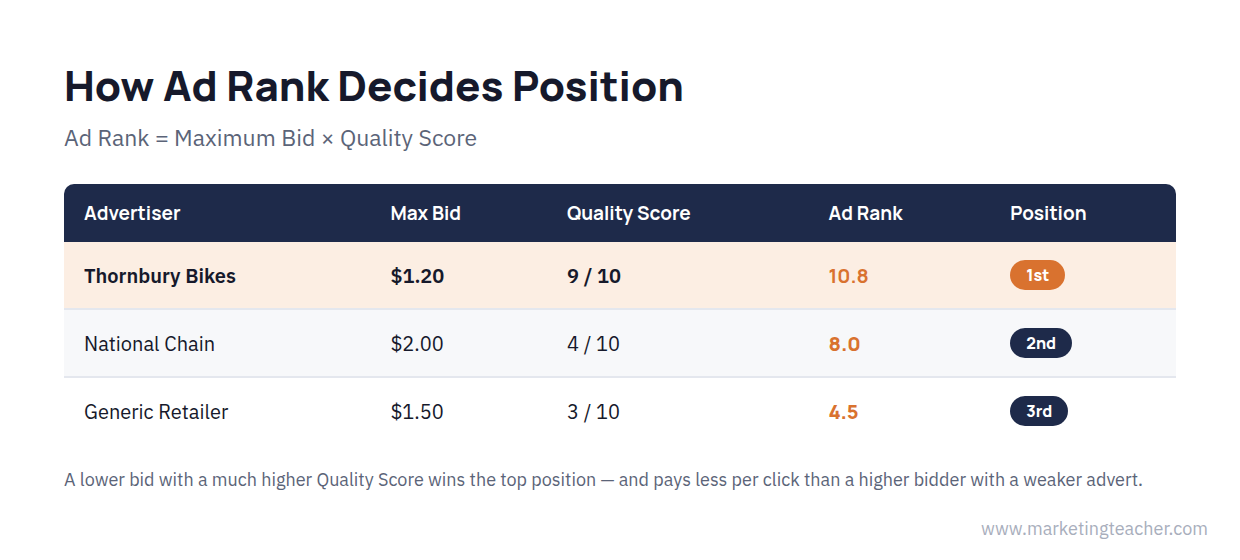
Advertisers do not simply pay the highest bidder’s price to appear top of the page. Varian (2007) showed that platforms such as Google Ads run a generalised second-price auction, in which each advertiser’s position is decided by an “Ad Rank” score, calculated from their maximum bid multiplied by a Quality Score that reflects the advert’s expected click-through rate, its relevance to the search term, and the quality of the landing page it links to. This means a lower bidder with a highly relevant, well-targeted advert can outrank a higher bidder whose advert is a poor match for the search, which is also why the amount actually charged per click is usually lower than the maximum bid an advertiser set.
Beyond Search: Where Else PPC Appears
Search advertising is only one part of the PPC landscape. The Google Display Network and equivalents place PPC banner and image adverts across a huge range of partner websites and apps, usually targeted by audience interest rather than a live search term. Paid social advertising on platforms such as Meta, TikTok and LinkedIn is also charged on a pay-per-click or pay-per-impression basis and uses a similar auction logic, ranking adverts by a combination of bid and predicted relevance to the viewer. Retargeting, where someone who previously visited a website is shown adverts for it elsewhere online, is one of the most common uses of display PPC, since it reaches an audience that has already shown some interest rather than a cold audience.
Setting a Budget and Choosing a Bidding Strategy
Most PPC platforms let an advertiser set a daily budget, which the platform then paces spending against across the day rather than spending it all in the first hour. Bidding can be managed manually, where the advertiser sets a maximum bid for each keyword directly, or through automated bidding strategies, where the platform’s own algorithm adjusts bids in real time to hit a target such as a maximum cost-per-acquisition or a target return on ad spend. Automated bidding tends to perform better once a campaign has enough historical click and conversion data for the algorithm to learn from, while manual bidding gives a new or very small campaign more direct control while that data is still being built up. Neither approach removes the need for a genuinely relevant advert and landing page, since Quality Score still shapes the final cost regardless of how the bid itself was set.
Measuring PPC Performance
A PPC campaign is judged mainly on click-through rate (the proportion of people who see an advert and click it), cost-per-click (the actual amount paid per click, which Quality Score directly influences), and conversion rate (the proportion of clicks that go on to complete a desired action such as a purchase or a booking). These three figures combine into cost-per-acquisition, the true cost of winning one customer through the campaign, which is the figure that ultimately decides whether a PPC campaign is worth running. The broader principles for tracking any campaign’s success, from setting objectives in advance to measuring against them, are covered in measuring the success of your campaign.
Summary
Pay-per-click advertising charges an advertiser only when their advert is clicked, and platforms such as Google Ads and Microsoft Advertising decide position through a generalised second-price auction based on Ad Rank: bid multiplied by Quality Score (Varian, 2007; Jansen & Mullen, 2008). This rewards relevance as much as budget, and PPC now extends well beyond search results into display networks, paid social and retargeting. Because cost-per-click and conversion rate together determine the real cost of winning a customer, measuring performance properly is what separates a profitable PPC campaign from an expensive one.
The slides, worksheet, lesson plan and poster for this lesson are free to download and free to use in your course — no sign-up, no permission needed.

