
Who Are the Baby Boomers?
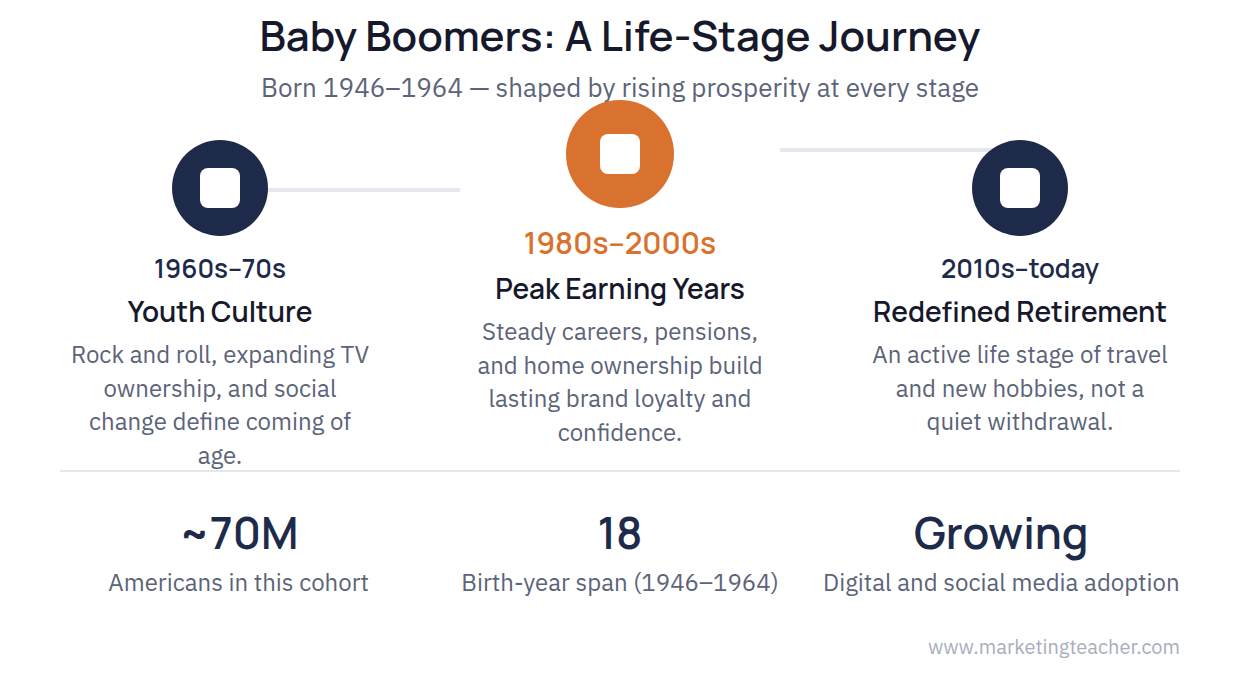
Baby Boomers are generally defined as Americans born between 1946 and 1964 (Dimock, 2019), named for the sharp rise in birth rates that followed the end of the Second World War as families reunited and settled down. At roughly 70 million people, it remains one of the largest generational cohorts in American history, and its sheer size has shaped consumer markets, housing, and public policy at every stage of its members’ lives.
Coming of Age in a Period of Rising Prosperity
Boomers grew up during a long stretch of post-war economic growth, entering a job market with genuinely reasonable expectations that living standards would keep improving, and for most of this generation, they did. Many Boomers worked steadily through their adult lives, benefited from employer pension schemes that have since become far less common, and bought homes when property was considerably more affordable relative to income than it is for younger generations today.
A Generation That Redefined Youth Culture
Boomers are often described as the first generation to be defined by youth culture itself, coming of age alongside rock and roll music, expanding television ownership, and the social movements of the 1960s and 1970s. Many Boomers embraced a period of significant social change, including rising rates of women working outside the home, a rising divorce rate that made separation far more socially accepted than for previous generations, and a general expectation that institutions and social norms could be actively challenged and changed rather than simply accepted.
Confident, Optimistic, and Brand-Aware
Having grown up with rising expectations largely met, Boomers as a group tend to display genuine optimism about the future and confidence in their own judgment, traits that translate into a willingness to spend on quality, brand reputation, and experiences rather than simply the lowest price. Boomers were also the first generation to grow up with television as a fully mainstream medium, which shaped a lasting comfort with traditional broadcast advertising that later generations, raised on more fragmented and skippable media, do not share to the same degree.
Redefining Retirement
Boomers were arguably the first generation to treat retirement as an active life stage rather than a quiet withdrawal from public life, taking up new hobbies, travel, and exercise rather than simply stepping back. That shift matters enormously for marketers, since a Boomer audience is not necessarily disengaging from spending or new experiences as they age, and a business that assumes otherwise is likely to under-serve a genuinely large and often high-spending segment of the market.
What This Means for Marketers
Boomers respond well to marketing that respects their experience and treats them as discerning rather than simply older, since this generation generally prefers messaging that speaks to competence and quality over marketing that leans on novelty for its own sake. Clear, well-organized information, whether printed or digital, tends to outperform highly stylized or meme-driven content with this audience, and the option of a genuine human conversation, whether over the phone or in person, remains a meaningful point of difference many younger-skewing digital brands have quietly abandoned.
Avoiding Broad Generalizations
As with any generational profile, individual variation within the Boomer cohort by income, health, region and personal history is substantial, and treating “Baby Boomers” as a single, uniform audience risks missing real differences in how comfortable individual Boomers are with digital channels or new brands. A generational profile works best as a starting hypothesis to test against real customer behaviour, not as a fixed rule to apply automatically.
A Generation Still Growing Its Digital Presence
While Boomers did not grow up with the internet, adoption of smartphones, social media and online shopping among this generation has grown steadily for years, and a meaningful share now research purchases online even when they ultimately buy in person or over the phone. Assuming a Boomer customer is unreachable through digital channels is as much a mistake as assuming they only want to be reached that way; the more accurate picture is a generation that increasingly blends both, favouring whichever channel is most convenient and trustworthy for a given decision.
Summary
Baby Boomers, born between 1946 and 1964, remain one of the largest and most economically significant generations in America, shaped by post-war prosperity, an active role in redefining social norms, and a comfort with traditional media built over decades (Dimock, 2019). For marketers, this translates into an audience that values quality, clear communication, and genuine service, and one that continues to spend actively well into what earlier generations would have considered retirement.
The slides, worksheet, lesson plan and poster for this lesson are free to download and free to use in your course — no sign-up, no permission needed. See the teacher resources →
Assign this lesson to your class:
Using Canvas, Blackboard or Moodle? Copy the link and paste it into your course page or assignment. More ways to add lessons to your LMS.

