
What Is Contribution Analysis?
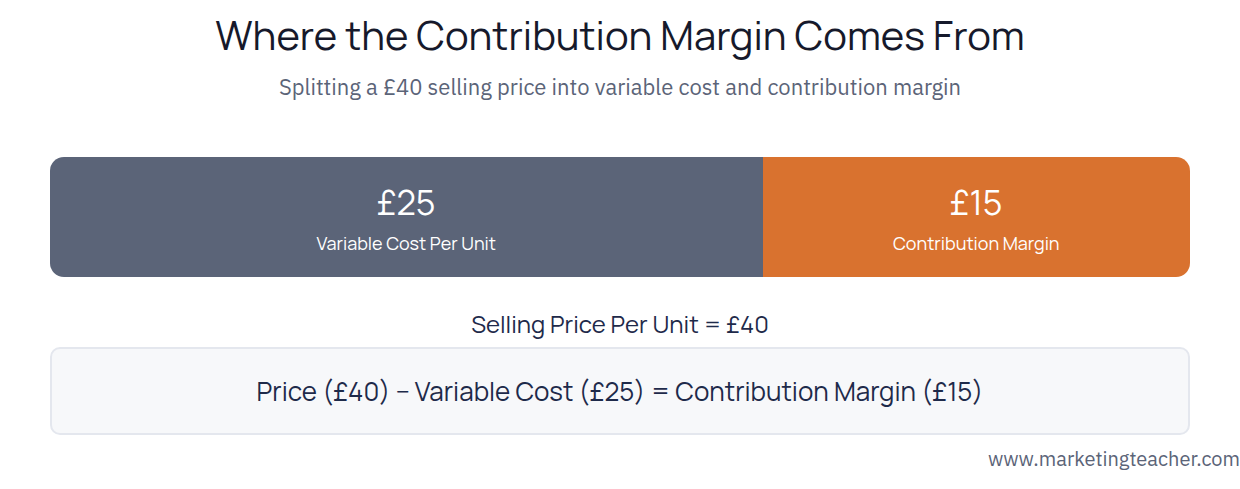
Most day-to-day pricing decisions can be made with routine costing information a business already has on hand. But occasionally a company faces an unplanned opportunity — a one-off bulk order, a short-notice contract, a spur-of-the-moment chance to use spare production capacity — that falls outside its normal costing process, and needs a faster way to work out whether the deal is actually worth taking. Contribution analysis is the tool built for exactly that situation: a way of isolating how much a specific order or product actually contributes to covering overhead and generating profit, without needing a full standard costing exercise first (Garrison, Noreen and Brewer, 2020).
The Contribution Margin Formula
The starting calculation is simple. Contribution margin per unit is the selling price of a unit minus its variable cost per unit — the costs, like materials and any labour tied directly to producing one more item, that rise and fall with production volume:
Price − Variable Cost Per Unit = Contribution Margin Per Unit
Multiplying that per-unit figure by the number of units in the order gives the order’s total contribution to profit:
Contribution Margin Per Unit × Units Sold = Product’s Contribution to Profit
What this figure deliberately leaves out is fixed overhead — rent, salaried staff, insurance, and similar costs that don’t change with this particular order. That’s the point: for a one-off decision about whether to accept extra business using capacity that would otherwise sit idle, what matters is whether the order’s price at least covers its variable costs and leaves something over, not whether it alone covers the whole business’s fixed costs.
Where Marketing Costs Fit In
Some firms extend contribution analysis further by treating certain marketing costs — advertising for a specific product line, or trade and consumer promotions tied to a specific launch — as direct, variable costs of that product rather than as general overhead. Doing this gives a more accurate contribution figure for that product specifically, since a campaign cost that only exists because that product is being sold behaves more like a variable cost than a fixed one. It also means a marketing team proposing a promotion can be asked, reasonably, what contribution margin the promoted volume needs to generate to justify the campaign’s own cost.
When Contribution Analysis Can Mislead
The technique’s biggest blind spot is the assumption that a discounted special order genuinely uses only spare, otherwise-idle capacity. If accepting the order actually displaces regular full-price sales — because production capacity is tighter than assumed, or because the discounted customer starts expecting the same price on future regular orders — the true cost of the deal is much higher than the contribution calculation alone suggests. A firm that accepts too many contribution-positive special orders can end up with a product line that looks profitable order by order while its overall margin quietly erodes, because the “spare capacity” assumption stopped holding true somewhere along the way. Contribution analysis is a decision tool for a genuinely one-off situation, not a substitute for reviewing standard pricing.
The Link to Activity-Based Costing
Contribution analysis works well for a single special-order decision, but it deliberately ignores how shared overhead should be split across a business’s normal product range — and that’s a harder problem. Activity-Based Costing (ABC) is the more detailed accounting method usually used to solve it, tracing overhead costs to the specific activities that actually drive them rather than spreading overhead evenly or arbitrarily across products (Garrison, Noreen and Brewer, 2020). The two techniques are complementary: contribution analysis answers “should we take this one-off order,” while ABC answers “how much of our regular overhead does this product line really deserve to carry.”
Summary
Contribution analysis calculates how much an individual order or product contributes toward covering fixed costs and profit, using the simple formula of price minus variable cost per unit (Garrison, Noreen and Brewer, 2020). It’s particularly useful for fast, one-off decisions like special orders that fall outside routine costing, and it connects to the more detailed work of Activity-Based Costing when a business needs to understand how its regular overhead should genuinely be distributed across its full product range.
The slides, worksheet, lesson plan and poster for this lesson are free to download and free to use in your course — no sign-up, no permission needed. See the teacher resources →
Assign this lesson to your class:
Using Canvas, Blackboard or Moodle? Copy the link and paste it into your course page or assignment. More ways to add lessons to your LMS.

