
What Is Consumer Buyer Behaviour?
Consumer buyer behaviour is the study of how individuals, groups and organisations select, buy, use and dispose of products and services to satisfy their needs. If a marketer can understand consumer buyer behaviour, they are in a far better position to design products, messages and offers that actually land with the people they are aimed at. At its core, buyer behaviour is about needs: marketing succeeds when it identifies a genuine need and satisfies it better than the alternatives on offer.
The Stimulus-Response Model of Buyer Behaviour
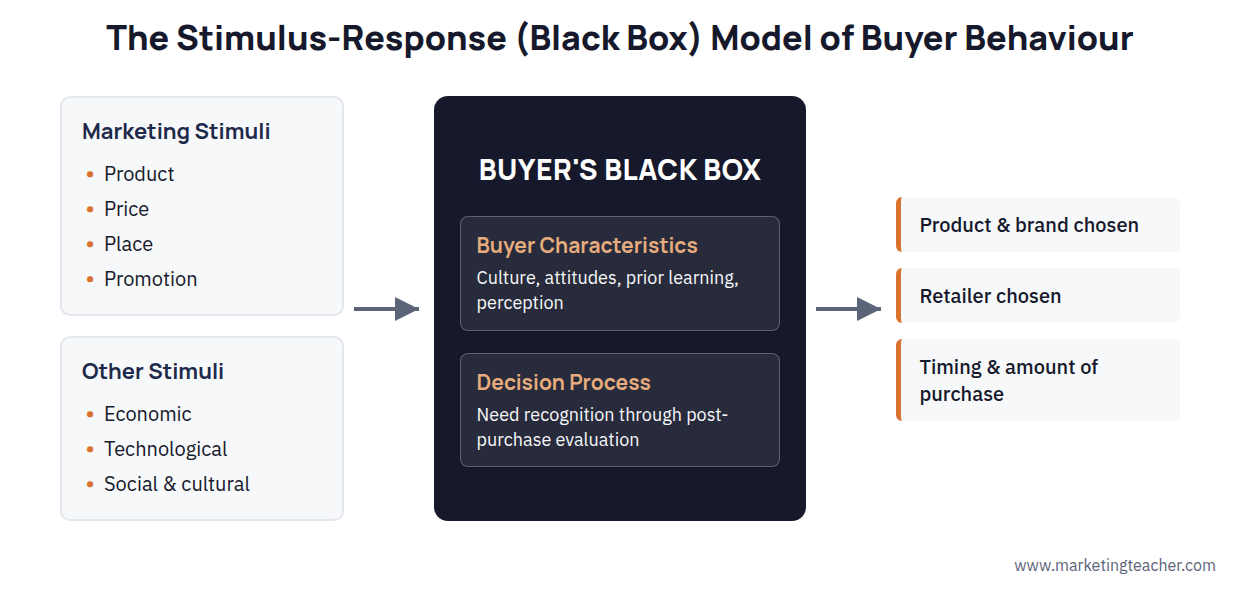
Kotler and Armstrong describe buyer behaviour using a stimulus-response model, sometimes called the “black box” model. On one side sit the stimuli: marketing stimuli (the four Ps of product, price, place and promotion) and other environmental stimuli (economic, technological, social and cultural forces). These stimuli enter the buyer’s “black box”, made up of the buyer’s own characteristics and their decision-making process, neither of which a marketer can observe directly. What comes out the other side are the buyer’s responses: the brand and product chosen, the retailer selected, and the timing and amount of the purchase. The model is deliberately simple, but it makes a useful point: marketers can control the stimuli going in and observe the responses coming out, but the actual psychological processing in between has to be inferred rather than seen.
How the Marketing Mix Interacts With the Buyer
Understanding consumer buyer behaviour means understanding how a person interacts with the marketing mix. The four Ps are adapted and interpreted by each individual buyer through the lens of their own culture, attitudes, prior learning and personal perception, so the same product, price and promotion can land completely differently with two different buyers. The buyer then works through a series of choices: whether to purchase at all, where to purchase, which brand to choose, and how much to spend. None of these choices happen in a vacuum; they are all filtered through the psychological factors inside the black box.
Needs as the Starting Point
Every purchase decision ultimately traces back to a need. Maslow (1943) proposed that human needs form a hierarchy, moving from basic physiological needs such as food, water and shelter, through safety, social belonging, esteem, and finally self-actualisation, the pursuit of one’s own fullest potential. Maslow’s hierarchy is typically drawn as a triangle because fewer people satisfy the needs at each higher level: almost everyone secures food and shelter, but far fewer reach a point where they are pursuing self-actualisation. A fuller treatment of how marketers use this hierarchy in practice is covered in the Internal Influences: Motivation lesson; here, the key point is simply that buyer behaviour always starts from an unmet need, and the marketing mix only succeeds when it connects to a need the buyer actually has.
Why the Model Still Matters
The stimulus-response model is intentionally simplistic, and later models of buyer behaviour add far more detail about the stages a buyer moves through and the influences acting on them at each stage. But the basic structure still holds up: marketers control the inputs, buyers process them through a personal, largely unobservable set of filters, and a response comes out the other end. Recognising that this internal processing exists, even when it cannot be directly measured, keeps marketers from assuming that identical stimuli will always produce identical results across different buyers, cultures or contexts.
High- and Low-Involvement Decisions
Not every purchase moves through the black box in the same way. A high-involvement decision, such as buying a car or a home, typically involves significant time, research and perceived risk, so the buyer’s internal processing is slow and deliberate. A low-involvement decision, such as picking up a familiar snack at a checkout, involves little conscious processing at all, and habit or convenience can drive the response almost as much as any marketing stimulus. Recognising which type of decision a product usually triggers helps a marketer judge how much information a message needs to carry, and how much can simply rely on familiarity and ease of purchase.
Summary
Consumer buyer behaviour explains how individuals, groups and organisations choose what to buy, where to buy it, and how much to spend. The stimulus-response model frames this as marketing and environmental stimuli entering a buyer’s “black box” of personal characteristics and decision-making, producing an observable purchase response. That internal processing is shaped by each buyer’s culture, attitudes, prior learning and perception, and it is ultimately anchored in the buyer’s underlying needs, from the most basic physiological requirements up through Maslow’s (1943) hierarchy to self-actualisation. Marketers who keep this whole chain in view, need, internal processing, and marketing mix, are better placed to design offers that genuinely land.
The slides, worksheet, lesson plan and poster for this lesson are free to download and free to use in your course — no sign-up, no permission needed. See the teacher resources →
Assign this lesson to your class:
Using Canvas, Blackboard or Moodle? Copy the link and paste it into your course page or assignment. More ways to add lessons to your LMS.

