
What Is Digital Personal Selling?
Personal selling happens whenever a salesperson communicates one-to-one with a specific potential customer, rather than broadcasting the same message to everyone at once, and it depends on two-way, back-and-forth communication that a customer can respond to directly. Digital personal selling is simply personal selling carried out, wholly or partly, through digital channels rather than exclusively face-to-face or by phone. The digital opportunity opens up two things a traditional salesperson could never fully access: direct digital communication with a prospect wherever they are, and digital information about that prospect gathered before a conversation ever begins.
The Personal Selling Process, Digitally Applied
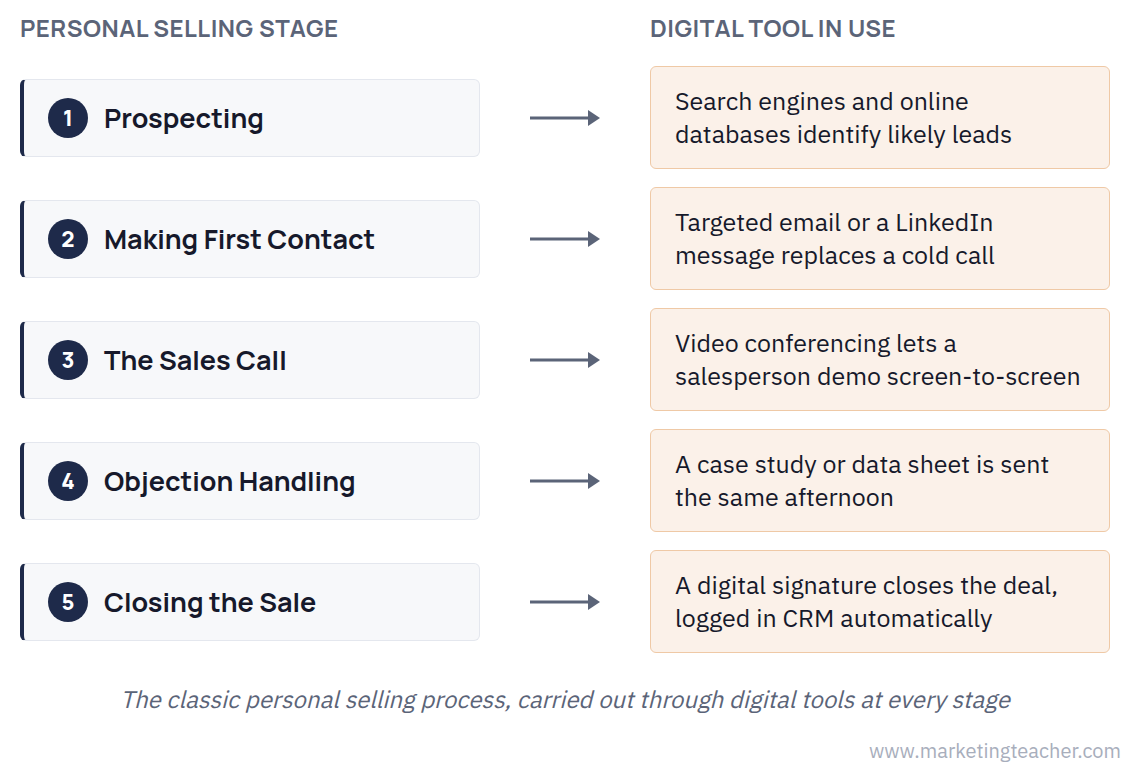
Kotler and Armstrong’s (2018) widely taught personal selling process breaks a sale into a sequence of stages, commonly summarised as prospecting and qualifying, making contact, presenting and handling objections, and closing the sale, with a follow-up stage afterward to protect the relationship. What digital tools change is not the sequence itself but how a salesperson carries out each stage. Prospecting can now draw on search engines and online databases to identify promising leads before any contact is made, rather than relying purely on referrals or cold calling. Making first contact can happen through a targeted email, a direct message on a professional network such as LinkedIn, or a comment on content a prospect has already engaged with, instead of only a cold phone call or an unannounced visit. The sales call itself can run over video conferencing software, letting a salesperson demonstrate a product screen-to-screen with someone on the other side of the country. Objection handling and closing still rely on the same judgement and rapport a good salesperson has always needed; digital tools mainly remove the friction around scheduling, distance, and getting the right information in front of a prospect at the right moment.
Digital Information: Knowing the Prospect Before You Call
The second digital opportunity, digital information, means a salesperson can walk into a first contact already knowing far more about a prospect than a cold call ever allowed. For a business selling to consumers, public data such as a postcode area can hint at likely income levels, property values, or the kinds of products already popular locally, helping a salesperson prioritise which leads to approach first. For a business selling to other businesses, a prospect’s own website, recent press coverage, and public social media activity can reveal what they currently use, what problems they have mentioned publicly, and who within the company actually makes purchasing decisions. None of this replaces an actual conversation, but it means the conversation can start from genuine relevance rather than a generic pitch, and it lets a salesperson qualify a lead, deciding whether it is worth pursuing at all, before investing any real time in it.
Software and the Digital Sales Force
Beyond individual conversations, software also gives a business the ability to manage and measure an entire sales force at once. Customer relationship management, or CRM, software such as Salesforce, HubSpot, or Microsoft Dynamics 365 tracks every prospect and customer interaction in one place, so a manager can see exactly where each deal sits in the process rather than relying on individual salespeople to report progress manually. Chaffey and Ellis-Chadwick (2019) note that this kind of sales force automation shifts CRM’s focus from simply recording customer history toward actively monitoring and improving sales performance in real time. A sales manager can spot which stage of the process a particular deal is stuck at, which salespeople are converting prospects fastest, and where the whole team’s process could be tightened, insight that would be far harder to gather consistently from a purely offline sales force.
Summary
Digital personal selling applies the same classic personal selling process, prospecting, making contact, presenting, handling objections, and closing, through digital channels instead of relying purely on face-to-face or telephone contact. Search engines and online databases sharpen prospecting, digital messaging and video conferencing widen how a salesperson can make contact and run a sales call, and CRM software such as Salesforce, HubSpot, or Microsoft Dynamics 365 gives a business real-time visibility into how its whole sales force is performing at every stage.
The slides, worksheet, lesson plan and poster for this lesson are free to download and free to use in your course — no sign-up, no permission needed. See the teacher resources →
Assign this lesson to your class:
Using Canvas, Blackboard or Moodle? Copy the link and paste it into your course page or assignment. More ways to add lessons to your LMS.

