
What Is a Digital Transformation Strategy?
Most businesses now run some kind of ongoing effort to explore new digital technologies and put them to work, from e-commerce and data analytics to automation and new digital products. Left unmanaged, these efforts tend to spring up separately across different parts of a business, each solving its own local problem without adding up to anything coherent. A digital transformation strategy is the answer to that: a single plan that coordinates, prioritises, and sequences all of a company’s digital transformation activities, so that separate projects reinforce each other and support the same overall direction rather than pulling in different directions or duplicating effort (Matt, Hess & Benlian, 2015).
It helps to be clear about what a digital transformation strategy is not. It is not the same as an IT strategy, which is mainly concerned with keeping the technology infrastructure running and deciding what systems to buy or build. A digital transformation strategy is broader and more business-facing: it is concerned with how new technologies change what a business actually offers, how it operates, and how it is organised, not just which systems sit behind the scenes.
The Four Dimensions
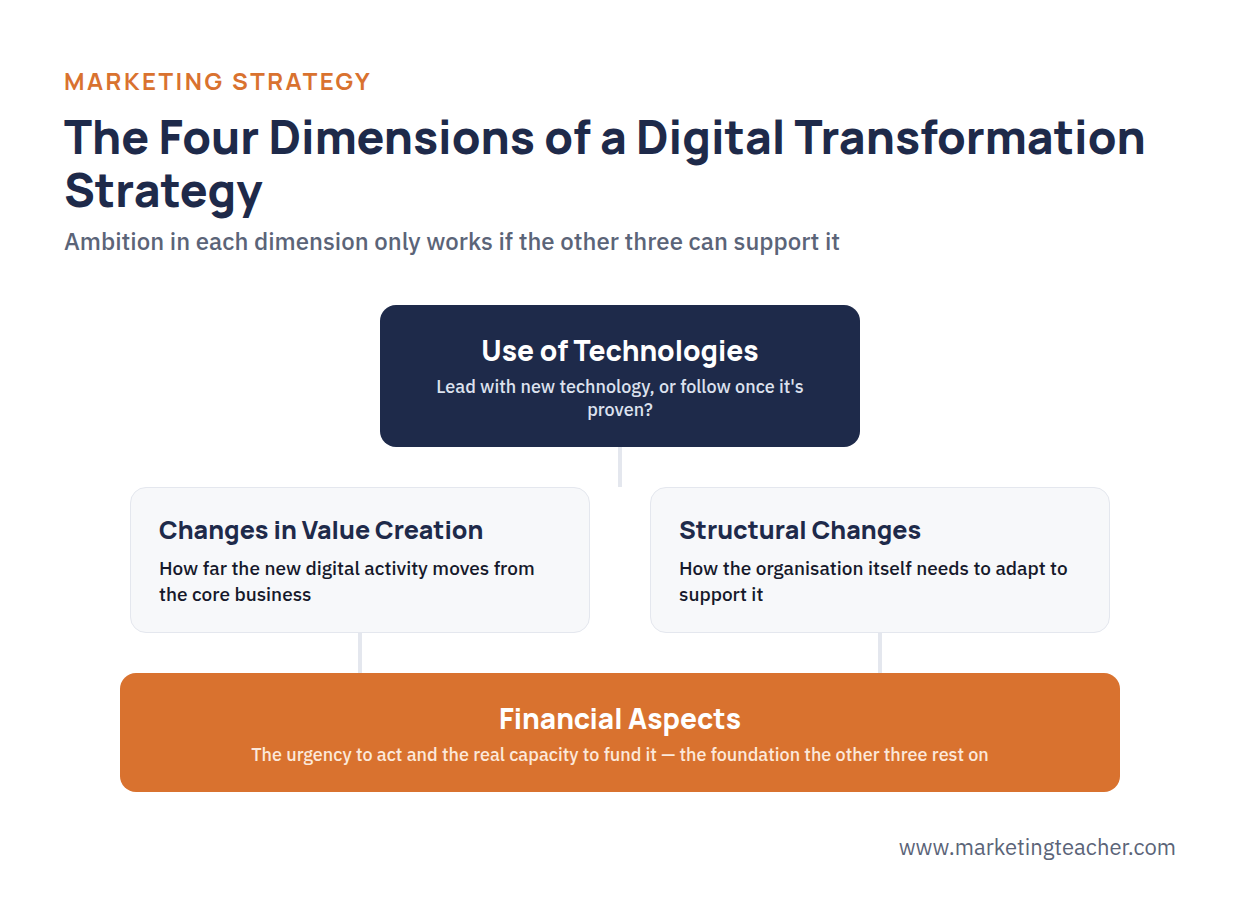
A useful way to think about a digital transformation strategy is as a balance between four different dimensions, each answering a different question about how a business changes as it adopts new technology (Matt, Hess & Benlian, 2015).
The first dimension is the use of technologies: how ambitious does the business want to be about new technology? A firm can choose to lead, adopting and shaping new technologies ahead of competitors, or it can choose to follow, waiting until a technology is proven and adopting established standards once the risk has come down. Leading can create a real edge, but it is also more expensive and uncertain; following is safer but can mean falling behind if a market moves quickly.
The second dimension is changes in value creation: how far do the new digital activities move away from what the business already does? A modest change might be adding an online booking system to an existing service. A much larger change might be entering an entirely new digital product line that has little in common with the core business. The further a firm moves from its existing value chain, the more new skills, partnerships, and risk it typically has to take on.
The third dimension is structural changes: how does the organisation itself need to change to support the new digital activities? A small addition to an existing product might be absorbed comfortably by an existing team, while a bigger transformation, such as building a new digital business line, may call for a separate unit, new roles, or even a newly created position like a Chief Digital Officer to give the effort a clear owner and enough authority to move it forward.
The fourth dimension is financial aspects, and it sits underneath the other three as much as alongside them (Matt, Hess & Benlian, 2015). Financial aspects cover both a firm’s urgency to act, often driven by pressure on its existing core business, and its actual ability to fund a transformation. A business under heavy financial pressure might feel the most urgent need to change, yet have the least capacity to pay for it, which is exactly the kind of conflict a digital transformation strategy needs to plan around honestly rather than assume away.
Balancing the Four Together
These four dimensions do not operate independently. The use of technologies a business chooses tends to drive how much its value creation shifts and how much structural change follows, while financial aspects act as the bounding force that determines how ambitious any of that can realistically be. A firm that wants to lead on technology and pursue a large shift in value creation, without the financial capacity or organisational structure to support it, is setting up a strategy that looks impressive on paper but is unlikely to survive contact with reality. The point of treating all four dimensions together, rather than focusing on just one, is to catch that kind of mismatch early, while it is still a planning problem rather than an expensive one.
Who Owns the Strategy, and How Often It Should Be Revisited
Because a digital transformation strategy cuts across products, processes, and organisational structure all at once, it needs a clear owner with the authority to make decisions across those areas, not just within one department. In smaller efforts this might sit with an existing executive; in larger, more ambitious transformations, businesses increasingly create a dedicated role, often called a Chief Digital Officer, specifically to hold that cross-functional responsibility.
A digital transformation strategy is also not something to set once and leave alone. Because digital technologies and customer expectations keep shifting, the assumptions behind a strategy can go stale faster than a traditional business strategy might. Building in a regular point to reassess progress against the four dimensions, and to adjust course if a technology bet, a value-creation move, or an organisational structure is not working, is what keeps a digital transformation strategy realistic rather than a document that was accurate on the day it was written and increasingly wrong ever since.
Summary
A digital transformation strategy coordinates a business’s digital initiatives around four dimensions: the use of technologies (how ambitious to be), changes in value creation (how far to move from the core business), structural changes (how the organisation needs to adapt), and financial aspects (the urgency and capacity to fund it all). None of these dimensions can be planned in isolation, since ambition in one only works if the others can support it, and because digital technology keeps shifting, the strategy needs a clear owner and a regular point of reassessment rather than being treated as a one-time plan.
Quiz

The slides, worksheet, lesson plan and poster for this lesson are free to download and free to use in your course — no sign-up, no permission needed. See the teacher resources →
Assign this lesson to your class:
Using Canvas, Blackboard or Moodle? Copy the link and paste it into your course page or assignment. More ways to add lessons to your LMS.

